Your fire protection contractor is halfway through the annual inspection when they find the floor control valve on the third-floor riser eight turns short of fully open. An electrician disconnected its tamper switch during a ceiling project in the spring, so the panel never showed a supervisory signal, and that valve isn’t on the route your technicians walk every week. For six months, a fire on that floor would have met a sprinkler system with a restricted water supply.
A valve inspection checklist prevents these kinds of oversights. It puts every valve that controls your fire, HVAC, plumbing, gas, and process systems on one route, with the checks each valve needs. Over time, the as-found records show you which valves keep failing, which systems need a shorter inspection interval, and where your valve reliability is improving.
This guide includes a valve inspection checklist you can customize for every system at your site, plus guidance on building a valve inventory, spotting failures that spread past the valve, and scheduling inspections by system criticality.
Key takeaways
- The system a valve serves decides how much its failure costs you. A closed fire control valve takes a whole suppression zone offline, while the same defect on an irrigation line can be scheduled for the next PM.
- Auditors expect as-found conditions, valve tag IDs, and supervision status on record. Capturing those details at every inspection gives you the compliance records you need without a separate documentation step.
- One team often covers fire, HVAC, plumbing, and process valves at once. Scheduling every cadence in one CMMS keeps a deadline in one system from crowding out another.
How to use this checklist
Customize for your facility
Customize this checklist by removing the categories that don’t apply to your site and adding the valves that do. An office building may skip process and control valves, while a manufacturing plant may need to expand them with steam, compressed air, or medical gas valves.
Set inspection frequency by each valve’s criticality, the valve manufacturer’s guidance, and the codes that apply to it, such as NFPA 25 for fire protection valves and the ASME Boiler and Pressure Vessel Code for pressure relief devices. Then group tasks by area so a technician can inspect valves on one route instead of crossing the building for each system.
This checklist covers valves in service. If a repair shop rebuilds your critical valves, ask for its test records, such as pressure test and nondestructive testing results, and attach them to the valve’s asset record.
For the systems around your valves, pair this checklist with a commercial fire inspection checklist, a commercial plumbing inspection checklist, and an HVAC maintenance checklist.
Use a CMMS
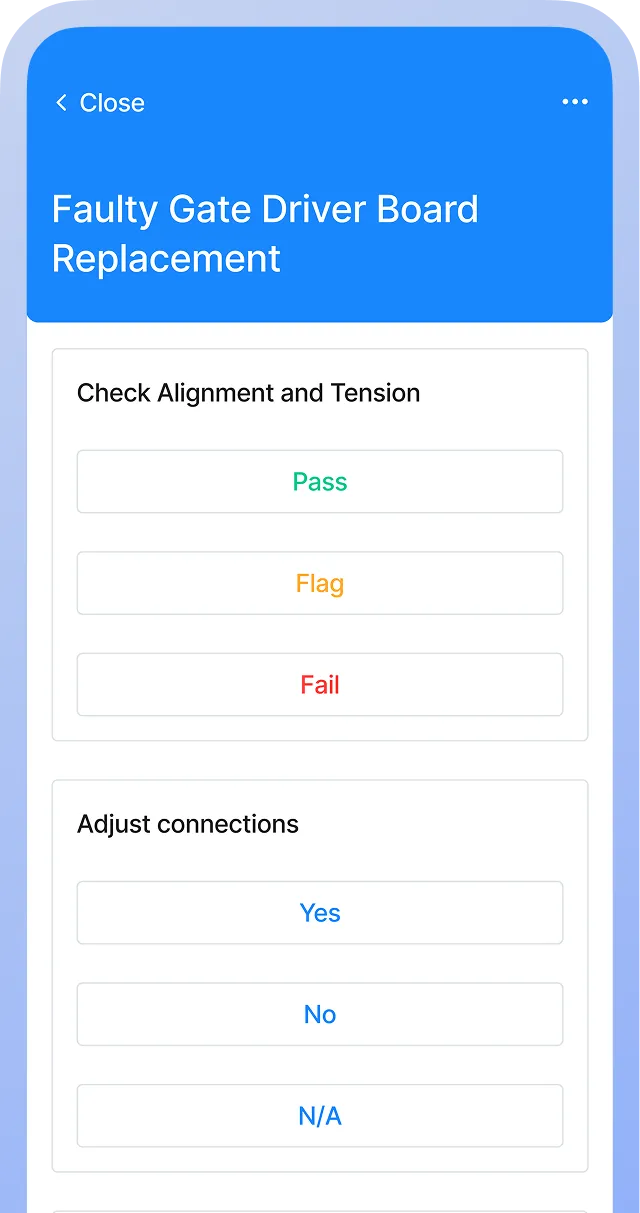
A CMMS turns this checklist into a repeatable digital procedure. Your technicians complete each step on a mobile device, attach photos of a corroded valve stem or weeping gaskets, and flag deficiencies as work orders on the spot. Recurring work orders keep fire protection and relief valve inspections on schedule, time-stamped records create an audit trail, and failure history shows you which valves need repair or replacement.


Valve inspection checklist
Fire protection valves
Pressure relief and safety valves
HVAC system valves
Plumbing and water system valves
Gas and fuel system valves
Process and control valves
Valve identification and access
Documentation and compliance
This checklist is to be used only by those with appropriate training, expertise, and professional judgment. You are solely responsible for reviewing this checklist to ensure that it meets all professional standards and legal requirements, as well as your needs and intent.
Build a complete valve inventory across multiple systems
Build your valve inventory by walking each system and recording every valve’s tag ID, location, type, normal position, and the system it serves. Most sites don’t have that list today. Fire suppression, HVAC, plumbing, and process lines each have their own valves, different teams document them separately, and some valves were never documented at all.
The system each valve serves is the most important field. A butterfly valve in a chilled water loop and a butterfly valve on a fire main may be the same model, but a failure in the chilled water loop affects comfort in one zone, while a failure on the fire main can leave a floor without sprinkler protection.
For each valve, also record:
- Flow direction, so you can confirm that check valves were installed with the arrow pointing the right way after the last repair
- Actuator type, such as manual, electric, or pneumatic actuators, and the fail-safe position
- Process fluid, pressure, and temperature, which tell you what leaks look like and how fast corrosion will progress
- Isolation role, including any double block and bleed arrangements, so your energy control procedures under OSHA 1910.147 list the isolation points that actually exist in the field
Once the inventory exists, group valves by the system they protect rather than by hardware type. That grouping makes it easier to schedule inspections around regulatory cadences and to spot a valve that nobody inspects because it sits between two systems.
How valve failures affect each system
A single valve failure can take down the whole system the valve serves, and the impact depends on which system that is:
- Fire protection: A closed or partly closed control valve disables suppression for a floor or zone, and nothing looks wrong until someone operates the valve or a sprinkler fuses.
- HVAC: A chilled water control valve stuck open overcools its zone while the control system keeps commanding it closed, and the air handler compensates until someone traces the problem to the valve.
- Plumbing: A failed pressure-reducing valve sends full supply pressure into the building, which stresses fixtures, water heaters, and T&P valves downstream.
- Pressure relief: Relief and safety valves that simmer, or whose discharge piping is blocked, may not relieve at set pressure when the vessel needs them.
- Gas: A manual shutoff that hasn’t been exercised in years may not turn when you need to isolate a leak.
- Process: A positioner that drifts out of calibration leaves the loop running off setpoint, and a pneumatic actuator that doesn’t reach its fail-safe position on loss of air turns a utility outage into a process upset.
Most of these failures start with stem corrosion, packing leaks, seat erosion, or actuator drift. Because seat erosion and other wear on internal components rarely show in the valve’s external condition, watch for indirect signs as well, such as rising differential pressure across a strainer and valve set, a downstream temperature that won’t hold, or gauge readings that differ from last month’s as-found values.
When you find a problem, weigh the valve’s consequence alongside its condition. A minor seat leak on a bypass line may only need monitoring, while the same leak on a main process feed could force an unplanned shutdown.
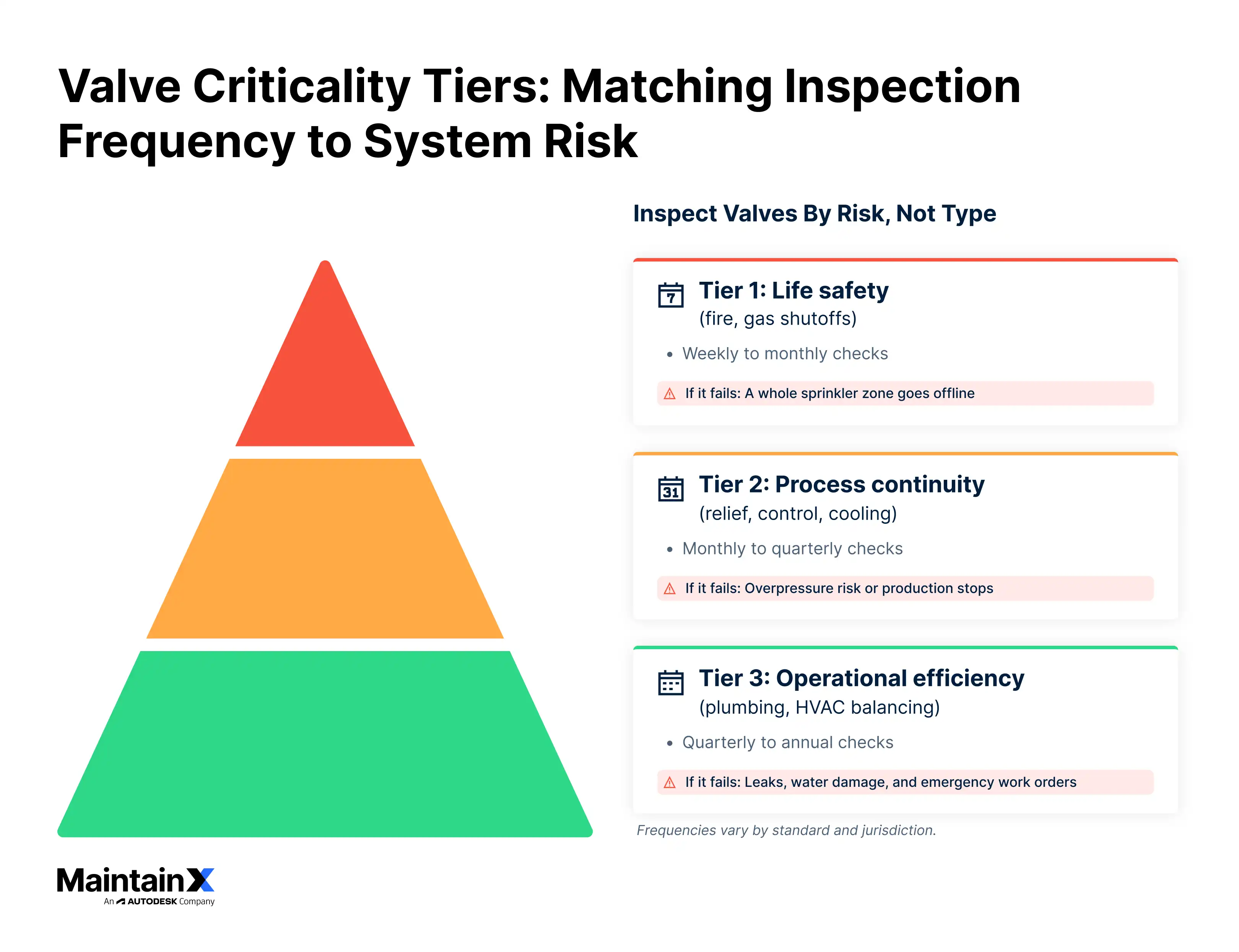
Organize valve inspections by system criticality, not valve type
Schedule valve inspections by the system each valve protects, because the system sets both the cost of a failure and the regulatory deadline. Sorting by valve type, gate valves one week and check valves the next, looks organized, but a gate valve on a fire main and a gate valve on a landscape irrigation line don’t share the same urgency.
The system also sets the interval:
- Fire protection valves: NFPA 25 sets the inspection intervals for control valves, and they depend on whether each valve is sealed, locked, or electrically supervised. It also requires you to operate control valves through their full range on a set schedule. Confirm the intervals in the edition your jurisdiction has adopted with your fire protection contractor or authority having jurisdiction.
- Process valves: For processes covered by OSHA’s process safety management standard, 1910.119(j) requires inspection and testing of piping components, including valves, and relief systems at a frequency consistent with the manufacturer’s recommendations and good engineering practice, and more often if your operating experience shows you need it.
- HVAC and plumbing valves: Few codes set an interval, so use the manufacturer’s guidance and your own failure history. Many teams tie these checks to seasonal changeover, when they already have the system shut down.
To rank valves within each system, an asset criticality assessment template gives you a consistent way to score consequence and likelihood.
A system-first schedule also simplifies audits. When a fire marshal asks for suppression valve records, you can pull them by system instead of filtering a spreadsheet sorted by valve type.
Digitize valve maintenance records with a CMMS
A CMMS ties every valve inspection to the valve’s tag ID, system, and schedule, so you can retrieve records quickly during an audit or an emergency. In MaintainX, you can set up each valve as an asset under the system it serves, with its tag ID, location, normal position, and documents, such as rebuild records, attached. Digital procedures based on this checklist capture as-found conditions, turn counts, supervision status, and photos, and a failed step becomes a corrective work order before the technician leaves the valve.
Book a tour today to see how MaintainX can help you digitize your valve asset records, inspection procedures, and recurring work orders for every system.
Valve inspection checklist FAQs
What are the NFPA 25 requirements for valve inspections in fire protection systems?
NFPA 25 requires regular inspection of fire protection control valves, at an interval that depends on whether each valve is sealed, locked, or electrically supervised. Each inspection confirms the valve is in its normal position, sealed, locked, or supervised, and accessible. NFPA 25 also requires you to operate each control valve through its full range on a set schedule. For the exact intervals and procedures, consult NFPA 25 itself in the edition your jurisdiction has adopted, and confirm them with your fire protection contractor or authority having jurisdiction. For internal inspections of alarm and check valves, follow the valve manufacturer’s recommended interval. A closed control valve takes an entire suppression zone offline.
How do you perform a proper valve inspection in a multi-facility environment?
Standardize the inspection around valve tag IDs, system type, and required cadence, and use the same procedure at every site. Record the as-found position, any visible leakage, and how the valve operated. A shared workflow keeps a fire valve at one site from going uninspected because a different team owns the HVAC valves next to it.
What are the signs of a failing valve that inspectors should look for?
The main signs of a failing valve are leaks at the stem and packing, corrosion, a seized or stiff handwheel, and unusual noise or vibration. Rough or jerky stem movement, a control valve that doesn’t reach its commanded position, and a rising differential pressure also point to trouble. Downstream pressure drops and temperature swings tell you the problem has already reached the system.
What valve testing standards should facilities follow during inspections?
Follow NFPA 25 for fire protection valves and the ASME Boiler and Pressure Vessel Code for pressure relief devices. For process valves, API 598 covers shell and seat pressure tests, and OSHA 1910.119(j) sets inspection and testing requirements for valves in covered processes. Your local fire marshal and insurer may add their own requirements. You should also check with your state or local code officials for any additional testing standards that apply to your site.
What testing methods are used in valve inspections?
Valve inspections use visual inspection and functional checks on valves in service, and nondestructive testing on new or rebuilt valves in the shop. In the field, a visual inspection looks for external leaks, corrosion, surface defects, and missing fasteners, and functional checks confirm that the valve strokes fully and seats correctly. Some teams also use ultrasonic testing to measure wall thickness on valve bodies in corrosive service.
In the shop, visual testing, penetrant testing, magnetic particle testing, ultrasonic testing, and radiographic testing find surface and material defects. Dimensional checks, chemical composition analysis of the materials, and dry film thickness readings on coatings confirm that the valve meets the manufacturer’s specifications. Ask your repair shop for these results when it returns a rebuilt valve.
How often should different types of valves be inspected in office buildings and warehouses?
Inspect fire protection control valves on NFPA 25’s schedule, which varies with how each valve is secured or supervised, and confirm the intervals with your fire protection contractor or authority having jurisdiction. For HVAC, plumbing, and process valves, set intervals from the valve manufacturer’s guidance and the valve’s criticality, then shorten them for any valve whose failure history shows it needs more attention.
What documentation should be maintained for valve inspection programs?
Keep records an auditor can verify: valve tag ID, location, as-found condition, supervision status, turn counts, corrective actions, inspector name, date, and photos. For fire protection valves, keep records for the period NFPA 25 and your local fire code require, and confirm it with your authority having jurisdiction. For valves in a PSM-covered process, OSHA 1910.119(j) requires each record to include the date, the inspector, the equipment identifier, the work performed, and the results.

Marc Cousineau is the Senior Content Marketing Manager at MaintainX. Marc has over a decade of experience telling stories for technology brands, including more than five years writing about the maintenance and asset management industry.