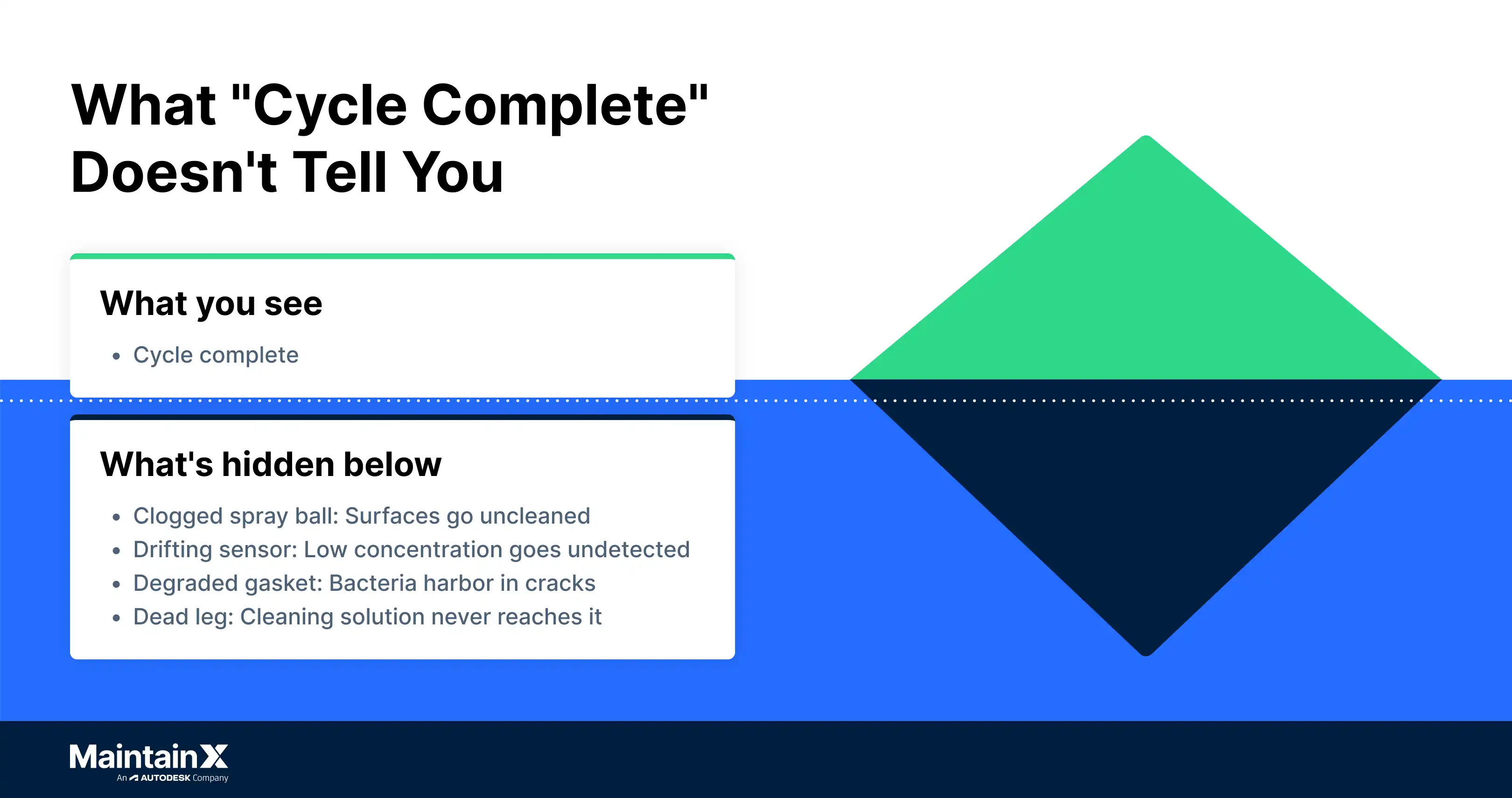
A clean-in-place (CIP) cycle can finish every step on time and still leave the circuit dirty, because the control system only checks what its instruments can measure. Time, temperature, conductivity, and flow can all read in range while a spray ball with three plugged holes leaves the same unwashed crescent at the top of a tank dome every cycle. Nothing on the panel alarms, and the soil left on that patch shows up later as a failed ATP swab or a bad micro result.
A clean-in-place inspection checklist is a routine check of the equipment behind each cleaning cycle, covering what the panel can’t measure. Your team looks at the hardware directly and verifies the instruments against reference standards, so a plugged spray ball turns up on an inspection round before it shows up in a failed swab. Those checks also give sanitation and maintenance one shared record that each cycle is delivering its validated parameters, which is the evidence food safety auditors ask for.
Key takeaways
- A CIP cycle can report complete while fouled spray balls, drifting sensors, or worn gaskets undermine the results. Inspecting the equipment directly shows whether your validated parameters are actually being delivered.
- Sanitation teams own the cycle, and maintenance teams own the equipment, but the overlap often has no owner.
- Digital records in a CMMS make cycle parameters, calibrations, and corrective actions easy to retrieve. That gives auditors the evidence they look for and helps your team spot recurring CIP issues.
How to use this checklist
Customize for your facility
Start by matching your clean-in-place checklist to the validated parameters for each circuit in your plant, including temperature, concentration, contact time, and flow rate for each phase. CIP systems vary widely by product, soil type, and circuit design, so a single-tank skid and a system cleaning multiple tanks, transfer lines, and a pasteurizer each have specific needs. Food processing industries also have different cleaning needs:
- Dairy: Protein and fat soils baked onto heat exchanger plates at high temperatures usually call for a caustic wash followed by an acid wash to remove milkstone, so add checks for plate pack condition and acid concentration.
- Brewing: Beerstone builds up in fermenters and bright tanks, and many breweries run acid-only or low-caustic cleaning cycles in CO2-filled vessels. Adjust the cleaning agent checks to match.
- Beverage: Sugar soils rinse more easily, but flavor and allergen changeovers raise the stakes on cross-contamination, so weight the rinse water and verification checks more heavily.
Align inspection and cleaning frequency with your sanitation program and the hygiene standards your customers or certification scheme hold you to, and add steps for piping changes, new spray devices, or regulatory requirements that apply to your site. Remove items for equipment you don’t have, such as turbidity sensors, rotary spray heads, or detergent tanks on a single-use system.
Use a CMMS
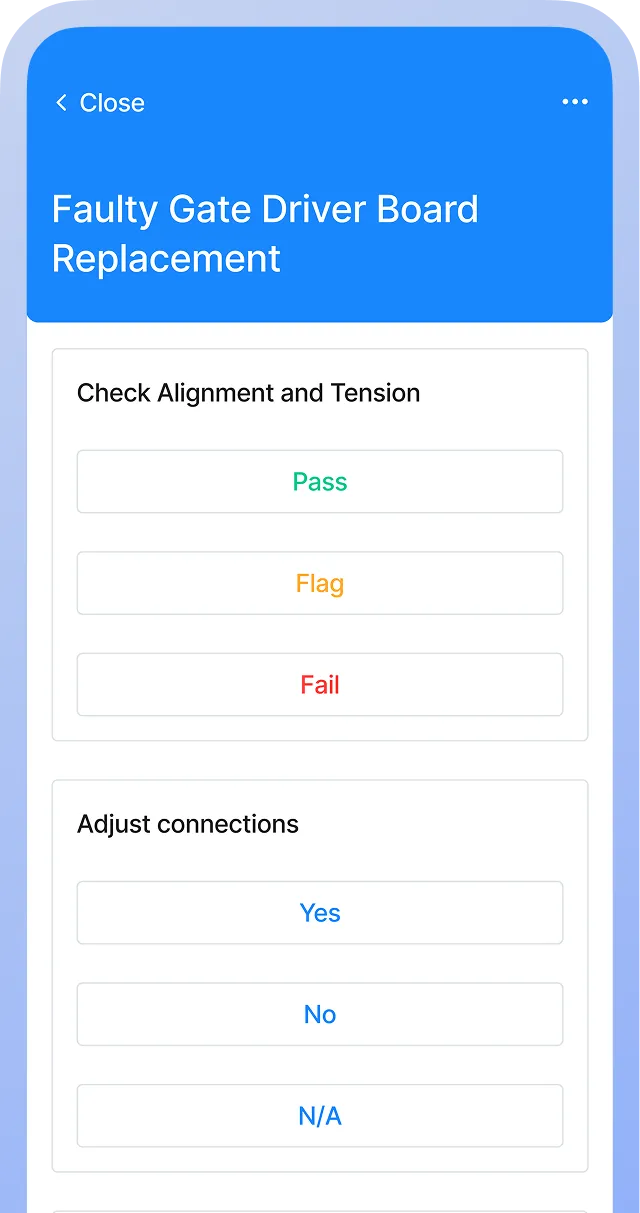
Load the final checklist into a computerized maintenance management system (CMMS) as a digital template so you can schedule recurring inspections and see trends across cleaning cycles that paper logs hide. Your team can capture readings, photos, and ATP results on a phone, and an out-of-spec finding can trigger a work order automatically. Time-stamped records also build an audit trail, which helps with validation reviews and recurring issues like fouled sensors or worn gaskets.


Clean-in-place inspection checklist
Pre-cycle setup
Chemical supply and dosing
Spray devices and coverage
Cycle monitoring
Post-cycle verification
Instruments and sensors
Piping, gaskets, and seals
Documentation and compliance
This checklist is to be used only by those with appropriate training, expertise, and professional judgment. You are solely responsible for reviewing this checklist to ensure that it meets all professional standards and legal requirements, as well as your needs and intent.
Common CIP system failures and how maintenance inspections prevent them
The most common CIP failures are equipment problems that let a cycle finish on schedule while it misses its validated parameters. Because the sequence still runs to completion, the cycle record looks normal, and the incomplete cleaning only shows up later in an ATP swab, a micro result, or a product quality complaint.
Here’s where it usually starts:
- Spray devices: A rotary spray head with a worn bearing stops turning and paints one stripe of the vessel wall. A spray ball reinstalled at the wrong angle after manual cleaning misses hard-to-reach areas under an agitator or around a manway.
- Instruments: A return temperature probe that reads a few degrees high lets the caustic wash run below its validated temperature, and the panel never alarms. Conductivity meters that drift do the same for detergent concentration and final rinse checks.
- Valves and seals: A mix-proof valve with leak-by can let cleaning fluids reach a product line in an adjacent circuit, which turns a cleaning problem into a chemical contamination risk. Worn gaskets crack and harbor biofilm that circulating solution can’t remove.
- Piping: A tee left capped after a line change becomes a dead leg the flow never sweeps. Low points that don’t drain hold rinse water that can carry contaminants into the next run.
- Heat and chemical supply: A failed steam trap on the heat exchanger slows heat-up and eats into contact time at temperature. A dosing pump with a tired diaphragm delivers weak solution that still reads within range if the sensor has drifted too.
Each of these is cheaper to catch on an inspection round than after a failed swab. A failed cycle means a re-clean at minimum, with the water, chemicals, and line time that go with it, and a hold on product if the failure reached a food-contact surface. Checking spray device rotation, calibrating instruments against reference standards, and inspecting seal surfaces target those root causes directly, which keeps cleaning effectiveness steady from run to run instead of letting it drift between validations.
How to coordinate CIP inspections between sanitation and maintenance teams
Split CIP inspections by ownership: Sanitation monitors the cycle on every run, maintenance verifies the hardware on a schedule, and both teams review the results together. Without that split, the overlap between the two teams has no owner, and checks like spray device orientation or sensor calibration fall to whoever notices first.
- Sanitation: Monitors time, temperature, chemical concentration, flow, and final rinse results during each run, and records ATP and visual checks after it.
- Maintenance: Verifies the equipment that delivers those parameters, including pump output, valve actuation, sensor accuracy, gasket condition, and spray device condition.
- Both: Sign off on any change that touches the circuit, from a spray device removed for manual cleaning to a new section of pipe.
A joint review cadence lets each team’s findings trigger the other’s checks. When sanitation sees return temperature trending toward its lower limit over a week of cycles, maintenance checks the steam trap and heat exchanger before the cycle fails. When maintenance finds reduced pump output, sanitation watches return flow and ATP results on that circuit more closely until the pump is repaired. Put both triggers in writing so they don’t depend on two people remembering to talk.
Documentation and recordkeeping for CIP equipment maintenance
Your CIP maintenance records need to show that the equipment delivering each cycle was inspected, calibrated, and repaired. The requirements depend on who regulates your plant:
- FDA-regulated facilities: 21 CFR 117.35(d) requires food-contact surfaces in wet processing to be cleaned and sanitized before use and after any interruption that could contaminate them.
- CIP as a sanitation preventive control: Where your food safety plan treats it as one, the verification requirements in 117.165 include calibrating, or checking the accuracy of, monitoring and verification instruments, and keeping records of it.
- USDA-inspected meat and poultry plants: The sanitation SOP and recordkeeping rules in 9 CFR Part 416 apply.
- GFSI-benchmarked schemes: SQF and BRCGS auditors look for the same link between each cycle and the equipment that ran it.
Records that tie each spray device, sensor, gasket, and valve to its own inspection and calibration history show auditors that your validated cycle parameters rest on verified equipment. They also determine how fast you can answer a records request. A binder in the CIP room and a calibration spreadsheet on someone’s laptop make a simple question take an afternoon. A centralized maintenance audit trail ties inspection dates, findings, and corrective actions to specific assets, so you can pull the full history for one circuit in minutes.
How a CMMS improves CIP reliability
A CMMS improves CIP reliability by putting every component across every circuit on its own inspection schedule and keeping its history in one place. A plant with several CIP skids can have dozens of spray devices, instruments, valves, and pumps, each on a different interval, and tracking them manually leaves room for missed inspections and lost records.
In MaintainX, you can set up each CIP circuit as an asset with its spray devices, sensors, and pumps underneath it, then schedule inspections on time or usage triggers so work orders generate automatically. When a technician completes a spray ball check or a sensor calibration, the record attaches to that asset with timestamps, readings, and photos, and a failed step becomes a corrective work order before they leave the skid.
That structure also surfaces patterns. Recurring pressure drops on one return pump or frequent gasket replacements on a specific circuit become visible trends instead of isolated tickets, so your team can move from reactive part swaps to targeted reliability fixes. When an auditor asks for a circuit’s inspection and calibration history, you can pull it from one system instead of reconciling logs.
Want to see how your team could run CIP inspections in MaintainX? Book a tour to walk through CIP asset hierarchies, digital inspection procedures, and calibration records for every circuit.
CIP checklist FAQs
What does CIP cleaning mean in food manufacturing?
CIP cleaning means cleaning the interior surfaces of tanks, pipes, heat exchangers, and other closed equipment without taking it apart. The system circulates rinse water, detergent, and sanitizer through the circuit at controlled time, temperature, concentration, and flow. Unlike manual cleaning, results depend on the condition of the pumps, spray devices, sensors, and valves behind the cycle.
What are the 5 essential steps in a CIP cleaning cycle?
The five common steps in a CIP cleaning cycle are pre-rinse, caustic wash, intermediate rinse, acid wash, and final rinse. Many plants add a sanitizing or disinfection step after the final rinse, and some skip the acid wash depending on soil type. Each step needs its validated time, temperature, concentration, and flow, and worn equipment can undermine any of them.
What FDA and USDA regulations apply to CIP systems in food facilities?
FDA-regulated facilities follow 21 CFR Part 117, which covers current good manufacturing practice and the preventive controls requirements of FSMA, including sanitation of food-contact surfaces. USDA-inspected meat and poultry plants follow FSIS sanitation SOP rules in 9 CFR Part 416 and HACCP rules in 9 CFR Part 417. Grade “A” dairy plants also follow the Pasteurized Milk Ordinance. All of them expect documented, verifiable records.
Requirements vary by product, process, and state, so confirm which regulations apply to your plant with your FDA or USDA inspector, state regulators, and your food safety team.
How often should CIP systems be validated and monitored?
Monitor every CIP cycle for time, temperature, concentration, and flow. Validate the system at commissioning, on the schedule your food safety plan sets, and after any change to equipment, piping, chemistry, or product. Inspect sensors, spray devices, and gaskets on a set schedule based on risk and your own failure history.
What are common CIP system failures, and how can they be prevented?
Common CIP system failures include fouled or seized spray devices, drifting sensors, worn pump seals, leaking valves, and degraded gaskets. Each can cause a cycle to miss its validated parameters without triggering an alarm. Scheduled inspections, regular instrument calibration, and timely part replacement catch these problems before a cleaning failure reaches product.

Marc Cousineau is the Senior Content Marketing Manager at MaintainX. Marc has over a decade of experience telling stories for technology brands, including more than five years writing about the maintenance and asset management industry.