

Your production line depends on precise measurements. When a temperature sensor reads incorrectly or a pressure gauge drifts from its true value, you're potentially looking at quality issues, safety risks, and compliance violations that can shut down operations.
For facilities already managing aging equipment and tight budgets, these measurement errors create avoidable losses that strain resources and disrupt operations.
This guide covers the essential equipment calibration types, walks through the calibration process step by step, and shows how digital maintenance management can streamline calibration management.
Key takeaways
- Equipment calibration is essential preventive and routine maintenance that uses certified standards to prevent critical measurement errors affecting safety and quality.
- Three main calibration types are most critical to operational precision: pressure, temperature, and electrical.
- Regulatory compliance requires strict documentation and traceability of all calibration results to national standards (e.g., NIST, ISO 17025).
- Using a CMMS automates calibration scheduling and documentation. You can integrate your CMMS with IoT sensors for real-time drift alerts.


Equipment calibration defined
Equipment calibration is the process of comparing your measuring instruments against a known, certified standard to verify their accuracy. When your pressure gauge reads 100 PSI, calibration confirms whether it's actually measuring 100 PSI or if it has drifted to 98 or 102 PSI.
The calibration process involves two key steps:
- Measurement: Compare your instrument's reading to a traceable reference standard
- Adjustment: If readings don't align within tolerance limits, adjust the instrument back into specification
Calibration ensures three critical outcomes for your facility:
- Safety: Prevents equipment failures caused by inaccurate readings
- Quality control: Ensures your products meet specifications consistently
- Regulatory compliance: Maintains documented measurement accuracy required by industry standards
Think of calibration as preventive maintenance for your measurement accuracy. Just as you service pumps and motors before they fail, regular calibration catches measurement drift before it affects your operations.
Common types of equipment calibration
Your facility relies on accurate measurements across pressure, temperature, and electrical systems. Equipment calibration is essential across many industries to ensure the accuracy of measurement instruments and test instruments. Understanding these three core calibration types helps you maintain the precision that keeps operations running smoothly.
Pressure calibration
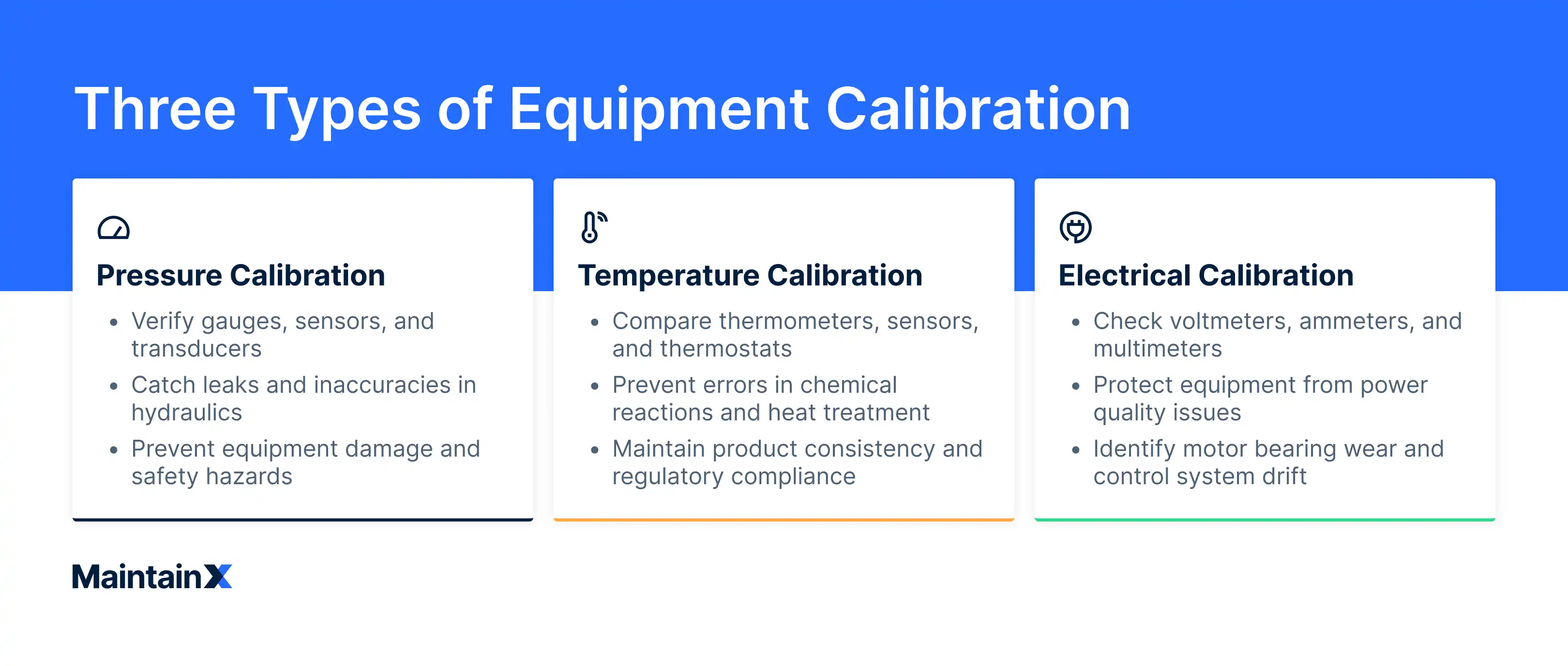
Pressure calibration verifies gauges, sensors, and transducers against standard pressure sources. This process catches leaks and inaccuracies in pneumatic or hydraulic systems before they affect equipment performance.
Pressure instruments drift over time due to vibration, temperature cycling, and everyday wear. A gauge reading that’s off by 5% can have serious consequences in hydraulic presses or steam systems, where inaccurate pressure measurements can cause equipment damage or pose safety hazards to your team.
Temperature calibration
Temperature calibration compares thermometers, sensors, and thermostats to reference temperatures. This prevents errors in processes that require precise temperature control, such as chemical reactions, food pasteurization, and metal heat treatment.
Even minor temperature measurement errors can compromise product consistency, waste energy, or create unsafe operating conditions. In pharmaceutical manufacturing, a slight temperature drift in an autoclave can affect the effectiveness of sterilization. In food processing, incorrect pasteurization temperatures create safety risks and regulatory violations.
Electrical calibration
Electrical calibration checks voltmeters, ammeters, multimeters, and other electrical instruments against certified reference standards. This protects expensive equipment from power quality issues and helps you identify developing problems like motor bearing wear, insulation breakdown, or control system drift before they cause unplanned downtime.
The equipment calibration process, step by step
Effective calibration follows a systematic approach that ensures accurate results and proper documentation. The basic process involves comparison with reference values to verify device accuracy. Breaking the process into three calibration steps—such as verification, adjustment, and validation—helps your team maintain consistency, ensure traceability, and avoid costly mistakes. Depending on the equipment and standards, different calibration methods may be used to achieve compliance and reliability.
Preparation and planning
- Identify critical equipment and calibration frequency: Start by determining which instruments require calibration and how often. Critical equipment like pressure relief valve sensors, boiler temperature controls, and gas detection systems need more frequent attention than general monitoring instruments like ambient temperature gauges or non-critical flow meters.
- Gather reference standards and required tools: Collect certified reference standards with current calibration certificates traceable to national standards—like NIST-certified pressure standards, platinum resistance temperature detectors (PRTs), or precision voltage references. Ensure you have the proper tools, like calibration cables, adapters, test leads, and documentation forms, before starting.
- Document baseline readings and previous calibration history: Review historical data like previous "as found" readings, drift rates over 6-12 month periods, and adjustment frequency to understand normal drift patterns and identify equipment that may need replacement soon.
Performing the calibration
- Compare instrument readings against reference standards: Test across the full measurement range using equipment like deadweight testers for pressure gauges or dry-well calibrators for temperature sensors. Start with current settings to capture "as found" data before making adjustments.
- Make adjustments as needed to align with accuracy requirements: Adjust only when readings fall outside acceptable tolerance limits (typically ±0.25% to ±2% depending on instrument class), using zero and span adjustments or potentiometer settings following manufacturer procedures or regulatory guidelines.
- Follow manufacturer or regulatory guidelines for procedures: Some instruments need simple two-point span adjustments, while others require complex five-point calibrations across 0%, 25%, 50%, 75%, and 100% of range performed by certified technicians.
Recording and interpreting results
- Log results in calibration sheets or a CMMS: Document both "as found" and "as left" readings, tolerance limits, environmental conditions (temperature, humidity), and technician signatures for compliance audits and performance tracking.
- Flag equipment that fails to meet tolerance: Identify instruments requiring repair or replacement based on drift exceeding 75% of tolerance limits, frequent out-of-tolerance conditions, or inability to achieve calibration within specification.
- Use data to plan preventive maintenance or replacements: Analyze calibration trends showing consistent drift patterns, increasing adjustment frequency, or degrading accuracy to schedule maintenance and budget for equipment upgrades before failures occur.
What standards and requirements govern equipment calibration?
Effective calibration programs follow established standards that protect your facility from regulatory violations, failed audits, and liability issues. Understanding these requirements helps you build a defensible calibration program that satisfies both internal quality goals and external compliance demands.
ISO calibration standards
ISO 17025 defines the requirements that testing and calibration laboratories must meet to demonstrate their ability to produce accurate, reliable results. This standard outlines specific requirements for personnel qualifications, equipment management, measurement traceability, and quality systems.
Facilities following ISO 17025 demonstrate their ability to produce technically valid results. The standard ensures international consistency, meaning a calibration performed in Ohio meets the same requirements as one done in Berlin or Tokyo. It guides accuracy requirements, documentation practices, and quality control procedures that auditors expect to see.
NIST traceability
NIST (National Institute of Standards and Technology) traceability links your calibration results to the highest measurement standards in the United States. This means when your pressure gauge reads 100 PSI, you can trace that measurement through documented steps back to NIST's master pressure standards, proving your reading is accurate and legally defensible.
NIST traceability provides legal and scientific credibility for your measurements. When auditors or customers question your measurements, NIST-traceable calibrations provide documentation that proves your instruments meet legal and technical accuracy requirements. Industries like pharmaceuticals, aerospace, and nuclear power require this level of traceability for compliance and liability protection.
Five key requirements for calibration
Every effective calibration program must meet these core requirements:
- Accuracy: Your instruments must meet defined tolerance levels specific to their application. A pressure gauge controlling a safety system needs tighter tolerances than one monitoring non-critical processes.
- Traceability: Every calibration must connect to recognized reference standards through documented measurement chains, typically leading back to NIST or international equivalents.
- Repeatability: Calibrated instruments should produce consistent results when measuring the same parameter under identical conditions, proving the calibration process is reliable.
- Documentation: Comprehensive records, including calibration certificates, "as found/as left" data, environmental conditions, and technician credentials, support audits and maintenance planning.
- Compliance: Your calibration program must meet industry-specific regulations, such as FDA requirements for pharmaceuticals or ASME codes for pressure vessels, as well as any internal quality policies.
Meeting these requirements becomes significantly easier when you have the right tools and technology supporting your calibration program.
Mobile and IoT-enabled calibration solutions
Traditional calibration relies on scheduled inspections and manual data collection. Modern technology transforms this reactive approach into a proactive system.
Many modern calibration services now offer IoT-enabled solutions for real-time monitoring and data management.
Using connected sensors for real-time calibration monitoring
IoT-enabled sensors continuously monitor instrument drift and environmental conditions that affect measurement accuracy. These smart devices track key factors that cause calibration drift:
- Temperature and humidity fluctuations that affect sensor accuracy
- Vibration and mechanical stress from equipment operation
- Electrical interference from motors, drives, and power systems
Connected pressure transmitters detect gradual drift in real time, alerting your team when readings approach tolerance limits rather than waiting for the next scheduled calibration.
Integration with CMMS and predictive maintenance tools
Modern calibration systems integrate directly with computerized maintenance management system (CMMS) platforms to streamline your maintenance operations via:
- Automatic work order generation when instruments require attention
- Predictive analytics that forecast when equipment will drift out of tolerance
- Seamless documentation of calibration results and environmental conditions
- Data-driven recommendations for optimal calibration intervals
Integrating your calibration systems with your CMMS eliminates manual scheduling and creates comprehensive audit trails without additional paperwork.
Tracking equipment calibration using a CMMS
Managing calibration schedules manually creates the potential for missed deadlines, compliance violations, and unexpected equipment failures.
A computerized maintenance management system (CMMS) transforms calibration from a reactive process into a strategic maintenance advantage by:
- Scheduling recurring calibrations automatically based on time intervals, usage hours, or process cycles to eliminate missed deadlines.
- Integrating with IoT sensors to receive real-time alerts when instruments drift toward tolerance limits.
- Storing historical calibration data and generating reports for compliance audits, trend analysis, and equipment lifecycle management.
- Linking calibration activities to broader maintenance workflows, spare parts inventory, and equipment replacement planning.
When your calibrated sensors connect to control systems and wireless networks, you can automatically track equipment performance and receive alerts when readings indicate potential problems, helping you schedule maintenance before failures occur.
Learn more about how MaintainX connects calibration with industrial controls and IoT systems to optimize your entire facility's performance.
FAQs
What is equipment calibration, and why is it important?
Equipment calibration is the process of comparing your measuring instruments to certified reference standards to verify accurate measurements.
It’s critical because measurement errors cause quality issues, safety hazards, and regulatory violations. Regular calibration is necessary to maintain acceptable reliability and ensure that all equipment requiring calibration is properly managed and kept on schedule.
How often should industrial equipment be calibrated?
Calibration frequency depends on the calibration interval recommended by manufacturers, the instrument's criticality, and regulatory body calibration requirements. Safety-critical measurement devices, such as pressure gauges, typically require quarterly attention, while general measuring equipment might require annual calibration.
Your equipment calibration program should track optimal calibration frequencies based on historical calibration data and patterns of measurement uncertainty.
What are the most common types of calibration for maintenance teams?
The three most common calibration types for maintenance teams are pressure, temperature, and electrical calibration.
Pressure calibration verifies gauges and sensors in hydraulic and pneumatic systems. Temperature calibration ensures accuracy in process control and safety monitoring. Electrical calibration maintains precision in power monitoring, motor diagnostics, and control system instruments.
How does a CMMS help track and manage equipment calibration?
A CMMS that includes calibration management automates scheduling at specified intervals, sends alerts before the calibration date, and stores calibration records for trend analysis.
It integrates measuring instrument management with other maintenance activities, generates calibration certificates for compliance, and helps optimize calibration procedures based on actual measurement instrument performance rather than fixed calibration frequencies.
What standards or regulations apply to equipment calibration?
ISO/IEC 17025 sets international standards for the competence of testing and calibration laboratories. National metrology institutes, such as NIST, ensure calibration results are traceable to national standards. Industry-specific calibration requirements, such as FDA rules for pharmaceuticals and ASME safety standards for pressure vessels, also apply to your calibration program, depending on your facility's operations.
How can calibration prevent operational failures or safety issues?
Periodic calibration detects measurement uncertainty before it causes problems. Accurate measurements from calibrated pressure instruments prevent equipment damage. Precise temperature sensor readings maintain process control and prevent overheating. Regular calibration of measuring instruments helps identify drift or damage that could lead to equipment failures, safety incidents, or production problems.

The MaintainX team is made up of maintenance and manufacturing experts. They’re here to share industry knowledge, explain product features, and help workers get more done with MaintainX!




.webp)