
Preventive maintenance for HVAC equipment relies on consistency and follow-through. A structured boiler maintenance checklist is a key part of a preventive maintenance program that helps you prevent breakdowns and keep your equipment reliable for longer. It can also support compliance with ASME, NFPA 85, and EPA Boiler MACT requirements.
This customizable boiler maintenance checklist turns regular inspections into a standardized program that can be adapted to any commercial facility.
Key takeaways
- Thorough maintenance records may qualify facilities for extended inspection intervals and satisfy multiple regulatory requirements simultaneously.
- Warning signs like pressure fluctuations, flame irregularities, and persistent safety device trips are best caught early through daily and weekly checks, not periodic inspections.
- Integrating EPA Boiler MACT tune-up requirements into routine maintenance means a single burner inspection record can meet both operational and regulatory documentation needs.
How to use this checklist
Customize for your facility
This checklist represents baseline preventive maintenance program requirements that are broadly applicable to most boiler types. Adapt it as necessary for your equipment. Remove sections that don't apply and add manufacturer-specific requirements from your equipment manuals.
Fire-tube and water-tube designs require different inspection programs, while gas-fired systems need more combustion analysis than oil-fired units. Some states mandate quarterly low water cutoff tests, while others mandate annual tests. Industrial facilities typically need more frequent water chemistry monitoring than commercial buildings.
Use a CMMS
We’ve made our boiler maintenance checklist available as a PDF you can print or download to your device. For best results, however, use it with a CMMS. With a CMMS, you can connect maintenance tasks to digital SOPs, capture audit trails for inspectors and insurance carriers, tie photo documentation to work orders, and more.


Boiler maintenance checklist
Burner and combustion system
Water and steam systems
Fuel supply system
Controls and safety devices
Venting and exhaust system
Electrical connections and components
Pressure vessels and piping
Documentation and compliance
This checklist is to be used only by those with appropriate training, expertise, and professional judgment. You are solely responsible for reviewing this checklist to ensure that it meets all professional standards and legal requirements, as well as your needs and intent.
Documentation requirements for extended inspection intervals
Boiler inspection intervals vary significantly by state and boiler type, so the path to longer intervals isn't uniform. In many states, including Illinois, Indiana, Maryland, and Michigan, a biennial cycle for low-pressure boilers is already the standard baseline, requiring no special approval. For high-pressure and fired boilers, some states allow extensions up to 36 months or more, but these require a formal application demonstrating a history of consistent upkeep with no significant deterioration from scaling, corrosion, or overheating.
State authorities typically look for water treatment records, safety valve testing, and evidence of timely repairs. Some states explicitly require weekly water chemistry test results to be kept on file and available to inspectors. Gaps in documentation can disqualify a facility even when the boiler itself is in good condition.
Routine inspection logs build the compliance trail that auditors and insurance carriers rely on. Facilities that maintain thorough digital records with timestamps and photo evidence tend to have smoother approval processes. The payoff for qualifying facilities is real: fewer shutdowns for jurisdictional inspections and lower inspection-related costs over time.
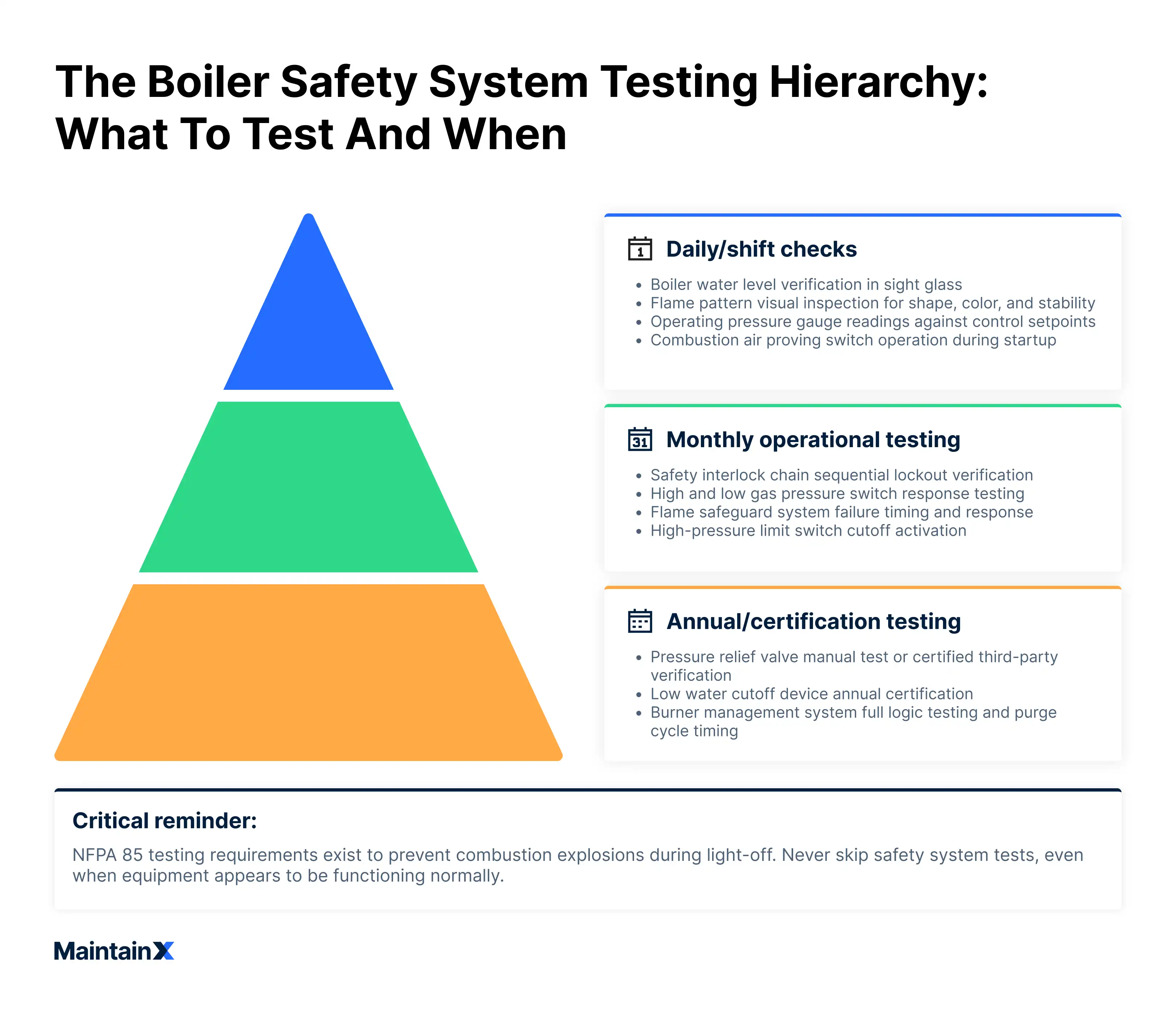
Combustion safety system testing under NFPA 85 and ASME CSD-1
Jurisdictional boiler inspections focus on pressure vessel integrity and rarely cover combustion safety systems. Facilities are responsible for testing these systems themselves, under either NFPA 85 or ASME CSD-1.
The applicable standard depends on boiler size. NFPA 85 covers larger boilers with a heat input above 12.5 MMBtu/hr, multiple burner boilers, and heat recovery steam generators. Smaller commercial and industrial boilers typically fall under ASME CSD-1 (Controls and Safety Devices for Automatically Fired Boilers).
Both standards outline testing requirements for burner management systems, fuel train components, and safety interlocks, including flame safeguard response timing, low water cutoff functionality, and fuel valve leak testing.
EPA Boiler MACT tune-up requirements
The EPA's Boiler MACT rule (40 CFR Part 63, Subpart DDDDD) requires periodic tune-ups for major source commercial and industrial boilers. Facilities classified as area sources fall under a separate rule, Subpart JJJJJJ, with its own requirements. Tune-up frequency under both rules depends on fuel type, heat input capacity, and use classification, ranging from annual to every five years, so facilities should confirm which interval applies to their specific equipment.
A compliant tune-up involves inspecting the burner, checking flame patterns, and adjusting the air-to-fuel ratio for correct combustion. Many of these tasks overlap with routine maintenance already on this boiler checklist.
Build a stronger boiler maintenance program with MaintainX
A preventive maintenance program is only as strong as the records behind it. Paper logs get lost, entries go missing, and inconsistent formats make records hard to use when it matters most. MaintainX gives your team a single platform to capture every inspection, repair, and test result with timestamps, photo attachments, and searchable history, so your maintenance program holds up whether you're facing an audit, applying for an extended inspection interval, or troubleshooting a recurring issue.
Learn more about how MaintainX helps with checklists and inspections, or book a tour to see it in action.
Boiler maintenance checklist FAQs
What maintenance does a commercial boiler need on a regular basis?
Commercial boilers require daily log readings, water treatment testing, and visual checks of gauges for water level, temperature, and pressure within the manufacturer's recommended range. Weekly tasks go deeper: checking safety controls, operating controls, and burner systems, and inspecting for leaks, corrosion, and hot spots around the boiler and surrounding piping.
Clean air filters, oil filters, and air inlet screens to maintain proper airflow, and inspect combustion air and flue gas vent piping for blockages or wear. Use a combustion analyzer to verify efficiency, and perform bottom blowdowns periodically to remove sludge and sediment.
How often should industrial boilers be inspected according to ASME and state regulations?
Most boilers require annual inspection under ASME standards and state regulations, typically including professional service, cleaning, and a hydrostatic test. High-pressure systems often need more frequent review. In some jurisdictions, documented preventive maintenance can qualify facilities for extended inspection intervals. Always review the most recent requirements and regulations to ensure proper maintenance.
Can facility maintenance staff perform boiler maintenance themselves, or is certification required?
Routine tasks like log readings and visual checks generally don't require licensing. Most jurisdictions require certified operators for combustion adjustments and pressure part repairs, though requirements vary significantly. Some states mandate stationary engineer licenses, while others allow trained staff to handle low-pressure systems, and a handful have no operator licensing requirement at all.
Managers looking to understand what applies to their facility should start with the National Board of Boiler and Pressure Vessel Inspectors' jurisdiction synopsis, which provides a state-by-state overview of licensing and inspection requirements. From there, contacting your state's chief boiler inspector directly is the most reliable way to confirm current rules, since regulations can change, and the consequences of non-compliance, such as fines, shutdowns, or liability exposure, make it worth verifying before assuming.
What are the most critical safety checks in a boiler maintenance program?
Pressure relief valve testing and flame safeguard verification are among the most important checks a maintenance team can perform. Low water cutoff devices should be verified regularly, and all system valves should be tested monthly for smooth operation. Safety interlocks, fuel train shutoffs, and burner controls require consistent functional testing. These combustion safety systems often fall outside jurisdictional inspections but protect against the most severe hazards.
How do you create an effective boiler preventive maintenance schedule?
Start with manufacturer recommendations, then layer in ASME inspection intervals and any applicable EPA tune-up requirements. Mapping daily, weekly, monthly, and annual tasks to specific standards helps your team stay organized and catch issues before they escalate.
What are the warning signs that a boiler needs immediate maintenance?
Pressure fluctuations, unusual noises, and visible flame irregularities are common indicators of a developing problem. Water level instability, changes in stack smoke, and efficiency drops can point to combustion or water treatment issues. Persistent safety device trips or control malfunctions should be addressed promptly.

The MaintainX team is made up of maintenance and manufacturing experts. They’re here to share industry knowledge, explain product features, and help workers get more done with MaintainX!

.webp)