
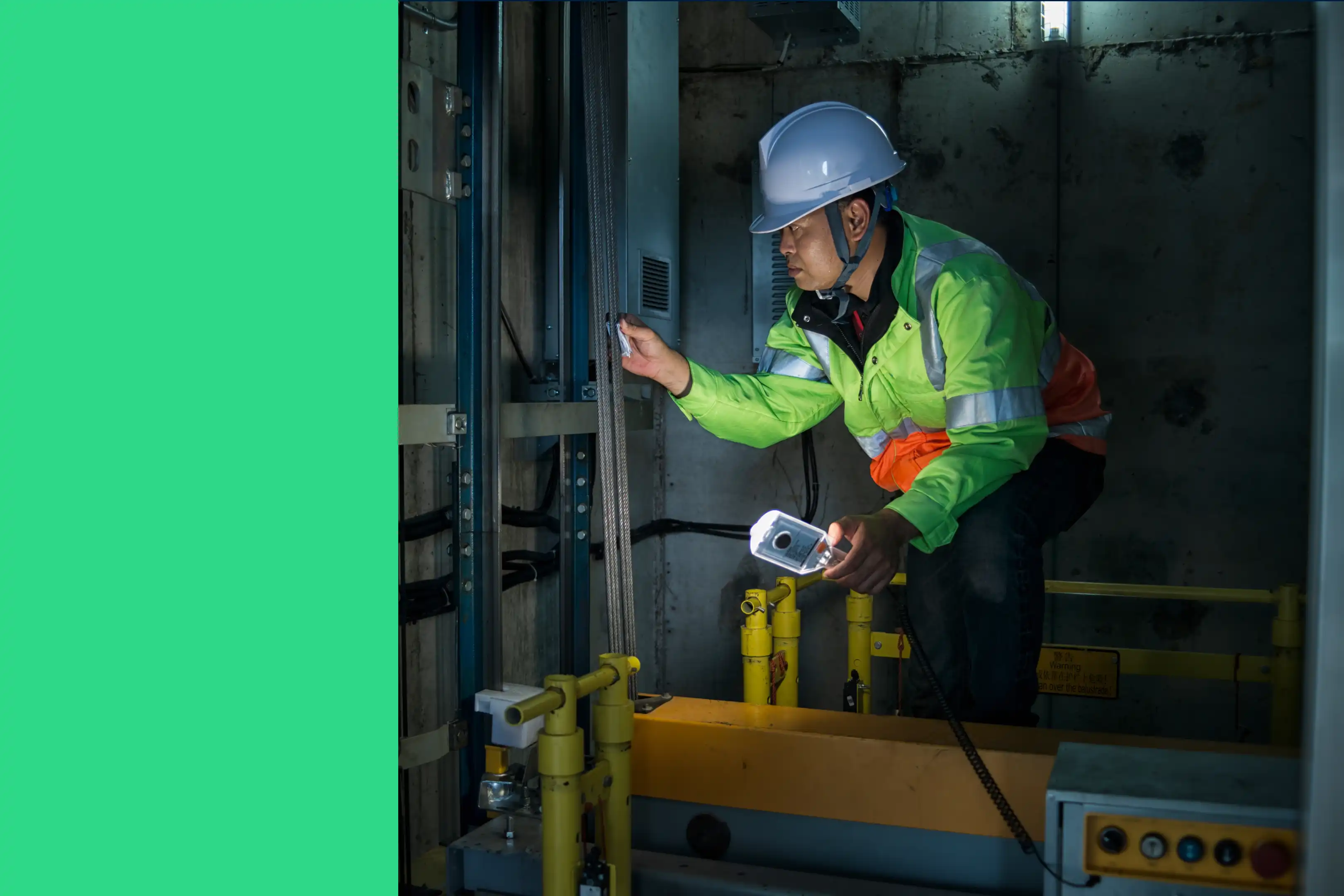
Routine elevator maintenance is critical to maintaining reliability, preventing expensive repairs, and reducing downtime. This guide covers what facility managers should verify, document, and monitor at every stage of the elevator maintenance lifecycle.
You’ll also find a downloadable elevator maintenance checklist template that can be printed out or imported into a computerized maintenance management system (CMMS). We’ve based it around owner oversight and ASME A17.1 Maintenance Control Program (MCP) specifications. However, be sure to check current regulatory requirements before proceeding.
Key takeaways
- Regular elevator maintenance provides early warning signals before minor issues escalate into unexpected breakdowns or costly repairs.
- Daily facility observations (slow doors, leveling issues, unusual sounds) become valuable data points when systematically documented.
- Elevator maintenance operates on multiple timelines: Daily monitoring, routine service visits, annual Category 1 tests, and five-year Category 5 cycles all require coordination between facilities staff and contractors.
- Digital checklists in a CMMS create the audit trail that supports MCP compliance and simplifies inspection readiness.
How to use this checklist
Customize for your facility
This checklist is a template that covers maintenance requirements for most traction and hydraulic passenger elevators. Facility managers should adapt the frequency and scope based on their equipment configuration, usage patterns, and local jurisdiction requirements.
Buildings with high-traffic elevators may need more frequent cab and door inspections, while facilities with specialized equipment like freight elevators or dumbwaiters should add manufacturer-specific items to their maintenance control program.
Use a CMMS
Upload this checklist to a CMMS to digitize elevator maintenance and centrally track contractor visits, test cycles, and deficiency resolution in real time. With a CMMS, you can create automated reminders to keep Category 1 and Category 5 tests current, attach photos of wear patterns, link work orders to specific MCP procedures, and generate reports that prove adherence to maintenance intervals during inspections or insurance reviews.


Elevator maintenance checklist
Cab and ride quality
Door operation and landing areas
Machine room and pit
Safety and emergency devices
Mechanical and electrical systems
Contractor oversight and service verification
Testing and inspection lifecycle
Documentation and MCP compliance
This checklist is to be used only by those with appropriate training, expertise, and professional judgment. You are solely responsible for reviewing this checklist to ensure that it meets all professional standards and legal requirements, as well as your needs and intent.
Daily elevator checks for non-technical facilities staff
Facilities staff ride elevators every day, making them the first line of defense against developing problems.
A slow-closing door, a cab that stops slightly above or below floor level, and unusual noises during travel are all observations that don't require technical training. Instead, give team members a simple way to log what's abnormal by uploading photos and notes via mobile app.
Soon, patterns will emerge: A leveling issue that appears once is a data point; the same issue three times in a week is a documented maintenance request.
Service technicians can review logged observations before each visit and prioritize accordingly. The logs become part of the property's compliance record, connecting everyday awareness to the formal inspection cycle that regulators expect to see.
Understand your MCP requirements
Delegating elevator work to a contractor is standard practice. However, in most cases the compliance obligation stays with the building owner. Many facility managers don't realize this distinction until an inspection surfaces gaps.
Facility managers who treat the MCP as a living document and update it after every service visit, deficiency report, and test stay ahead of inspection findings rather than scrambling to respond to them. An MCP should document the procedures, intervals, and responsibilities for maintaining each elevator in a building. This includes everything from routine lubrication schedules to emergency procedures and parts replacement criteria. Crucially, the owner must maintain this documentation and keep it accessible for AHJ inspectors.
CAT 1 and CAT 5 testing: What to schedule, witness, and verify
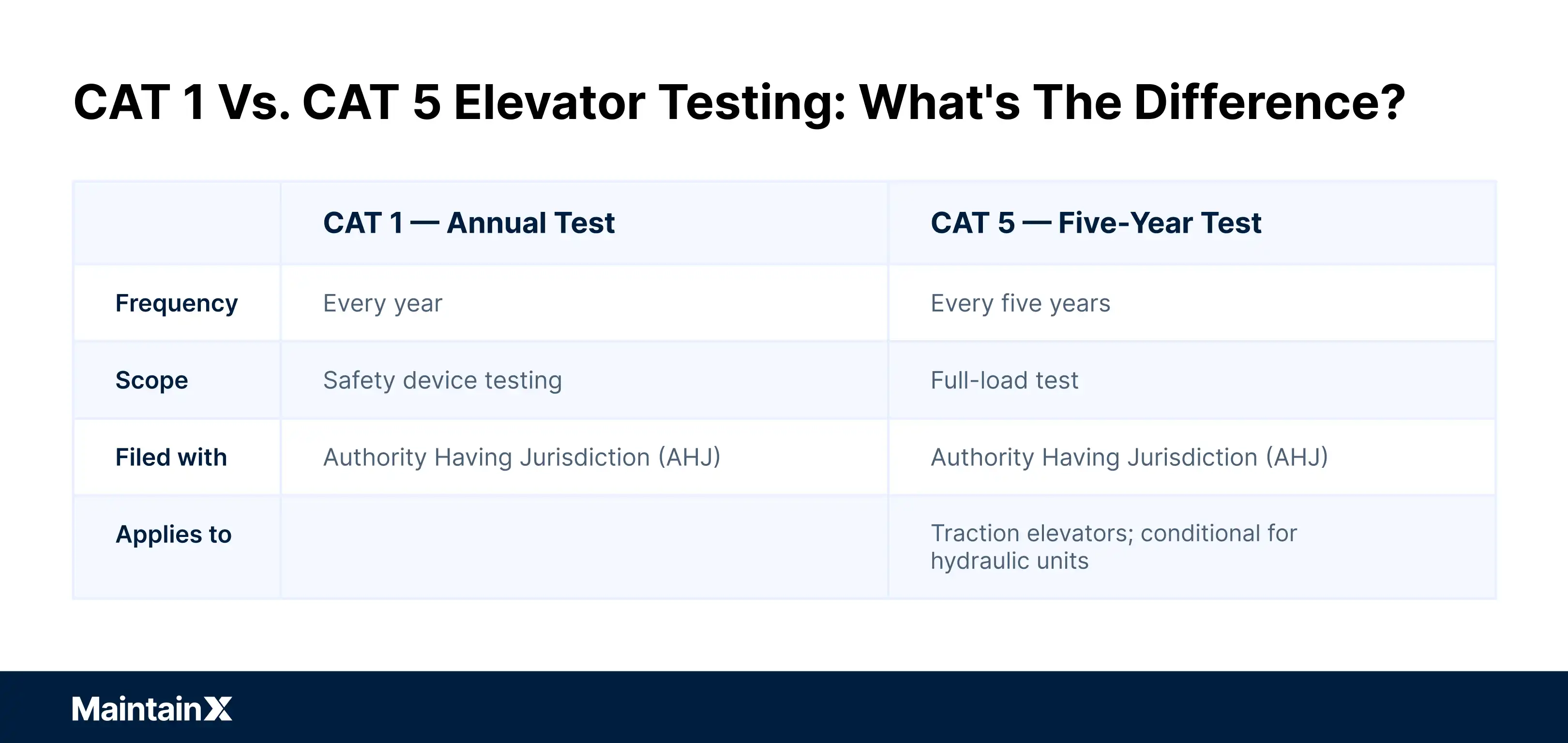
Category 1 and Category 5 tests follow different intervals and serve different purposes, but the owner's role in both is similar: Schedule them on time, witness the process, and verify the results.
CAT 1 tests occur annually and cover safety devices and operational controls without full-load conditions. CAT 5 tests happen at longer intervals (often every three to five years, depending on jurisdiction) and involve full-load and overspeed testing of the safety systems.
Facility managers don't perform these tests, but they should confirm that the testing company provides complete documentation afterward. That means signed test reports, noted deficiencies, and recommended corrections with timelines.
Missed or poorly documented tests are among the most common compliance violations. Tracking upcoming test dates and archiving completed reports within the MCP can help maintain documentation for inspectors.
Document and track elevator deficiencies with a CMMS
An elevator deficiency is only managed when it's recorded, assigned, and tracked to resolution. Across spreadsheets and email threads, that thread tends to get lost over time.
MaintainX gives facility managers a single place to log deficiencies from daily observations, contractor service reports, and formal inspections. Each deficiency carries a priority level, an assigned contractor, and a target resolution date. When an AHJ inspector asks about an open item, the answer is a few taps away.
This approach to documentation also builds long-term visibility into equipment trends. MaintainX ties maintenance records directly to work orders and inspection histories, keeping the MCP documentation current without extra administrative effort.
Ready to see it in action? Book a tour today.
Elevator maintenance checklist FAQs
What is the difference between Category 1 and Category 5 elevator testing?
Category 1 testing occurs annually and includes full-load safety tests and door operation verification. Category 5 testing happens every five years and requires more rigorous component examinations, including buffer strike tests and governor overspeed checks. Most safety standards mandate both Category 1 and 5 tests to ensure elevator safety and compliance. Always review applicable safety and compliance requirements.
How often should commercial elevators be inspected and maintained?
Most jurisdictions require annual inspections by certified third-party inspectors, with monthly maintenance visits from your service contractor. Some high-traffic installations may need more frequent attention based on ASME A17.1 usage categories and local codes.
What does ASME A17.1 require in an elevator Maintenance Control Program (MCP)?
ASME A17.1 Section 8.6 typically requires owners to establish documented maintenance procedures, inspection schedules, testing protocols, and record-keeping systems. The MCP must ensure compliance with applicable codes and safety regulations by specifying task frequencies, qualified personnel requirements, and deficiency resolution timelines for each elevator type.
Note: This is a general informational summary only and does not constitute legal, regulatory, or compliance advice. Consult a licensed elevator inspector, qualified elevator contractor, or legal counsel to determine the specific obligations applicable to your jurisdiction and equipment.
How do you create an effective elevator maintenance checklist for your building?
Start with your equipment manufacturer specifications and regulatory requirements, then tailor inspection items to your building's usage patterns. An effective elevator maintenance checklist should cover regular inspections and include all key components, connecting daily facilities staff observations with monthly contractor visits and annual testing cycles.
Who is qualified to perform elevator inspections and maintenance?
Only a certified technician with state or local licensing should perform technical inspections and repairs, ensuring all work adheres to established safety standards. Building owners and facility managers oversee contractor performance, verify MCP compliance, and document daily operational observations without performing mechanical work themselves.
What are the most common elevator maintenance issues found during inspections?
Door sensors and closing mechanisms top the list, followed by safety device test failures, cab leveling issues, and overdue Category 1 or 5 tests. Many findings stem from incomplete maintenance documentation rather than actual mechanical problems.

The MaintainX team is made up of maintenance and manufacturing experts. They’re here to share industry knowledge, explain product features, and help workers get more done with MaintainX!

.webp)