A 6S score is only as reliable as the standard behind it, and on a busy floor that standard drifts toward whatever is already there. Once shadow boards get redrawn around substitute tools and the red-tag area turns into permanent storage, an area can keep scoring a 3 out of 4 while its actual condition gets worse every month.
A 6S audit checklist is a scored inspection of workplace organization and safety in one work area against Sort, Set in order, Shine, Standardize, Sustain, and Safety. It holds every auditor to the same written criteria, so a score from March means the same thing as a score from September, and it gives each deficiency an owner, a due date, and a corrective action. That makes the audit process a working part of your continuous improvement cycle instead of a form that gets filed, and it lets you track progress zone by zone.
The 6S audit checklist below is organized by pillar, so you can adapt it to any work area. The sections after it cover turning audit findings into work orders, setting audit frequency by zone, and closing the corrective action loop.
Key takeaways
- Give each 6S audit finding an owner and a due date when it is recorded, and turn maintenance-related findings into work orders.
- Safety has its own section, but it also runs through Sort, Set in order, Shine, Standardize, and Sustain. Clutter in an aisle, a spill under a machine, or a missing chemical label often signals a potential hazard before an incident happens, so look for safety issues in every section of the audit.
- Tracking scores and corrective action completion in a CMMS reveal trends, link findings to work orders, and help your team audit declining areas more often.
How to use this checklist
Customize for your facility
Start with the categories that match your operation, then adjust the items to fit each work environment. For example:
- Machine shops: Add coolant and chip management under Shine.
- Assembly lines: Add kitting and WIP limits under Sort, so each station holds only the required parts for the current build.
- Warehouses and storage areas: Add rack labeling, pallet staging lanes, and forklift aisle markings under Set in order.
- Chemical, paint, or plating areas: Add secondary containment and container closure checks under Safety.
Align the Safety section with the OSHA standards that apply to your site and your internal safety standards, including PPE compliance, clear fire exits, and access to safety equipment, such as eyewash stations. Then set scoring thresholds and audit frequency by area risk, so high-traffic zones get checked more often.
Use a CMMS
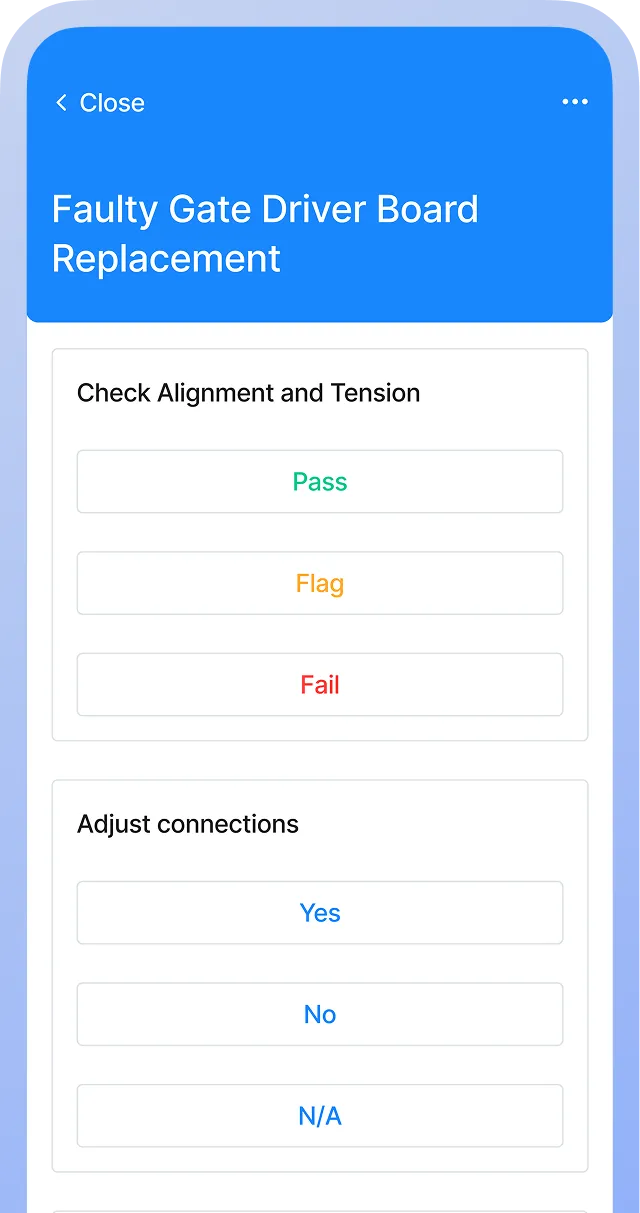
A CMMS turns this checklist into a recurring digital template, so every auditor scores areas the same way and attaches photos of deficiencies on the spot. You can assign audits by zone, create work orders from failed items, and document findings with time-stamped records that give you an audit trail. This makes score trends easy to review, while open corrective actions stay visible until someone closes them.


6S audit checklist
Sort
Set in order
Shine
Standardize
Sustain
Safety
Corrective actions and follow-up
Documentation and compliance
This checklist is to be used only by those with appropriate training, expertise, and professional judgment. You are solely responsible for reviewing this checklist to ensure that it meets all professional standards and legal requirements, as well as your needs and intent.
How to turn 6S audit findings into corrective work orders
Turn each 6S audit finding into a corrective work order at the moment the auditor flags it, with an owner, a due date, and a severity rating attached before the auditor leaves the area.
To make that possible, decide ahead of time who owns each type of finding, so the auditor doesn’t have to work it out on the floor. Most findings fall into one of two groups, and each one goes to a different owner:
- Housekeeping and organization findings, such as unnecessary items at a workstation, an unlabeled bin, or a cleaning schedule nobody signed, go to the area’s team lead. They’re usually same-shift fixes.
- Maintenance-related findings, such as a burnt-out fixture over the inspection bench, a cracked forklift crossing marking, or a machine guard or other safety devices held on with zip ties, go to maintenance as corrective work orders, prioritized by risk.
A CMMS can generate those work orders directly from failed checklist items and assign them to the right technician or team lead. When the same finding shows up audit after audit, open a root cause analysis instead of another work order for the symptom.
Set your 6S audit frequency based on performance trends
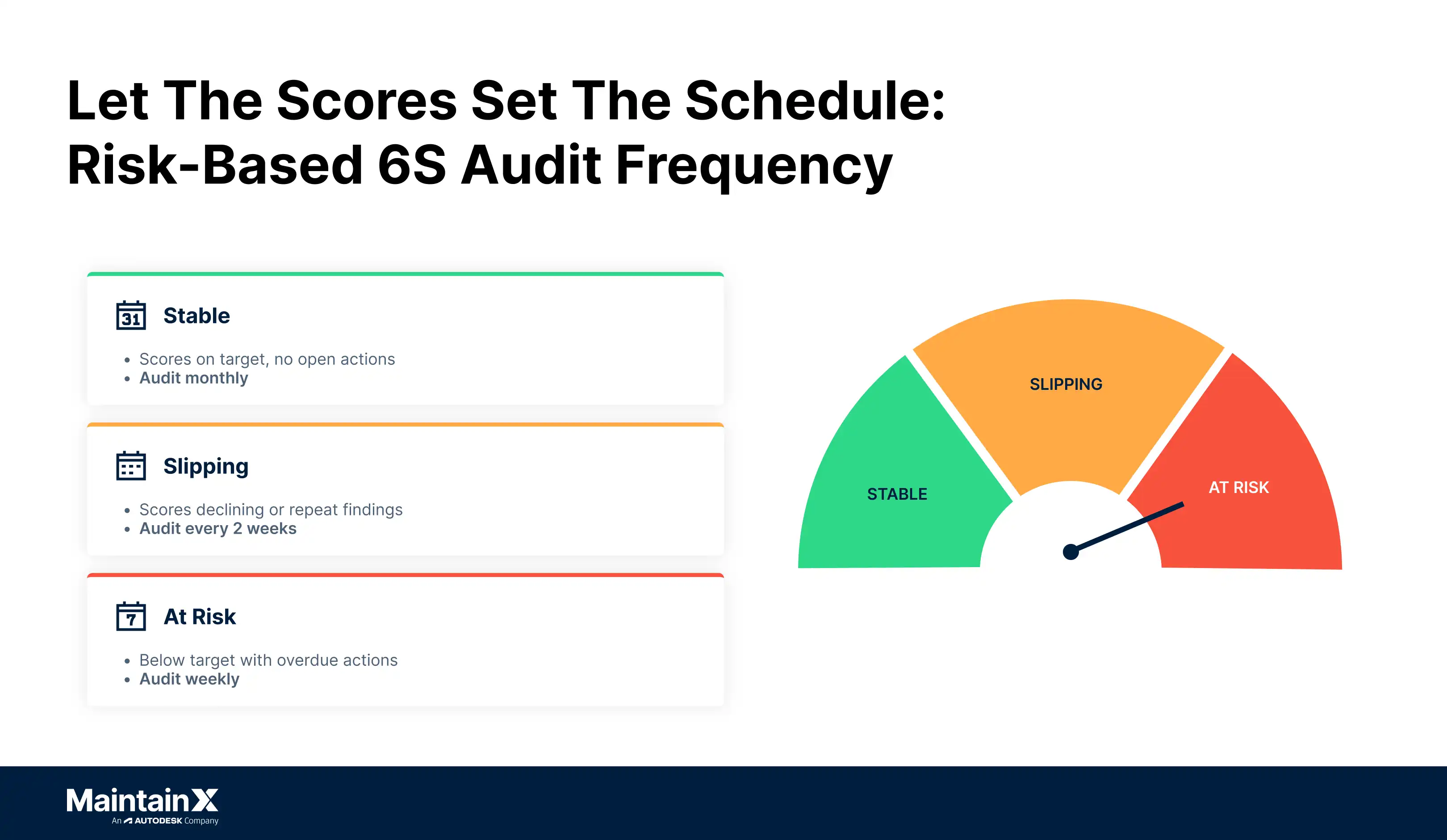
Set your 6S audit frequency zone by zone, using two signals from your own audit data: each area’s score trend and how quickly its corrective actions close. Start each zone on a monthly audit, then adjust as the data comes in.
Score trends tell you where to audit more or less often. Move zones with consistently high scores to a longer interval, and audit zones with recurring deficiencies weekly until their scores stabilize. If a zone struggles on only one pillar, such as a production cell that scores well on Sort and Set in order but keeps losing points on Shine, run a short audit on that pillar instead of a full walkthrough.
Corrective action completion tells you whether more audits will help. If actions in a zone close quickly, it’s likely ready for a longer interval. If they sit open past their due dates, auditing that zone more often won’t change the result, so get the open actions assigned and closed first.
Between formal audits, short daily walkthroughs or a gemba walk let team leads catch small problems that crop up in daily operations.
Common 6S audit failures and how to close the corrective action loop
The most common 6S audit failure is identifying problems without tracking whether anyone fixes them. Three other breakdowns also weaken the connection between the audit and the outcome:
- Inconsistent scoring between auditors: One auditor scores a cluttered bench a 2, and another scores it a 3. Have two auditors score the same area periodically and compare results to keep the overall score meaningful from one audit to the next.
- Treating safety as a separate pass: Trip hazards from an extension cord or a pallet left in an aisle are Sort and Set in order problems first. Score them in both places.
- Corrective actions without deadlines: Without a due date, an assigned action has no point at which it counts as late, so it tends to slip behind daily work.
Every deficiency needs a named person responsible, a target date for resolution, and a follow-up check confirming the fix held. Without all three, corrective actions stay open indefinitely. Following up on every finding shows your team that audits lead to fixes, which helps standards hold between audits.
Audits are easier with a CMMS
MaintainX makes 6S audits easier by keeping the checklist, the findings, and the work orders they generate in one platform, so your audit records never depend on a binder or a spreadsheet. Auditors complete checklists on mobile devices, attach photos of deficiencies, and trigger work orders on the spot. Managers can also review scores by zone, track corrective action completion rates, and spot recurring problem areas without compiling data manually.
Because every audit lives in the same system as your work orders and maintenance history, each finding connects directly to the work that resolves it, and you can see whether recurring issues are declining over time. If you’re building out a broader audit program, the same approach works for a layered process audit or a maintenance audit checklist.
If you want to score zones, assign findings, and track corrective actions from the same app, book a tour to see a 6S audit run in MaintainX from first walkthrough to closed work order.
6S audit checklist FAQs
What are the 6 S’s in a 6S audit checklist?
The 6 S’s are Sort, Set in order, Shine, Standardize, Sustain, and Safety. The first five come from the original 5S methodology used in lean manufacturing, and each builds on the last. Safety gets its own section in the checklist, but it also works as a lens across the other five pillars.
How often should you conduct 6S audits?
Run a full 6S audit monthly as a baseline, with quick daily or weekly walkthroughs in high-traffic areas like assembly lines and tool cribs. Adjust the interval for each zone based on its score trend, and close out each audit’s corrective actions before the next one starts.
What’s the difference between a 5S audit checklist and a 6S audit checklist?
A 6S checklist adds Safety to the original five pillars of a 5S audit. The extra pillar pushes auditors to spot hazards that come from clutter, poor layout, or weak standards, and it ties safety findings directly to corrective actions.
How do you score a 6S audit effectively?
Score a 6S audit on a consistent scale, such as zero to four, with written criteria for each rating so every auditor applies it the same way. Link every low score to a named owner, a due date, and a resolution path.
What are the most common 6S audit failures in manufacturing?
The most common 6S audit failures are unlabeled tools, blocked aisles, unneeded items left in work areas, outdated standards, and cleaning routines that fade. Most trace back to Sustain. Without ownership and trend tracking, gains erode between audits.
Can a 6S audit checklist help with ISO 9001 and ISO 14001 certification?
Yes. A 6S checklist supports ISO 9001 and ISO 14001 by documenting workplace controls, corrective actions, and continual improvement. Certification auditors look for records showing findings were assigned, resolved, and verified. Pair the checklist with document control and spill or waste checks.

Marc Cousineau is the Senior Content Marketing Manager at MaintainX. Marc has over a decade of experience telling stories for technology brands, including more than five years writing about the maintenance and asset management industry.