

A maintenance audit checklist confirms that maintenance documentation exists, but it also measures whether your preventive maintenance program actually works. It helps your maintenance team answer whether documented procedures are being followed, whether maintenance records are accurate, and whether planned maintenance tasks translate into real equipment uptime gains.
Maintenance audits also help you identify internal issues before they surface during external compliance audits conducted by the regulatory agencies relevant to your facility and industry.
This guide helps you customize a maintenance audit checklist for your maintenance department while building an audit process that quantifies gaps and drives corrective action.
Key takeaways
- Actionable maintenance audits score performance metrics like preventive maintenance compliance and work order data quality to turn subjective assessments into measurable benchmarks.
- Effective audits connect findings to operational outcomes like equipment downtime and corrective maintenance costs, and assign owners and deadlines to each finding.
- Centralizing audit trails within a computerized maintenance management system (CMMS) makes maintenance records accessible and actionable for your entire maintenance team.
How to use this checklist
Customize for your facility
Maintenance audits are a broad, industry-agnostic category, and we've designed this template to be useful to a wide range of facilities. You'll want to adapt audit checklist categories based on your facility's asset mix, criticality rankings, and program goals.
Manufacturing maintenance operations typically focus on equipment performance and preventive maintenance schedule compliance, while facilities with distributed assets may prioritize workforce coverage and spare parts inventory.
You'll also want to adjust audit frequency to match your operational complexity: Quarterly reviews work for most maintenance operations, while high-risk environments benefit from monthly assessments. Add industry-specific checks relevant to your safety regulations and environmental regulations as well.
Use a CMMS
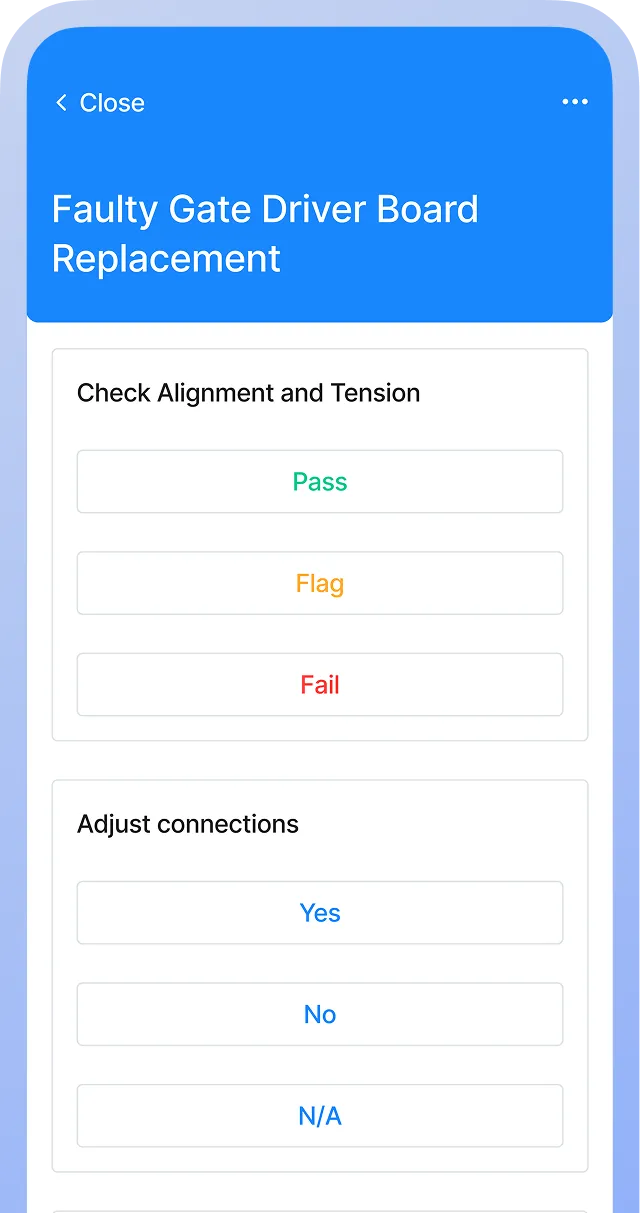
A CMMS centralizes audit evidence and tracks corrective actions through to completion. Upload this checklist to a CMMS to automate preventive maintenance compliance calculations, flag overdue maintenance tasks, and maintain timestamped maintenance records for regulatory compliance reviews.
Maintenance teams using a CMMS can generate real-time reports on backlog trends and maintenance personnel certification status, cutting manual data collection during audits. A central audit trail also simplifies year-over-year comparisons of maintenance processes, helping operators identify areas to streamline operations, assess equipment lifespan, and make more informed decisions about critical equipment replacement.


Maintenance audit checklist
Pre-audit preparation
Work order and data quality
Preventive maintenance program
Equipment and asset condition
Safety and compliance
Spare parts and inventory
Workforce and training
Findings and corrective actions
This checklist is to be used only by those with appropriate training, expertise, and professional judgment. You are solely responsible for reviewing this checklist to ensure that it meets all professional standards and legal requirements, as well as your needs and intent.
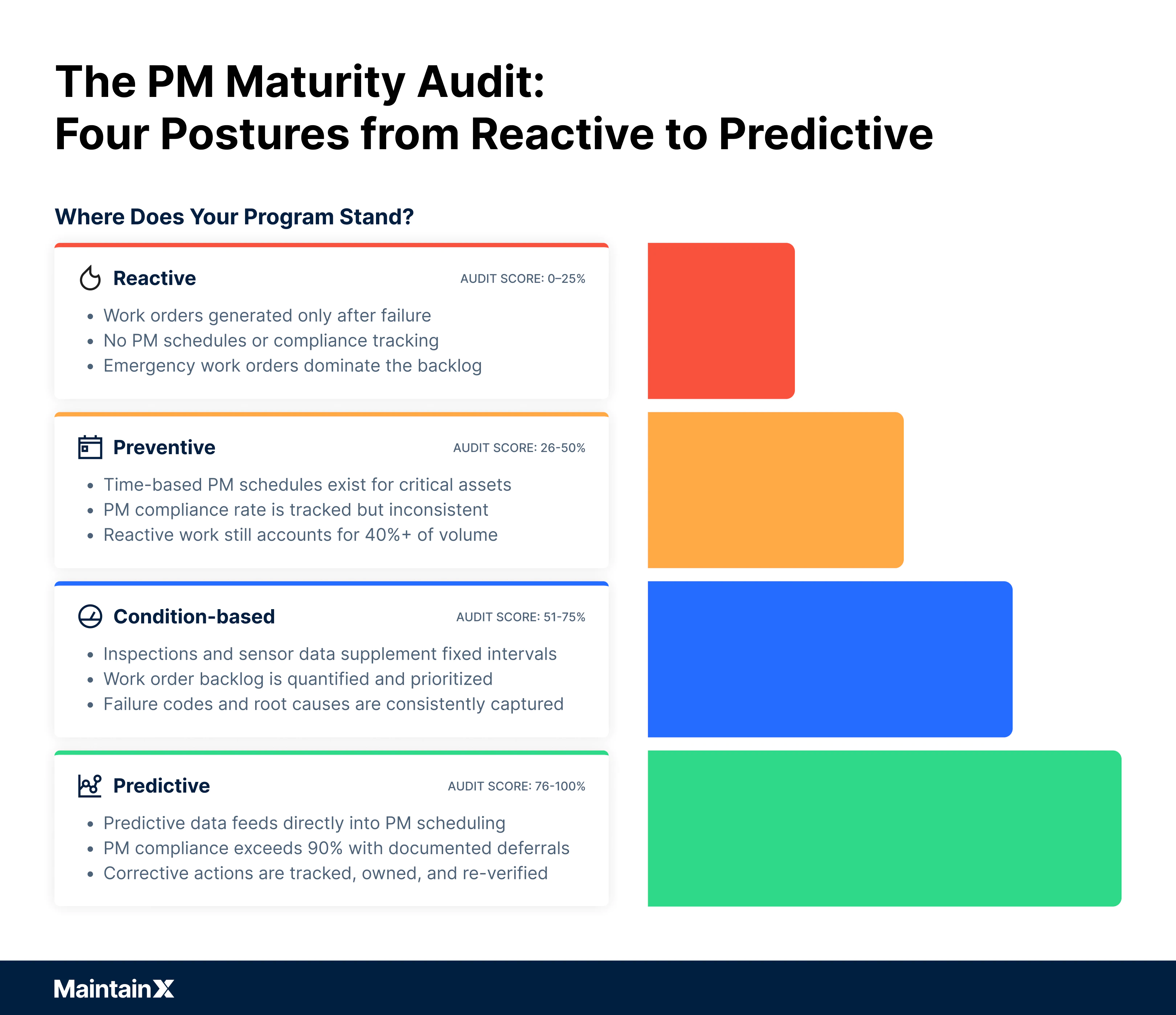
How to score preventive maintenance program maturity
Using a consistent scoring rubric can turn maintenance audit findings into measurable benchmarks that leadership can act on. Effective maturity models assess overall maintenance performance across at least five dimensions:
- PM completion rate
- Work order data quality
- Spare parts inventory availability
- Mean time to repair
- Backlog management
Each dimension receives a score on a simple scale, such as 1 (reactive) through 5 (predictive), giving leadership clear direction on where to focus maintenance resources. If PM completion scores a 2 while parts management scores a 4, task completion is where operators should direct attention and budget.
Repeating the assessment quarterly or biannually creates a trendline that shows whether corrective actions from previous audits drove continuous improvement or just reshuffled the same maintenance issues.
Audit technician adoption: Do frontline teams actually follow your procedures?
Auditing adoption means checking whether documented procedures match the maintenance tasks your team actually performs in the field.
Start with work order data. Low detail, missing timestamps, or skipped steps often signal that maintenance staff have developed workarounds. If you notice these patterns, confirm them with field observations during routine preventive maintenance tasks.
The goal is to identify root causes, not just flag gaps. Are maintenance personnel working with unclear instructions, outdated maintenance manuals, or tools that slow them down? A maintenance audit surfaces these issues and gives leadership the context needed to take corrective actions.
When findings identify procedure gaps, assign each one a specific owner and a follow-up date, and document those assignments in a centralized system. Without that structure, the same maintenance issues tend to reappear in the next audit cycle.
How disconnected systems sabotage audit accuracy
Maintenance audits pull data from multiple sources: work orders, inspection logs, equipment records, and compliance files. Paper-based documentation significantly extends the audit timeline, forcing maintenance staff to track down information across spreadsheets, physical forms, and separate software tools.
Fragmented systems also hide maintenance issues. A maintenance task may be marked complete in one system while another record flags the need for replacement parts without context. Without a single source of truth, auditors spend time reconciling maintenance history instead of evaluating program health and working toward continuous improvement.
There is also a workforce risk. A senior technician's specialized skill and years of undocumented knowledge don't appear in any system without consistent record-keeping. If that person leaves, critical maintenance gaps stay invisible until something fails, creating safety risks and unexpected equipment downtime.
Connect audit findings to business outcomes with a CMMS
Audit findings carry more weight when tied to equipment downtime, regulatory compliance risk, or maintenance costs. MaintainX supports equipment and asset management by housing work orders, maintenance history, and inspection data in one platform, making it easier to trace which missed preventive maintenance tasks led to unplanned downtime and build new maintenance policies to prevent recurrence.
MaintainX also supports the corrective action loop. Each audit finding can automatically generate a work order with an assigned owner, a deadline, and a re-audit checkpoint, turning a static report into an active improvement cycle and helping your maintenance team verify that fixes hold over time.
Build a repeatable, quantitative record of maintenance checks with MaintainX. Book a tour today.
Maintenance audit checklist FAQs
What are the five key elements of a maintenance audit?
Most maintenance audits examine five core areas of maintenance management:
- Preventive maintenance completion rates
- Work order data quality
- Regulatory compliance
- Maintenance personnel procedure adherence
- Asset performance outcomes
Effective audits measure whether maintenance activities produce results like reduced equipment downtime and fewer defects, not just whether documentation exists.
How often should maintenance audits be conducted?
Audit frequency depends on preventive maintenance program maturity, compliance requirements, and operational complexity. Stable maintenance programs typically need annual audits, while newer programs benefit from quarterly reviews to build traction. High-risk facilities or those under regulatory scrutiny often audit semi-annually.
What is the difference between a maintenance audit and a maintenance inspection?
Inspections evaluate equipment condition and performance. Audits evaluate the maintenance program itself, examining whether preventive maintenance tasks are completed on schedule, whether maintenance records contain quality data, and whether documented procedures are followed consistently. Audits examine the system; inspections examine the assets.
What are common red flags found during maintenance audits?
The most common red flags occur when informal knowledge replaces documented procedures among maintenance staff:
- Low preventive maintenance completion rates
- Incomplete work orders
- Maintenance personnel bypassing safety protocols
- Disconnected systems requiring manual workarounds
- Gaps between planned maintenance and actual task execution
How do you score or rate maintenance audit findings?
Effective scoring uses key performance indicators to evaluate maintenance performance: PM completion percentage, work order close rate, procedure compliance, and defect recurrence, among other quantifiable metrics. Facilities assign numeric ratings per category and calculate an overall maturity score. Data-driven scoring reduces subjectivity, supports cost effectiveness analysis, and creates a trackable record of continuous improvement over time.

The MaintainX team is made up of maintenance and manufacturing experts. They’re here to share industry knowledge, explain product features, and help workers get more done with MaintainX!


.webp)