

A well-structured cooling tower maintenance checklist does more than track mechanical upkeep. It connects inspection tasks to the compliance, Legionella prevention, and worker safety outcomes they support.
When your team consistently completes and tracks inspections in a digital checklist, they create the auditable documentation trail that regulators like ASHRAE 188 and OSHA expect. Regular inspections also help maintain optimal equipment performance, keeping operating costs low and occupants comfortable.
This guide will help you build a checklist for your facility, organize inspection tasks by frequency, and maintain the documentation that regulators look for.
Key takeaways
- Mechanical components like drift eliminators and fill media directly control Legionella transmission risk, making their inspections public health control points and high-priority tasks.
- Tie inspection frequencies to regulatory mandates to distinguish compliance-critical work from optional best practices, especially under resource constraints.
- Storing digital checklists in a computerized maintenance management system (CMMS) creates an easily retrievable lo that can serve as a compliance artifact for ASHRAE 188 and OSHA audits.
How to use this checklist
Customize for your facility
This checklist is designed for any type of cooling tower, and should be adapted accordingly. Adjust inspection frequencies based on your cooling load, water quality, and regulatory requirements. Industrial facilities with heavy fouling potential and large commercial buildings typically need more frequent cleaning intervals, while office buildings can extend those intervals further.
Adjust chemical testing protocols to match your treatment program and local health department requirements. Your tower configuration, whether counterflow, crossflow, or hybrid, should also inform how you schedule fill media and distribution system inspections.
Use a CMMS
Upload this checklist to a CMMS to store water chemistry logs and schedule work orders automatically. Automated reminders help maintain consistent testing intervals, and mobile access lets technicians log readings directly from the tower site.
A CMMS also helps teams maintain complete audit trails for compliance reviews. Centralized digital records simplify health department inspections and support ongoing Legionella risk management documentation.


Cooling tower maintenance checklist
Pre-maintenance safety requirements
Daily operational checks
Weekly inspection and water testing
Monthly mechanical maintenance
Quarterly cleaning and Legionella testing
Seasonal startup and shutdown
Annual overhaul and system review
Documentation and compliance
This checklist is to be used only by those with appropriate training, expertise, and professional judgment. You are solely responsible for reviewing this checklist to ensure that it meets all professional standards and legal requirements, as well as your needs and intent.
Cooling tower maintenance record-keeping and audit requirements
Maintenance logs serve a dual purpose for cooling towers: they guide ongoing work and function as compliance artifacts.
ASHRAE 188 and many local health codes require documented proof that water management activities occurred on schedule. Without complete records, even well-maintained towers can create liability exposure during audits or Legionella investigations.
Effective documentation should capture:
- Date
- Technician name
- Specific tasks performed
- Water treatment readings
- Any corrective actions taken
Document each mechanical inspection alongside its biological risk control outcome to strengthen the audit trail. A drift eliminator check, for example, serves as both a mechanical task and a documented barrier against aerosol-borne pathogen release.
How often should cooling tower inspections be performed?
Inspection frequency depends on task type, regulatory mandates, and operational risk; the checklist on this page represents a baseline for a strong preventive maintenance program in most facilities. Your key priorities should include:
- Daily: Basin water level checks, blowdown valve operation, and visual inspection for unusual foam or discoloration.
- Weekly or monthly: Biological testing, belt and motor inspections, and water treatment chemical verification, depending on your facility's risk level.
- Quarterly and annual: Full mechanical assessments of fill media, drift eliminators, fan assemblies, and structural integrity.
Many jurisdictions also require Legionella culture testing twice yearly or annually.
Some of these tasks carry compliance deadlines with real consequences for missed intervals, while others reflect manufacturer recommendations or industry guidance. Organizing your maintenance schedule around these tiers helps your team prioritize compliance-critical items first while still covering the full scope of preventive care.
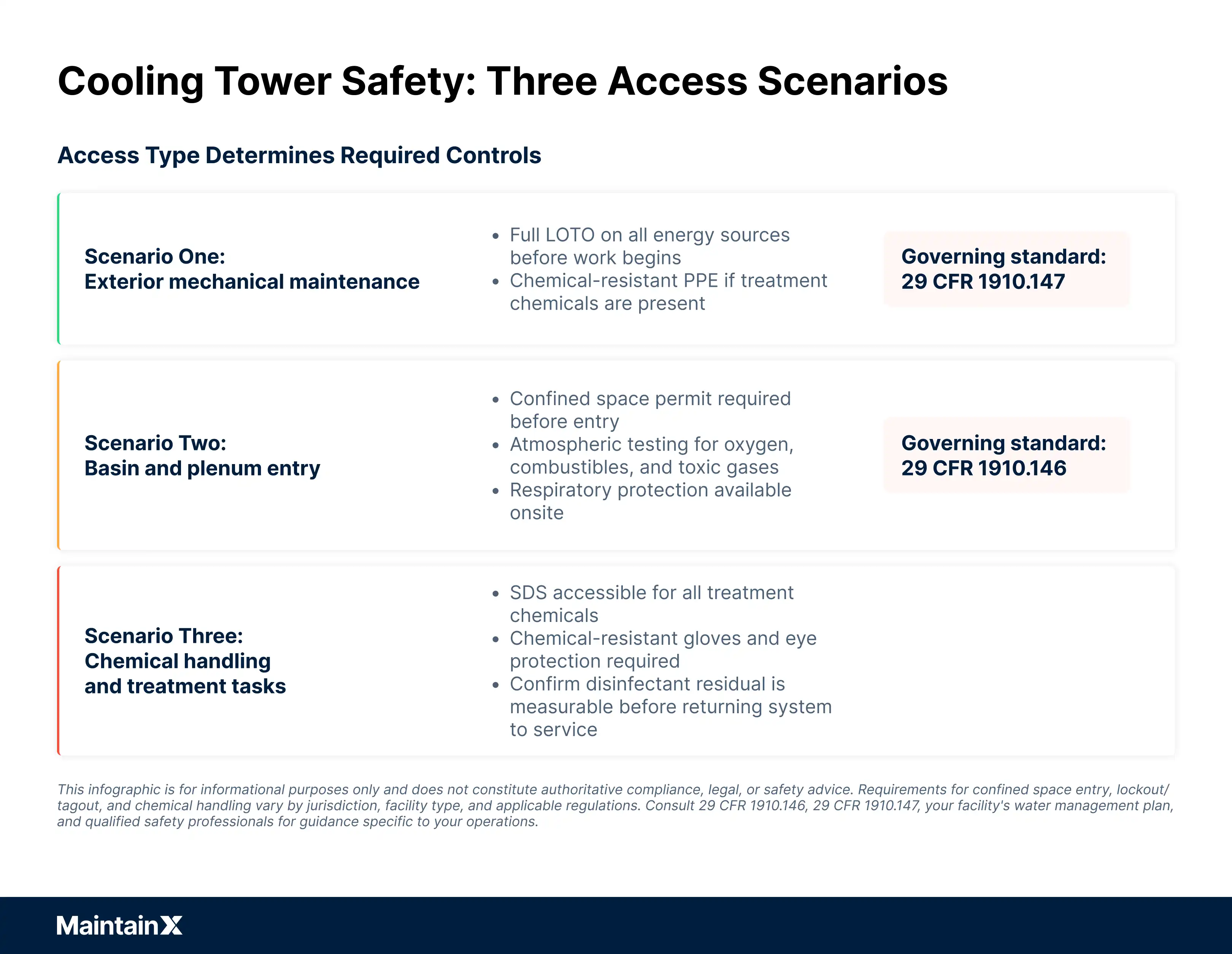
Safety requirements for cooling tower access and maintenance
Cooling tower maintenance involves several overlapping hazards, including confined spaces, fall risks, chemical exposure, and biological contaminants. Rather than treating safety as a separate briefing, experienced teams embed specific precautions directly into each step of their maintenance program:
- Basin cleaning and internal inspections often qualify as confined space entry under OSHA standards, requiring atmospheric monitoring, a trained attendant, and a rescue plan.
- Work involving fan motors or drive systems requires lockout/tagout procedures.
- Chemical handling for biocide treatment or scale inhibitors demands appropriate PPE, including chemical-resistant gloves and eye protection.
- Fall protection applies on induced-draft towers where technicians access fan decks or upper structures.
Tie each safety protocol to the specific maintenance step it governs to reduce the chance that crews skip precautions. Adding these steps to your maintenance checklist in a CMMS creates the documented safety compliance trail that OSHA inspectors expect.
Note: This is a general informational summary only and does not constitute safety, regulatory, or compliance advice. Cooling tower maintenance involves serious hazards including confined space entry, chemical exposure, and biological contaminants. Always follow applicable OSHA standards, ASHRAE guidelines, your authority having jurisdiction (AHJ), and your facility's own safety protocols. Consult a licensed contractor or qualified safety professional to determine the specific requirements applicable to your installation and jurisdiction.
How a CMMS reduces unplanned downtime
Cooling towers tend to fail in predictable patterns: scale buildup prevents a proper flow rate, corroded basins develop leaks, and neglected drift eliminators degrade water management controls.
Well-structured preventative maintenance programs help facilities protect this critical asset and stay ahead of failures. MaintainX is an essential tool that keeps workflows running smoothly by automating work orders based on inspection findings and maintenance schedules across daily, weekly, monthly, and annual intervals.
Over time, maintenance data reveals patterns, showing which components fail most often so teams can adjust preventative intervals accordingly. This allows facilities to move from reactive to data-informed maintenance, which typically reduces emergency repairs and extends equipment life, while maintaining a complete, documented compliance trail.
Book a tour and see for yourself how to streamline your maintenance workflows with MaintainX.
Cooling tower maintenance checklist FAQs
What are the ASHRAE Standard 188 requirements for cooling tower maintenance?
ASHRAE 188 requires a documented water management program with hazard analysis, control measures for bacterial growth, routine monitoring protocols, and corrective action procedures. The standard connects mechanical maintenance tasks directly to biological risk controls.
Note: This is a general informational summary only and does not constitute legal, regulatory, or compliance advice. Consult a licensed inspector, qualified contractor, or legal counsel to determine the specific obligations applicable to your jurisdiction and equipment.
How often should cooling tower water be tested for Legionella bacteria?
Testing frequency depends on risk assessment outcomes and facility-specific hazard levels. High-risk sites near vulnerable populations, such as healthcare facilities, typically test monthly during operation. Lower-risk facilities can test quarterly, increasing frequency after disruptions or maintenance.
What water quality parameters must be monitored in a cooling tower maintenance program?
Critical water quality parameters include:
- pH
- Conductivity
- Biocide residuals
- Total dissolved solids
- Temperature
- Cycles of concentration
Each parameter controls specific biological and corrosion risks, and these risks affect scale formation and biocide effectiveness.
What happens if cooling tower maintenance is neglected or delayed?
Neglected towers create dual failure modes:
- Mechanical degradation through corrosion and scaling reduces efficiency.
- Biofilm accumulation creates Legionella amplification sites that can contribute to Legionnaires’ disease, leading to regulatory scrutiny and liability exposure.
How should cooling tower maintenance differ between summer operation and winter shutdown periods?
Operating towers need daily visual checks and weekly water testing to control biological risks during the summer.
Winterized towers shift to preservation mode, which includes complete drainage, biocide treatment, and equipment protection.
What documentation is required to show compliance with cooling tower regulations?
Compliance requires:
- Timestamped inspection logs
- Water test results with lab certifications
- Corrective action records
- Training documentation
- Water management plan updates
Taken together, these documentation elements serve as proof of regulatory adherence during audits.

The MaintainX team is made up of maintenance and manufacturing experts. They’re here to share industry knowledge, explain product features, and help workers get more done with MaintainX!

.webp)