

A structured data center maintenance checklist prevents cascading failures by surfacing the dependencies between power, cooling, fire suppression, and security systems. This guide organizes inspections around those cross-system relationships and tier-level requirements so data center operations teams can maintain critical infrastructure without disrupting uptime.
Key takeaways
- Understanding the dependencies between data center systems helps teams catch potential failures before they compound across infrastructure.
- Tier III and IV facilities require coordinated workflows that verify redundant paths before single-path maintenance.
- Connecting maintenance tasks to failure modes transforms routine checking into informed decisions. When technicians understand how clogged filters affect server throttling, they spot hot spots and other warning signs earlier.
How to use this checklist
Customize for your facility
Data centers vary by tier classification, equipment density, and uptime requirements. Adjust this checklist template based on your redundancy level and specific needs. Facilities with N+1 cooling systems may inspect CRAC units monthly, while 2N configurations might extend to quarterly.
You'll also want to modify this checklist to reflect your specific infrastructure: add liquid cooling inspections for immersion systems or include edge protocols for distributed facilities. Align fire suppression checks with your clean agent type and review ASHRAE thermal guidelines alongside local AHJ requirements and original equipment manufacturers' service recommendations.
Use a CMMS
In mission-critical environments, documentation gaps that impact root cause analysis have significant consequences.
A computerized maintenance management system (CMMS) digitizes inspection workflows, automatically timestamps findings, and creates searchable audit trails for security audits and compliance reviews. With a CMMS, you can set up automated task assignments based on equipment criticality and trigger escalations when environmental thresholds are exceeded.


Data center maintenance checklist
Power and electrical systems
Cooling and environmental controls
Fire detection and suppression
Network and cabling infrastructure
Server and IT equipment
Building integrity and physical security
Cross-system redundancy and coordination
Documentation and compliance
This checklist is to be used only by those with appropriate training, expertise, and professional judgment. You are solely responsible for reviewing this checklist to ensure that it meets all professional standards and legal requirements, as well as your needs and intent.
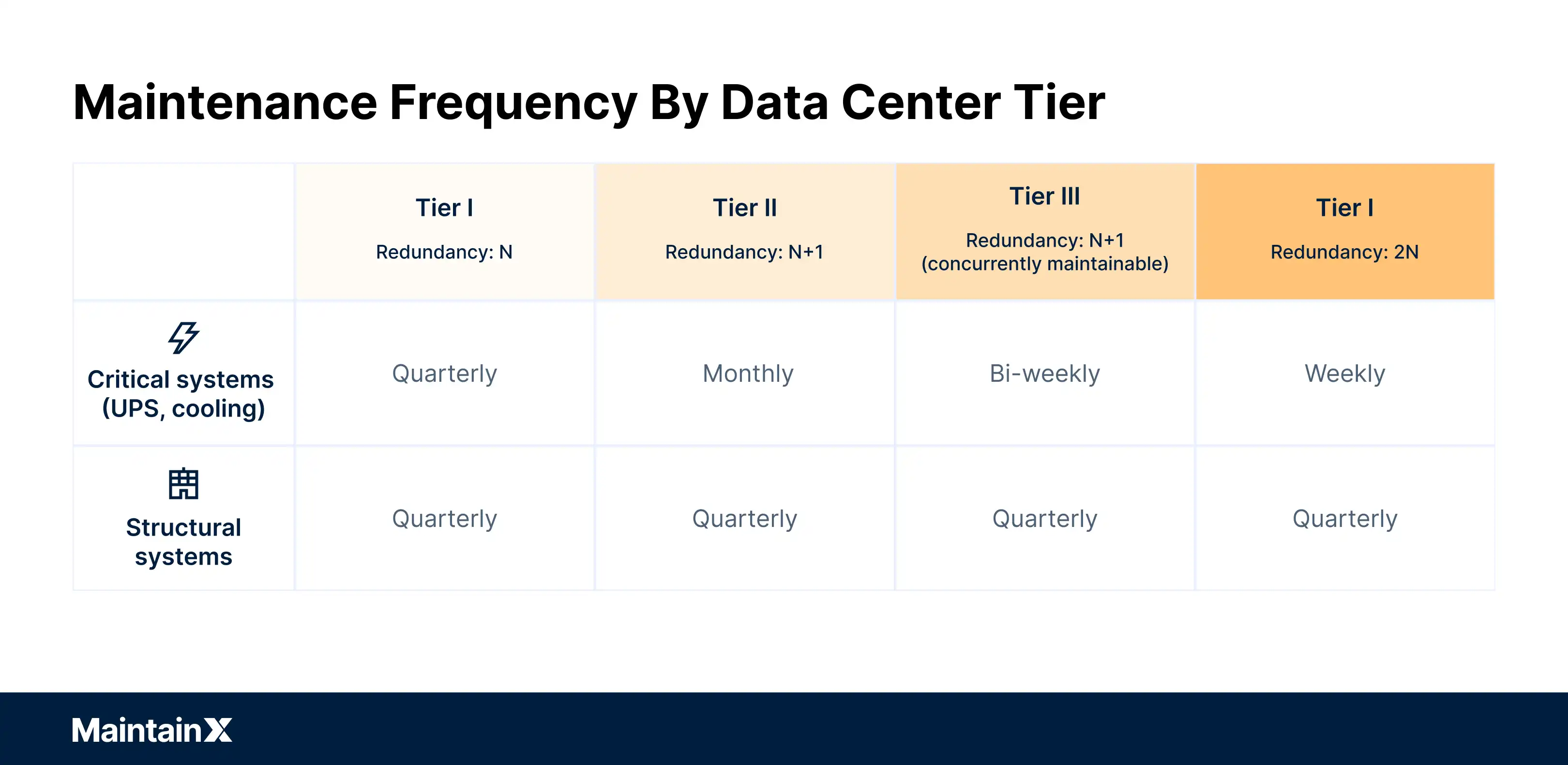
How maintenance frequency changes with tier classification and criticality
Tier classification directly shapes how often teams inspect and service data center equipment. A Tier I facility with a single distribution path might follow standard monthly or quarterly cycles under a straightforward preventive maintenance approach. A Tier III or IV facility, with redundant components and multiple active paths, typically requires more frequent checks across a wider set of critical systems.
The reason is straightforward: higher-tier environments carry higher uptime expectations. That means tighter inspection intervals for uninterruptible power supply systems, cooling redundancy, and automatic transfer switches. It also means more frequent verification that redundant paths actually function as designed, since a single overlooked gap can turn a routine failure into full system failure.
Facility managers often align frequencies with Uptime Institute or TIA-942 guidelines, then adjust based on equipment age, environmental conditions, and historical failure data. Some teams also layer in reliability-centered maintenance principles, prioritizing inspection depth based on which failures carry the greatest consequence for data center operations rather than treating every component identically. A cooling unit nearing end-of-life in a Tier III facility, for example, warrants closer attention than the same unit in a less critical environment.
Concurrent maintainability protocols for Tier III and IV facilities
Concurrent maintainability is a design standard, but keeping it operational is a coordination problem. Tier III and IV facilities allow teams to service any component without taking the site offline. That promise only holds when teams follow strict protocols during every maintenance window.
Before isolating a UPS module or switching a chiller offline, technicians need to verify that the redundant path is active and carrying load. This means confirming that automatic transfer switches respond correctly and backup generators and cooling systems meet current thermal demands.
Communication matters as much as technical steps. Power, cooling, and network teams should coordinate timing so one group's maintenance window doesn't overlap with another's. A single unannounced switchover can cascade into exactly the kind of outage these facilities and protocols are designed to prevent. Pre-maintenance checklists and cross-team notifications help close that gap and reduce the human error that tends to creep in when coordination happens informally.
Documentation and audit trail requirements for compliance readiness
Data center compliance audits from frameworks like SOC 2, ISO 27001, or HIPAA don't just ask whether maintenance happened. They ask for proof: timestamped records, technician sign-offs, and documented corrective actions.
Strong documentation practices turn routine inspections into audit-ready evidence. Every task completion, abnormal finding, and follow-up work order becomes part of a traceable history. This matters especially when auditors examine how quickly teams responded to a flagged issue or whether recurring problems received root-cause attention through predictive maintenance or reliability-centered maintenance review.
Paper-based logs and spreadsheets can technically satisfy these requirements, but they introduce gaps. Missing signatures, illegible entries, and inconsistent formatting slow audit preparation considerably. Digital records with automatic timestamps and photo attachments tend to hold up better under scrutiny. The goal is a documentation workflow that captures compliance evidence as a natural byproduct of daily maintenance, not a separate administrative task layered on top of already-busy operations.
This information is for general reference only and does not constitute legal or compliance advice. Consult applicable regulations and a qualified professional to confirm requirements for your facility.
How a CMMS strengthens data center maintenance
Data center maintenance involves tightly coupled systems where a missed task on one component can affect several others. MaintainX helps teams manage that complexity by connecting scheduled inspections, work orders, and asset histories in one platform, giving data center management teams a clearer picture of how infrastructure, power, and cooling systems interact day to day.
For facilities practicing concurrent maintainability, MaintainX provides visibility into which redundant paths are under active maintenance at any given time, helping data centers running mixed-criticality workloads keep both efficiency and reliability on track without sacrificing one for the other.
Book a tour for a closer look at the benefits of using MaintainX in your data center.
Data center maintenance checklist FAQs
What maintenance tasks should be performed daily in a data center?
Daily tasks focus on critical systems: verify UPS and generator status, check HVAC temperatures and airflow, inspect fire suppression panels, and monitor environmental alarms. These checks catch anomalies before they cascade across interdependent power, cooling, and safety systems.
How often should data center HVAC systems be inspected and serviced?
Inspect HVAC systems daily for airflow and temperature anomalies, perform filter changes monthly, and schedule thorough servicing quarterly. Tier III and IV facilities require additional redundant system checks to maintain concurrent maintainability during service windows.
What are the critical compliance standards for data center facility maintenance?
Key standards include Uptime Institute Tier classifications, TIA-942 data center design requirements, NFPA 75 fire protection guidelines, and ASHRAE thermal management specifications. These frameworks establish baseline maintenance frequencies and redundancy requirements based on criticality.
This information is for general reference only and does not constitute legal or compliance advice. Consult applicable regulations and a qualified professional to confirm requirements for your facility.
What are the essential components that require regular maintenance in a data center?
Essential components include UPS systems, backup generators, CRAC/CRAH units, PDUs, fire suppression systems, and access controls. Each system affects others. Cooling failures impact power equipment, and power interruptions disable security systems. These dependencies require coordinated maintenance approaches.
How do you create a preventive maintenance schedule for data center equipment?
Build schedules around equipment criticality, manufacturer recommendations, and facility tier requirements. Map cross-system dependencies to sequence maintenance tasks, verify redundancy before servicing primary systems, and establish communication protocols for coordination between power, cooling, and network teams.
What temperature and humidity levels should be maintained in a data center?
ASHRAE recommends 64-80°F (18-27°C) with 40-60% relative humidity for equipment longevity and efficiency. Most facilities target narrower ranges of 68-72°F with 45-55% humidity to balance energy costs against thermal management risks.
What emergency preparedness checks should be included in data center maintenance?
Verify generator auto-transfer switches, test UPS battery runtime under load, confirm fire suppression system readiness, and validate redundant cooling path functionality. Emergency checks ensure failover systems activate correctly when primary infrastructure fails, protecting against data loss and supporting any disaster recovery plans already in place.

The MaintainX team is made up of maintenance and manufacturing experts. They’re here to share industry knowledge, explain product features, and help workers get more done with MaintainX!

.webp)