
Computer numerical control (CNC) maintenance should aim to preserve machine precision and reliability through regular, preventive service. Even rugged machines built to withstand harsh environments require consistent maintenance to ensure precise operations and long-term durability. Tolerance drift, surface finish degradation, and rising scrap rates may start as maintenance problems, but they quickly become quality issues.
This CNC machine maintenance checklist provides a framework for preventive maintenance, from daily operator checks through scheduled technician interventions.
Key takeaways
- Recording maintenance in a CMMS transforms compliance paperwork into quality intelligence. A CMMS helps track maintenance requirements and supports a maintenance schedule to reduce downtime.
- Correlating bearing hours, coolant readings, and backlash measurements against scrap rates reveals which preventive tasks deliver the highest returns, while also evaluating maintenance's effectiveness through data analysis.
- Structured escalation between operators and technicians catches problems early. Daily checks for unusual noise or jerky movement during warm-up trigger scheduled diagnostics before precision loss affects production.
How to use this checklist
Customize for your facility
This checklist and the information in this article are guidelines, meant to be broadly applicable to most CNC machine shops.
Heavy roughing operations typically require more frequent coolant and chip handling checks than precision finishing. Direct-drive spindles need different lubrication intervals than belt-driven units. Specialized equipment like Swiss-type lathes or horizontal machining centers have specialized maintenance requirements.
Consider all of these things alongside safety best practices, compliance requirements, and machine usage when customizing this checklist to the needs of your facility. Use it as the basis for an annual maintenance plan to ensure reliability and minimize downtime.
Use a CMMS
Making the transition from paper checklists to a mobile-friendly computerized maintenance management system (CMMS) helps track CNC machine maintenance tasks and follow-up actions. With a CMMS, technicians can identify damage on the floor, attach photos, and automatically generate work orders when repairs are needed.


CNC machine maintenance checklist
Spindle and drive components
Fluid power and lubrication systems
Coolant and cutting fluid system
Chip handling and debris management
Electrical and control systems
Tooling and work-holding
Safety and guarding systems
Calibration and precision verification
Documentation and compliance
*Disclaimer: This checklist is to be used only by those with appropriate training, expertise, and professional judgment. You are solely responsible for reviewing this checklist to ensure that it meets all professional standards and legal requirements, as well as your needs and intent.
How to recognize early warning signs in part quality
Precision problems show up quietly in the parts themselves.
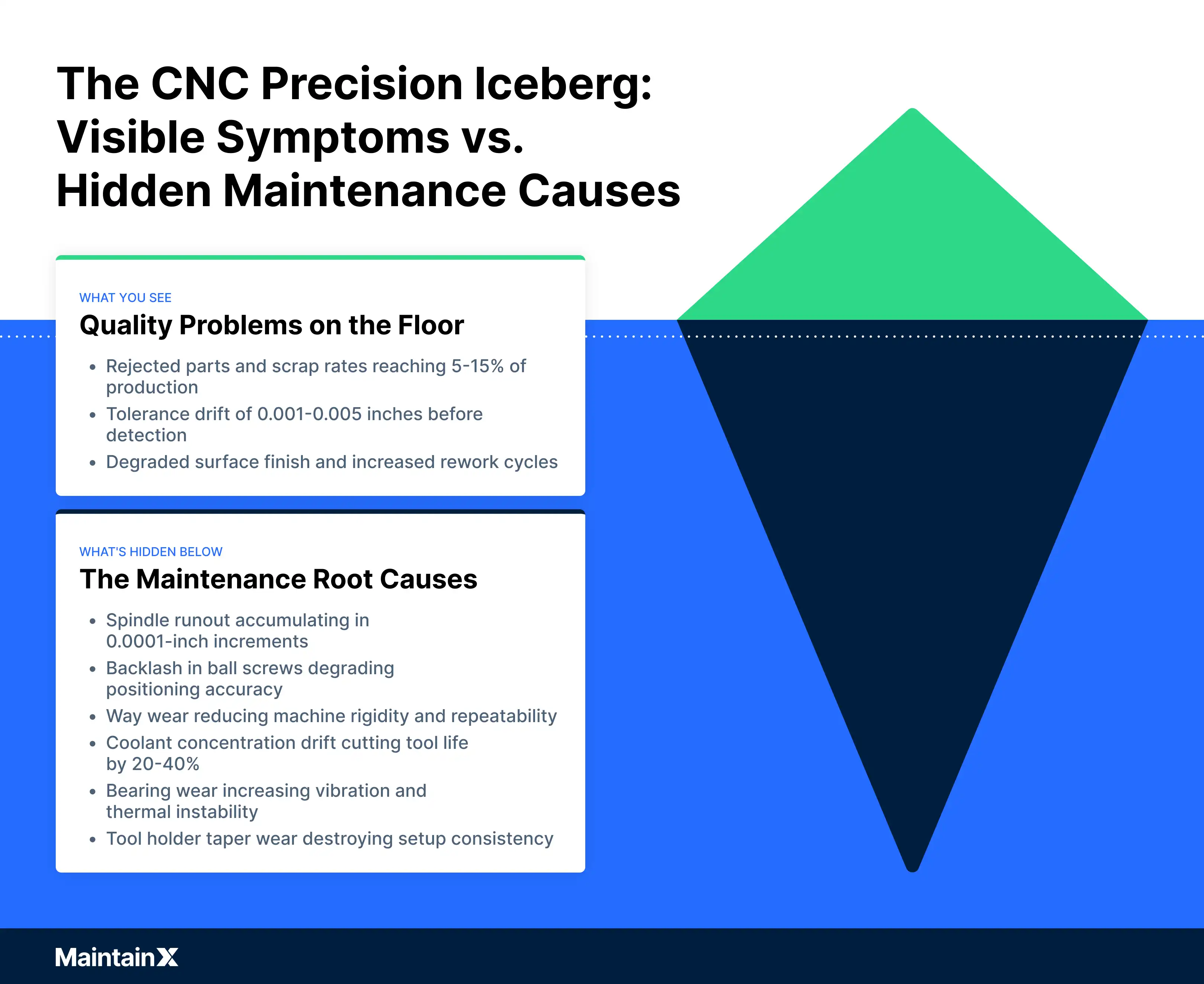
Tolerance drift is often the first signal: Dimensions that once held tight start creeping toward the edge of spec, surface finishes grow rougher, and scrap rates tick upward before anyone traces the cause back to the machine.
Quality shifts tend to precede mechanical failure by weeks or even months. A spindle bearing losing preload, for example, affects part concentricity long before it generates noticeable vibration or noise.
Regular visual inspection and machine inspection are essential for early detection of these issues, allowing operators to identify potential problems before they escalate. Inspecting cutting tools and machine beds helps maintain accuracy and prevents subtle shifts from impacting production.
Tracking these trends over time reveals which maintenance tasks have the greatest impact on accuracy. The connection between part quality data and machine condition separates reactive shops from precision-focused ones.
Escalation best practices for CNC quality alerts
Operators notice things first: a subtle chatter mark, a dimension trending off-center, unusual spindle noise during a finishing pass. What happens next determines whether the issue stays small or becomes a production problem.
Effective escalation depends on clearly defined responsibilities at each level. Operators typically handle routine inspection tasks like coolant levels, chip removal, and basic tool wear. When something falls outside that scope, a direct path to maintenance technicians keeps response times short. For more complex issues, the maintenance supervisor steps in to coordinate, ensuring problems get addressed before they turn into breakdowns.
The escalation itself should capture specifics: which axis, which operation, what changed in part quality, and when. Vague reports like “machine sounds weird” slow diagnosis. “Z-axis chatter appeared during finishing at 8,000 RPM on part 47” gives a technician something to act on immediately.
Documenting every alert, ideally in a CMMS where data can be shared, builds a pattern library that makes future diagnosis faster.
How to scale CNC preventive maintenance across multi-brand machine fleets
A shop running five identical CNC machines can standardize easily. A fleet spanning multiple brands, vintages, and control systems is a different challenge.
Standardizing a maintenance schedule across the fleet helps ensure optimal performance and minimizes costly downtime. The most practical approach groups tasks by function rather than brand. Spindle lubrication, way cover inspection, and axis backlash checks apply across platforms, even if intervals and specs differ. Brand-specific procedures then layer on top of that shared foundation.
Maintenance records become especially valuable at fleet scale. Tracking quality outcomes by machine reveals which units hold tolerance well and which need more frequent attention. Over time, this data highlights whether a particular brand or model consistently underperforms, so you can make more effective repair-vs-replace decisions.
A CMMS helps manage these variations by assigning machine-specific intervals and procedures while rolling up fleet-wide trends into a single view, allowing maintenance teams to use centralized systems to coordinate maintenance across the fleet.
Turn this checklist into a preventive maintenance system
Printed checklists and inspections capture intent. A digital system captures results, which connect maintenance actions to production quality over time.
When inspection findings, measurements, and technician notes live in MaintainX, they become searchable history. Teams can trace a surface finish problem back to a skipped lubrication cycle or correlate tolerance drift with spindle hour counts. This helps coordinate maintenance, enabling teams to minimize downtime and maintain optimal machine performance.
The real payoff comes from closing the feedback loop. Maintenance data paired with quality records show which preventive tasks actually protect precision and which are just routine. Systematic documentation not only supports machine longevity but also helps in evaluating maintenance's effectiveness over time. That insight turns a checklist into a system that improves with every cycle.
Want to see it in action? Book a tour.
CNC machine maintenance checklist FAQs
What are the essential daily maintenance tasks for CNC machines?
Operators should inspect cutting tools for wear or damage, perform a thorough machine inspection, and ensure proper operation procedures are followed.
Check coolant systems, including inspecting the coolant tank for contamination, verifying proper coolant levels, and ensuring optimal coolant flow as part of daily coolant management.
Remove all metal chips from the machine bed and working areas to prevent damage and maintain precision.
Inspect the lubrication unit and check lubrication levels.
Clean or replace air filters and maintain dust collection systems, especially in environments with high particulate matter.
How often should preventive maintenance be performed on CNC machines?
Daily operator checks maintain baseline precision, while technicians perform detailed inspections weekly and thorough servicing monthly. High-production environments may require more frequent maintenance intervals to address increased wear and tear.
What should be included in a CNC machine maintenance log?
Record maintenance actions alongside quality metrics: dimensional accuracy trends, surface finish measurements, tool life data, and scrap rates. Include coolant condition, lubrication points serviced, hydraulic fluid levels, lubrication levels, and any additional details of coolant management, such as coolant levels and cleaning routines. Document any tolerance drift observed. For traceability, also record machine parameters and control settings in the maintenance log.
How do you maintain CNC machine accuracy over time?
Regular CNC machine inspection is essential for maintaining accuracy and detecting early signs of equipment issues. Use automated temperature sensors to monitor the cooling system and prevent thermal issues that could affect machine performance. Monitor backlash, verify geometric accuracy quarterly, and address vibration sources promptly.
What are the most common CNC machine maintenance mistakes to avoid?
Ignoring early quality signals like increased tool wear or tolerance drift often leads to expensive cnc machine breakdowns. Inconsistent maintenance scheduling will gradually degrade precision. Other common mistakes include neglecting dust collection systems, air filters, and electrical connections, which can result in contamination, reduced machine efficiency, or safety hazards.
When should you replace CNC machine components versus repair them?
Replace components when precision requirements can’t be met economically through repair. Worn ballscrews causing backlash beyond specs, damaged spindle bearings affecting surface finish, or outdated controllers limiting accuracy typically warrant machine replacement. Historical maintenance data is essential for identifying when repairs are no longer cost-effective and for informing future business decisions about equipment upgrades or replacement.

The MaintainX team is made up of maintenance and manufacturing experts. They’re here to share industry knowledge, explain product features, and help workers get more done with MaintainX!




.webp)