
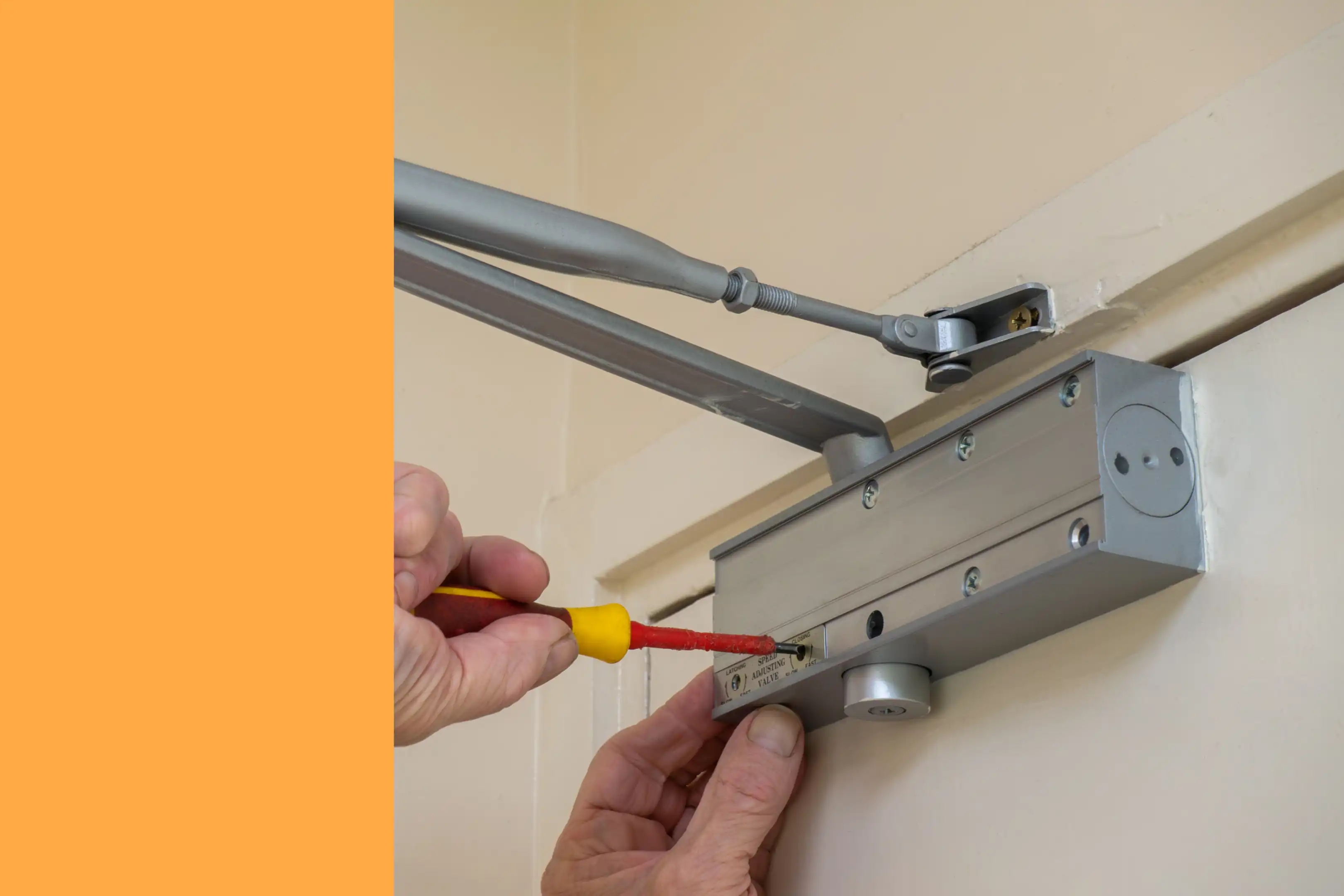
A fire door maintenance checklist built around monthly, quarterly, and annual inspection tiers turns NFPA 80 compliance into a steady routine rather than a last-minute scramble. This guide covers what to inspect at each cadence, how to handle identified issues when you find them, and how to keep your fire door inspection report and other documentation audit-ready across your entire door assembly inventory.
Key takeaways
- Fire door compliance breaks down when staff members prop doors or add hardware between fire door inspections. Addressing workflow needs, often with alarm-integrated hold-opens, maintains ongoing compliance with less staff friction.
- A tiered inspection rhythm of monthly visual rounds, quarterly wear checks, and annual NFPA 80 surveys prevents the compliance scramble of treating hundreds of fire door inspections as a once-a-year event.
- Digital checklists link each door's identifier to measured door clearances, deficiency history, and remediation dates. Door-level tracking typically resolves surveyor questions faster than building-level summaries.
How to use this checklist
Customize for your facility
Adapt this checklist to your fire door inventory and facility risk profile. Healthcare and educational facilities often schedule regular fire door inspections more frequently than National Fire Protection Association minimums require. Focus daily checks on high-traffic areas and critical egress paths. Adjust quarterly tasks based on your door types: rolling doors, paired assemblies, or electromagnetic hold-opens. Verify inspection frequency aligns with local building codes, local fire marshal requirements, and insurance stipulations for your jurisdiction.
Use a CMMS
Paper inspection records may be fine for small facilities, but challenges compound at scale.
Using a computerized maintenance management system (CMMS) simplifies fire door compliance by scheduling inspections, documenting findings with photos, and maintaining audit-ready records. Cloud-based storage meets three-year retention requirements and keeps each fire door inspection report accessible for facility managers, compliance officers, and building owners during AHJ reviews or insurance audits.


Fire door maintenance checklist
Daily awareness checks
Monthly preventive maintenance
Quarterly inspections
Annual inspections
Documentation and compliance
This checklist is to be used only by those with appropriate training, expertise, and professional judgment. You are solely responsible for reviewing this checklist to ensure that it meets all professional standards and legal requirements, as well as your needs and intent.
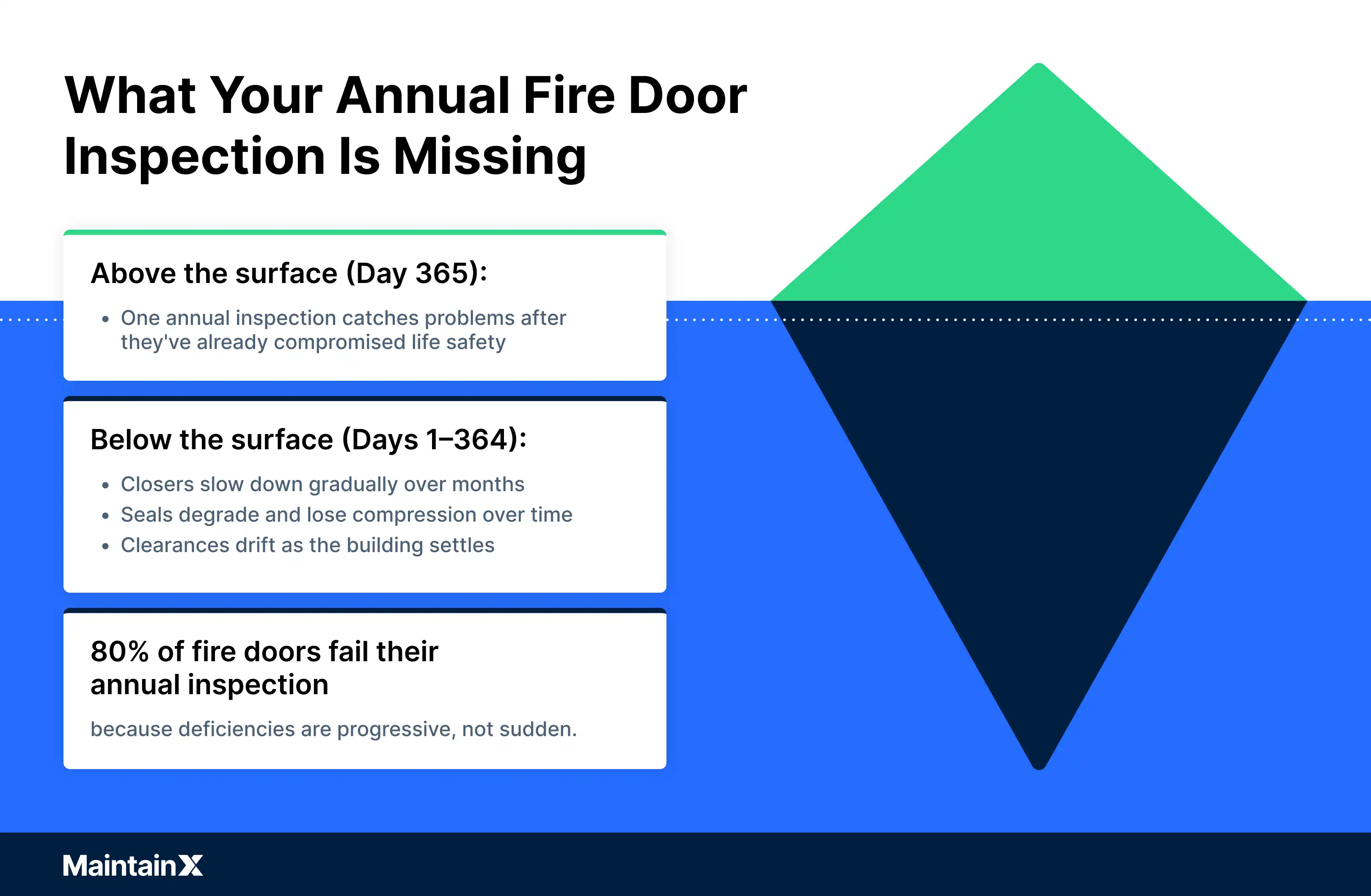
Why 80% of fire doors fail annual inspections
Most fire door failures stem from everyday wear rather than catastrophic damage. Gaps that exceed clearance tolerances, missing or broken parts in hinges, painted-over labels, and disabled self-closing device function account for the bulk of identified issues.
These problems rarely appear overnight. They develop over months of daily use, propped-open doors, and deferred maintenance. Facilities that treat fire door inspection requirements as an annual event tend to discover a backlog of issues too large to remediate before an inspector's deadline.
A year-round inspection cadence with more frequent checks catches these small problems early, when a single work order can resolve them. Waiting 12 months turns a minor hinge adjustment into a failed inspection, an emergency repair ticket, and a compliance gap that auditors flag during surveys.
Build a fire door deficiency reporting workflow
Finding a deficiency is only half the job. Without a clear path from discovery to remediation, deficiencies sit in limbo, and compliance gaps widen.
Effective reporting workflows typically follow a consistent sequence. The inspector documents the deficiency, whether it's an open hole in a door face, damaged glazing, or hardware not securely fastened, with a photo and description. A work order generates immediately, and a technician receives a prioritized assignment. The completed repair then triggers a re-verification inspection. Each step gets a timestamp and an owner, giving the responsible person at your facility a clear record to point to later.
Priority levels matter here. A missing door label needs attention, but a broken self-closing device compromises fire safety and demands same-day action. Sorting deficiencies by severity helps teams allocate resources without treating every finding as equally urgent.
The documentation chain from this workflow is what survives a survey. Auditors want to see when each deficiency was found, who fixed it, and when someone confirmed the repair, since ensuring compliance depends as much on the paper trail as the physical fix.
This information is for general reference only and does not constitute legal or compliance advice. Consult applicable regulations and a qualified professional to confirm requirements for your facility.
The three-tier fire door maintenance cadence
Spreading inspections across the year makes large door inventories manageable. A three-tier cadence breaks the work into monthly, quarterly, and annual cycles, and it's one of the more reliable ways to ensure ongoing compliance with fire safety regulations without overloading any single week.
Monthly visual rounds cover the basics: doors close and latch, no visible damage to frames or hardware, and no obstructions or propping devices blocking swinging doors from operating as designed. These rounds take minutes per door and catch problems early.
Quarterly functional checks go deeper. Inspectors verify self-closing speed, gasket and edge seal integrity, and hinge alignment. They also confirm that previous deficiency repairs held up under daily use.
The formal annual NFPA 80 inspection then becomes a confirmation exercise rather than a discovery event. The earlier tiers have already identified and resolved most issues, which is exactly what a thorough inspection process should build toward.
Organizing doors by zone or risk level helps teams rotate through large inventories without overwhelming any single maintenance window, and it gives facility managers a clearer sense of which high-traffic areas need the closest attention.
Why a CMMS makes fire door compliance easier to maintain
MaintainX ties each door's asset record to its full documentation chain. Inspection results, deficiency photos, work orders, and re-verification dates all live in one place. When an auditor asks for proof that door 247-B had its closer replaced and re-inspected, the record is ready.
Automated scheduling also keeps the three-tier cadence on track. Monthly rounds, quarterly functional checks, and annual inspections generate automatically based on each door's last completed date. Teams spend less time managing the calendar and more time actually inspecting fire doors.
See how MaintainX can help simplify fire door inspections and other facility compliance checks. Book a tour today.
Fire door maintenance checklist FAQs
What is the 13-point fire door checklist required by NFPA 80?
NFPA 80 requires annual inspections covering door assembly components: latching hardware, hinges, door and frame condition, clearances, self-closing function, and signage. Each point verifies that the door assembly can contain smoke and fire during a rated event.
This information is for general reference only and does not constitute legal or compliance advice. Consult applicable regulations and a qualified professional to confirm requirements for your facility.
How often do fire doors need to be inspected and maintained in commercial and industrial facilities?
Annual formal inspections meet code minimums, but effective programs include monthly visual checks for obvious damage and quarterly functional tests. High-traffic doors often need more frequent checks since wear accelerates failure risk between annual inspections.
What documentation is required after completing fire door maintenance?
Maintain records for each door showing inspection date, inspector credentials, specific deficiencies found, corrective actions taken, and re-verification dates. Facilities typically keep three years of documentation to show continuous compliance during authority surveys.
Can in-house staff perform fire door inspections, or must you hire certified inspectors?
In-house teams can handle monthly visual rounds and basic maintenance. Annual formal inspections require individuals trained in NFPA 80 requirements. These can be certified third-party inspectors or qualified staff with documented training and competency verification.
What are the most common fire door deficiencies found during facility inspections?
Blocked or propped-open doors, damaged or missing door closers, oversized clearances, broken latches, and missing labels appear most frequently. Paint buildup on edges and disabled self-closing mechanisms also rank among the top compliance failures.
What happens if a fire door fails inspection at your facility?
Document the specific deficiency, generate a work order with remediation timeline, and put temporary protection in place if needed. Re-inspect after repairs to verify code compliance, then update records showing the complete deficiency-to-resolution chain.
Do fire doors in low-traffic or storage areas have the same inspection requirements as high-traffic areas?
Annual inspection requirements remain consistent across all locations. However, facilities often inspect high-traffic doors more frequently since daily use accelerates wear. Storage area doors may show different failure patterns, like rust or seized hardware.

The MaintainX team is made up of maintenance and manufacturing experts. They’re here to share industry knowledge, explain product features, and help workers get more done with MaintainX!




.webp)