
In an ideal world, maintenance is always done on time. But that’s easier said than done in a world where resources and time is limited, and the unexpected is not uncommon. That’s why deferred maintenance is part of the strategy for most teams.
Deferred maintenance usually starts with minor problems like a squeaky machine or a leaky roof that gets deprioritized, intentionally or unintentionally, due to a lack of resources. The longer you defer the tasks, the bigger the problem becomes. If left unchecked, deferred maintenance leads to higher repair costs, increased downtime, disrupted operations, reduced profits and productivity, and greater safety risks.
This article explores the cost of deferred maintenance and the strategies that work to shrink your backlog before it spirals out of control.
Key takeaways
- Deferred maintenance is the practice of postponing necessary maintenance tasks, often due to limited resources like budget, staffing, or time.
- While strategic deferral helps you manage immediate priorities, a growing backlog increases the risk of equipment failure, unplanned downtime, and higher long-term repair costs.
- You can reduce deferred maintenance by auditing your backlog, prioritizing tasks based on asset criticality and risk, and shifting to a proactive maintenance strategy.
- Using a computerized maintenance management system (CMMS) helps you track asset history and performance data, enabling informed decisions on which tasks to prioritize and which can be safely postponed.
What is deferred maintenance?
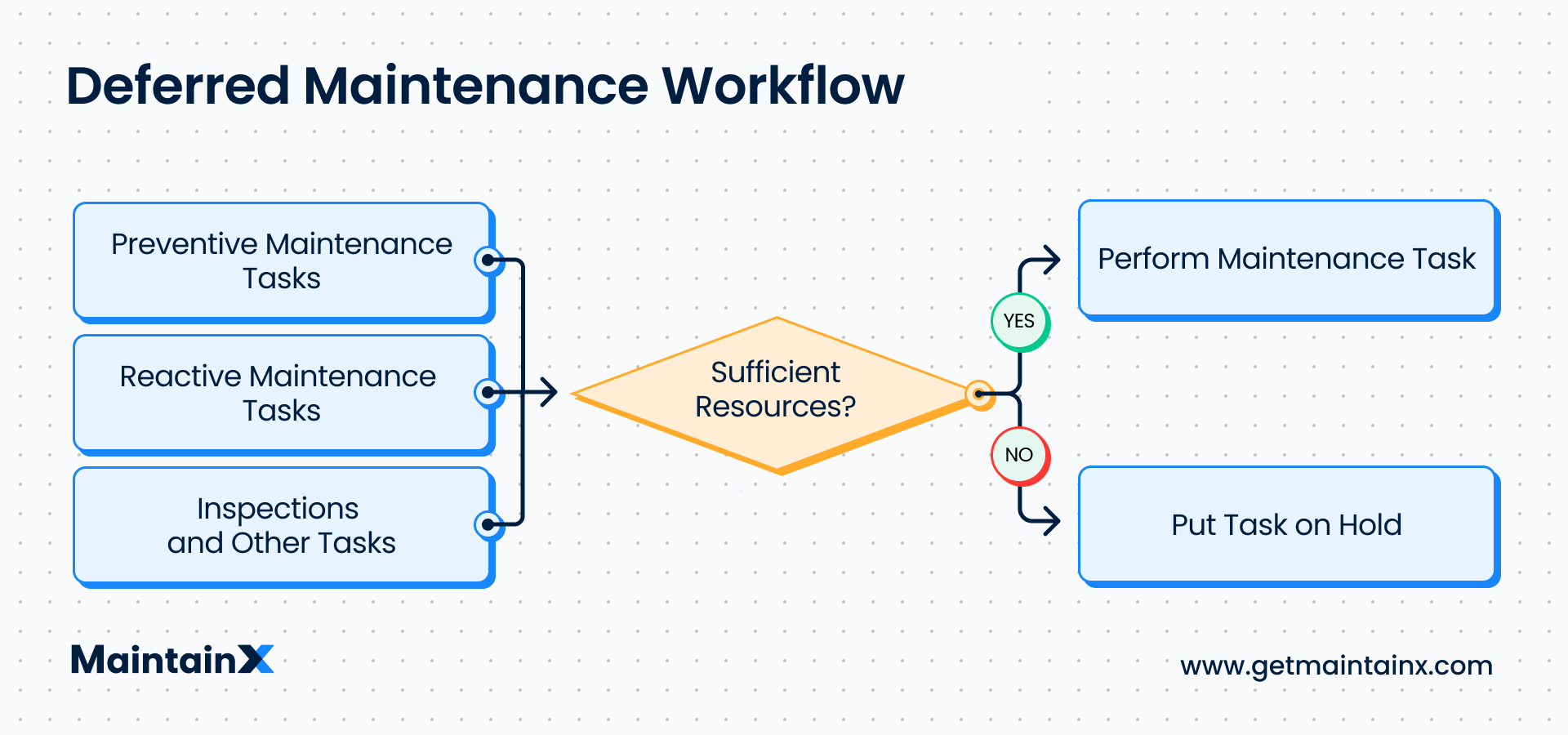
Deferred maintenance refers to maintenance activities that teams delay or postpone because of limited resources like time, workforce, or budget. Think of it as a to-do list of overdue maintenance tasks.
A small maintenance backlog is normal and healthy. But when tasks are postponed too long, deferred maintenance costs can quickly spiral as problems pile on top of one another. These delays increase future costs by driving up operational expenses, accelerating equipment breakdowns, and creating additional safety hazards.
Types of deferred maintenance
Deferred maintenance can be either strategic or unintentional. Both types of deferred maintenance impact an asset's longevity, performance, and reliability. The difference is in the intent of the delay and the approach to addressing the backlog.
Strategic deferred maintenance
Strategic deferred maintenance is deliberate. You are making a calculated decision to prioritize more urgent maintenance tasks over lower-priority ones. You decide to defer maintenance activities to make the most of your budget and staff while keeping operations running smoothly. You're essentially buying time by putting off small or noncritical tasks so critical systems stay up and running.
Unintentional deferred maintenance
Unintentional deferred maintenance results from resource constraints: budget limitations, emergencies, and a failure to keep up with the maintenance schedule. Most of these factors are beyond your control. Even worse, unintentional deferred maintenance creates a snowball effect. Delayed repairs and maintenance tasks turn into bigger problems that cost more to fix and cause significant disruption.
Common causes of deferred maintenance
There are several reasons why maintenance teams defer maintenance tasks. Some of the most common reasons include:
Resource-related causes
- Budget: Budget constraints often prevent maintenance managers from completing all maintenance tasks. To make the most of available financial resources, you need to make difficult choices. You prioritize tasks with high maintenance criticality and defer less urgent repairs and replacements to later.
- Insufficient staffing or lack of skills: Human resources are limited. Sometimes, you need a larger team to check all the boxes on your maintenance task list. Or, the repairs are too complex for your in-house maintenance team. Third-party contractors help, but they're not always available and are often expensive.
- Lack of maintenance equipment: Companies that don't monitor parts and tool inventories end up putting maintenance work orders on hold when they don't have what they need. This is an easy fix. If your deferred maintenance stems from frequent parts or tool stockouts, use an inventory management system to alert you when inventory levels dip below your specified threshold.
Process and decision-making causes
- Inefficient decision-making: Suppose your company allows you to request more funding for maintenance when necessary. But how fast does an approval come through when you need it? If management takes weeks to approve funding, the pending tasks end up in your deferred maintenance backlog.
- Prioritization: You schedule maintenance tasks based on budget cycles and long-term plans. Or, you optimize resources to keep machines running and not risk your team's health and safety. Consider a manufacturing plant with a critical customer order requiring 72-hour continuous production. A maintenance manager must defer a scheduled bearing replacement on a packaging line until after delivery.
- Unforeseen emergencies: Unforeseen events demand immediate attention and resources. You defer maintenance tasks if the emergency pushes you to move resources from routine maintenance to address an emergency. For example, say a piece of medical equipment critical for patient care malfunctions. Your immediate priority would be patient care and safety.
- Reliance on corrective maintenance: Corrective maintenance involves performing maintenance on an as-needed basis. Without a proactive maintenance plan, you don't have the data or documentation to help identify the issue causing the breakdown. Of course, it's also hard to budget for corrective maintenance. You cannot accurately estimate the cost of maintenance needs.
- Lack of maintenance equipment: Companies that don’t monitor parts and tool inventories can end up putting maintenance work orders on hold when they don’t have what they need. This can be an easy fix. If your deferred maintenance stems from frequent parts or tool stockouts, use an inventory management system to alert you when inventory levels dip below your specified threshold.
Signs of deferred maintenance
You often see the signs of deferred maintenance in assets and across a facility as a whole. Common signs you find in a facility with a considerable deferred maintenance backlog include:
- Unusual noises or odors: A noise from a machine or a foul odor, such as mildew or mold in old filters, indicates the need for routine upkeep.
- Wear and tear: Visible signs of equipment deterioration indicate deferred maintenance. Peeled paint, cracked walls, and rusted surfaces are signs of a growing maintenance backlog.
- Safety hazards: Facilities with a maintenance backlog have faulty lighting, loose tiles, and blocked emergency exits. These risks threaten workers' safety.
- Expensive repairs: Neglecting maintenance issues for long periods leads to increased repair costs. In some cases, neglecting repairs translates to complete failure and requires you to replace the entire asset.
- Non-compliance notices: Failed inspections or non-compliance fines for safety standards or other industry regulations indicate a maintenance backlog.


Advantages of deferred maintenance
Short-term deferred maintenance offers two immediate benefits:
- Meeting immediate maintenance needs: Deferring maintenance allows you to focus on urgent maintenance tasks and to wait on low-criticality tasks.
- Saving costs: Deferring maintenance in the short term saves you money at the time. But, you risk paying more for repairs in the long term when you defer maintenance for too long, and problems get worse.
Short-term deferred maintenance offers limited benefits. When possible, keep up with your maintenance schedule. Deferred maintenance almost always costs your company more in the long run.
Disadvantages and risks of deferred maintenance
Deferring maintenance for too long has many disadvantages, including:
- Expensive repairs: Deferring maintenance for too long worsens minor issues.
- Increased energy consumption: Poorly maintained assets, like heating, ventilation, and air conditioning or insulation systems, use more energy and increase your energy bill.
- Reduced asset lifespan: Poor upkeep reduces the useful life of assets. This results in needing to replace them prematurely, translating to long-term higher costs.
- Safety hazards: Not fixing a broken window or replacing a conveyor belt poses safety risks for workers on the shop floor.
- Non-compliance: Failing to comply with maintenance requirements and industry regulations leads to non-compliance fines, penalties, and loss of reputation.
Examples of deferred maintenance
Deferred maintenance isn't specific to assets. Delaying maintenance on roof repairs, parking lots, and other parts of a building's infrastructure also adds to your deferred maintenance task list. Let's examine some common examples of deferred maintenance in various industries.
Deferred maintenance in manufacturing plants
Deferred maintenance in manufacturing plants leads to subpar production quality and increased equipment downtime. Malfunctioning equipment leads to incorrect alignment and loose components, resulting in quality issues.
Rework and waste are expensive. The loss of reputation is even more costly.
Suppose you manufacture bearings and have a deferred maintenance problem. Here are the consequences you may face:
- Deviation from tolerances: Deferred maintenance results in deviations from specified tolerances and dimensions in bearings. Such deviations lead to inaccurate sizes and shapes of bearings.
- Poor surface finish: Worn-out tooling and inadequate lubrication result in poor surface finish. This adversely impacts the bearings' functionality and durability.
- Contamination of material: Ignoring required maintenance on filtration systems leads to material contamination, compromising the integrity of the manufactured units.
Deferred maintenance in property maintenance
Maintenance backlogs in real estate and property management are apparent in faulty electrical systems, dysfunctional heating, ventilation, and air conditioning units, and plumbing issues. These problems ruin a tenant's experience and lead to safety hazards.
But that's not all. Inadequate maintenance is bad for your brand image and bottom line. You'll also spend more on increased energy use and operational inefficiency, not to mention fines and closures.
Deferred maintenance in education
For years, public-sector schools in the U.S. have been asking for more funding to clear their maintenance backlogs. Postponing maintenance and repairs year after year has led to increased safety hazards like water leaks and structural issues.
How to decrease deferred maintenance
There are ways to manage deferred maintenance before your backlog gets out of hand. Here's what you can do to decrease deferred maintenance:
Step 1: Audit your maintenance needs
Run a maintenance audit to identify current problems in your maintenance approach. You can break the audit down by root cause and the return on investment (ROI)—the financial benefit compared to the cost—of solving each problem.
To decrease deferred maintenance, you need to know what's causing it. This is where an audit helps.
Do you need more funding for maintenance? Do you need more skilled maintenance personnel? Or do you just need a better regular maintenance plan?
Step 2: Prioritize maintenance tasks with a high ROI
Order the tasks in your deferred maintenance task list based on ROI. Compare the cost of not completing the maintenance tasks on your to-do list with the cost of performing maintenance.
For example, the cost of equipment failure due to lack of lubrication is much greater than that of lubricating your equipment. The higher the difference between the cost of performing and not performing a maintenance task, the higher the ROI. Calculate the difference for all tasks in the backlog and prioritize completing tasks with the highest ROI first.
Step 3: Transition to proactive maintenance
Transition to proactive maintenance to prevent the maintenance backlog from growing. Plan your resources, like funding, spare parts, and staffing, to keep up with your preventive maintenance program.
The better the plan, the lower your risk of emergencies. Automate your maintenance schedule with a CMMS to eliminate manual scheduling bottlenecks.
Step 4: Adapt and optimize
No preventive maintenance program is perfect. Keep looking to improve your workflow and adjust your program as you go.
If you use a CMMS, monitor work order histories to see if you can optimize resources using maintenance checklists. CMMS gives you an overview of essential data—maintenance history, performance metrics, and even predictive analytics. This visibility helps you make data-driven decisions to optimize your preventive maintenance strategy.
Suppose you've installed a thermometer on one of your machines. Technicians collect the data in standard operating procedures (SOPs) stored in your CMMS. The system triggers work orders when the data is out of bounds. These triggers allow you to adjust maintenance frequency and manage resources more effectively.
Take control of deferred maintenance with MaintainX
Deferred maintenance is a reality for every industrial operation, but it doesn't have to control your production schedule or drain your budget.
MaintainX is built specifically for maintenance professionals in asset-intensive industries who need to prevent unexpected downtime. The mobile-first platform helps you identify problems before they become emergencies, enabling planned maintenance instead of reactive repairs.
Ready to reduce your deferred maintenance backlog? Sign Up for Free and start streamlining your maintenance workflows today. Your equipment—and your production schedule—will thank you.
Deferred maintenance FAQs
What are the risks of deferred maintenance?
Deferred maintenance poses several risks, including:
- Increased operating costs
- System failures
- Expensive repairs
- Reduced equipment efficiency
- Health and safety risks
- Shorter useful lifecycles of assets
What are the causes of deferred maintenance?
Causes of deferred maintenance can include:
- Staffing shortages
- Emergencies
- Budget constraints
- Not implementing preventive maintenance
- Lack of asset management and spare parts inventory
When should you defer maintenance?
Deferring maintenance makes sense in some cases. For example, when you’re working on an important order, you can’t pause production to perform routine maintenance. Another case where deferring maintenance makes sense is when you have a limited maintenance budget. You should prioritize high-ROI maintenance tasks and defer the remaining tasks to the next budget cycle.
What does deferred maintenance mean for manufacturing facilities?
In manufacturing facilities, deferred maintenance refers to postponed repair, service, or inspection tasks for production-critical equipment like conveyor systems, motors, and process machinery. For plant managers and maintenance directors, even a 2% increase in deferred maintenance translates to 15–20% more unplanned downtime incidents.
What are common examples of deferred maintenance in manufacturing operations?
Common examples in manufacturing include delaying the replacement of worn conveyor belts, postponing the lubrication of machine bearings, not recalibrating precision instruments, or putting off repairs for a leaking hydraulic line. Each of these escalates from a minor issue into a major cause of unplanned downtime.
How should maintenance teams prioritize deferred maintenance backlogs?
Your maintenance team should prioritize the backlog using a risk-based approach. Start by identifying tasks that pose the greatest safety risk or have the highest potential to cause costly production downtime. Use a criticality analysis to rank assets and focus on high-priority equipment first, ensuring you apply your limited resources where they have the most impact.
What is the difference between strategic and involuntary deferred maintenance?
Strategic deferred maintenance is a conscious, calculated decision to postpone low-priority tasks to focus resources on more critical repairs. In contrast, involuntary deferred maintenance is an unplanned delay caused by unexpected events like budget cuts, emergencies, or a lack of skilled technicians, which often leads to a reactive and inefficient maintenance cycle.

Caroline Eisner is a writer and editor with experience across the profit and nonprofit sectors, government, education, and financial organizations. She has held leadership positions in K16 institutions and has led large-scale digital projects, interactive websites, and a business writing consultancy.
.webp)