
Public parks absorb heavy daily use across playgrounds, trails, restrooms, and athletic fields. The wear adds up fast. A structured park maintenance checklist gives maintenance staff a consistent framework for catching safety hazards before they injure visitors, while also documenting inspections for liability protection and compliance.
Key takeaways
- Playgrounds, trails, and athletic fields each carry different hazards and compliance requirements. A zone-based checklist helps park maintenance staff focus on each area's distinct risks rather than working through a one-size-fits-all task list.
- Daily walkthroughs catch obvious hazards. Monthly operational checks find the slower-developing problems: worn playground hardware, irrigation failures, and structural deterioration in shelter structures. Both tiers matter, and neither replaces the other.
- Paper logs can technically track park inspections, but they make it hard to prove consistent follow-through when a liability claim surfaces months later. A computerized maintenance management system (CMMS) creates searchable, timestamped records that hold up under legal scrutiny.
How to use this checklist
Customize for your facility
Parks vary widely in size, amenities, and visitor capacity. This checklist is meant to be a general guideline that can be adapted to your needs. Review each category and adjust inspection frequencies accordingly.
Use a CMMS
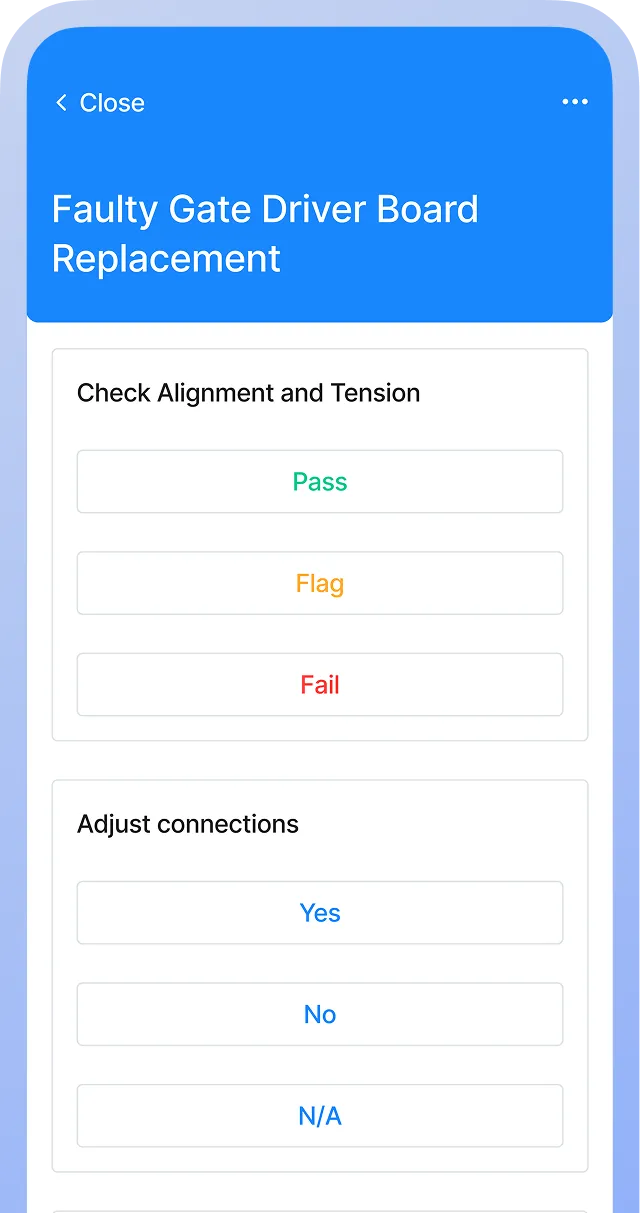
Digital maintenance management reduces paperwork and tracks compliance automatically. Using this checklist with a mobile-friendly CMMS lets you schedule recurring inspections, assign tasks to park maintenance workers and crew members, and maintain audit trails for regulatory review. Staff can complete checklists on mobile devices while in the field and attach photos directly to work orders.


Park maintenance checklist
Grounds and landscaping
Playground equipment and surfacing
Sports and recreation facilities
Pathways, trails, and access points
Park structures and amenities
Utilities and infrastructure
Safety and worker protection
Documentation and compliance
This checklist is to be used only by those with appropriate training, expertise, and professional judgment. You are solely responsible for reviewing this checklist to ensure that it meets all professional standards and legal requirements, as well as your needs and intent.
Daily vs. monthly vs. annual park inspection frequencies
Not every park feature needs the same level of attention on the same maintenance schedule.
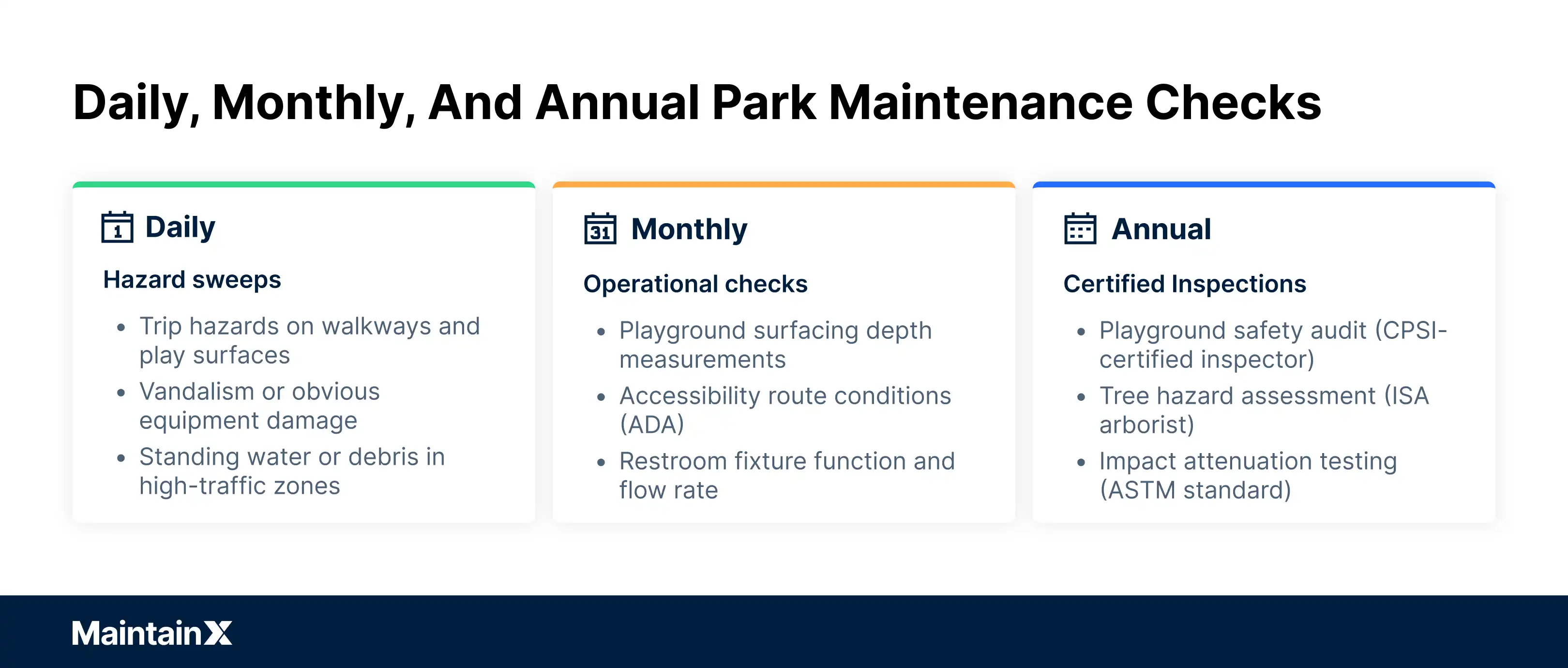
Daily visual sweeps should cover high-traffic zones like playgrounds and restrooms. These quick walkthroughs catch obvious safety hazards: broken glass, graffiti removal needs, vandalism, broken amenities, or standing water near play surfaces. Maintenance workers completing daily rounds should also handle litter removal and debris removal to keep parks safe and welcoming.
Monthly operational checks should go deeper. Maintenance supervisors and technicians examine moving parts on playground equipment, test sprinkler and irrigation systems, assess trail erosion, check picnic tables and picnic shelters for damage, and verify that drainage infrastructure functions correctly. Weed control, dead plants, and pest management issues that accumulated since the last cycle should also be addressed at this tier.
Annual audits typically involve certified inspectors evaluating playground equipment against ASTM F1487 and CPSC guidelines, checking ADA compliance across all zones, and reviewing structural integrity of shelter structures and bridges. Landscape professionals may assist with plant identification, fertilization services, and assessment of trees requiring pruning.
Why park maintenance documentation establishes your standard of care
When an injury occurs in a public park, the first question in litigation is whether the municipality met its standard of care. The answer almost always comes down to documentation.
Timestamped inspection records with attributable sign-offs show that park maintenance staff actively monitored conditions and addressed safety hazards. Without them, a legal team has little evidence to prove reasonable diligence.
Effective documentation goes beyond checking boxes. It captures the condition found, the corrective action taken, and the timeline for resolution. If playground equipment showed wear during a monthly check and the team completed repairs within 48 hours, that paper trail becomes a powerful defense.
In short, courts don't just want proof that regular inspections happened. They want proof they happened consistently, on schedule, and with follow-through.
Note: This is a general informational summary only and does not constitute legal advice. Standards of care, liability exposure, and documentation requirements vary by jurisdiction, facility type, and circumstances. Always consult a qualified legal professional to determine the specific obligations applicable to your municipality, organization, and park facilities.
Best practices for assigning park maintenance tasks
Daily visual sweeps, including trash removal, litter removal, and debris removal, work well for general park maintenance workers already moving through the park. Monthly operational checks covering park equipment, irrigation systems, and drainage infrastructure often require technicians with more specialized knowledge. Annual audits may call for certified playground safety inspectors or third-party landscape professionals.
Maintenance supervisors should also consider workload balance and geographic routing. Assigning a single technician to inspect scattered zones across a large park wastes time. Grouping park maintenance tasks by zone and shift keeps inspections efficient and ensures all park facilities receive consistent attention.
Whoever receives a task should also have authority to flag urgent issues for immediate action rather than waiting for the next scheduled review cycle.
Why use a CMMS for park maintenance?
Paper logs and spreadsheets can technically track park maintenance activities, but they create gaps that grow more costly over time. MaintainX centralizes inspection records, work orders, and corrective actions in one searchable system.
For park maintenance teams, the practical benefits are immediate. Photo attachments document conditions at the time of inspection, from graffiti removal needs to broken amenities. Automated timestamps and user attribution build the defensible records that municipalities need for liability protection.
All of that, ultimately, translates to a safer, more enjoyable experience for park guests.
Book a tour to see the benefits of using MaintainX for park maintenance.
Park maintenance checklist FAQs
What should a park maintenance checklist include?
A complete park maintenance checklist should organize tasks by zone and inspection frequency:
- Daily maintenance activities: Remove litter and trash, clear debris from pathways and play areas, remove graffiti, visually inspect playground equipment and park furniture, including picnic tables, check parking lot conditions for safety hazards, and verify restroom cleanliness, including mopping floors and restocking supplies
- Weekly checks: Mow grass and control weeds in turf areas, inspect trails and athletic fields for erosion or damage, check security cameras and surveillance equipment, and inspect picnic shelters and shelter structures for damage or vandalism.
- Monthly maintenance tasks: Test sprinkler and irrigation systems, inspect park equipment moving parts, assess dead plants and complete fertilization services where needed, prune trees near pathways and play areas, and verify HVAC systems in park buildings are functioning correctly.
- Annual inspections: Complete a full playground safety audit against CPSC and ASTM standards, do an ADA compliance review across all park facilities, assess the structural integrity of shelter structures and bridges, and review pest management and pesticide and fertilization services programs.
Consistent regular inspections across these tiers keep parks safe, ensure compliance with local authorities' requirements, and build the documentation trail that protects municipalities in liability situations.
How often should teams conduct park maintenance inspections?
Inspection frequency varies by zone and risk level. High-traffic playgrounds typically require daily visual sweeps, while trails and athletic fields need weekly checks. Full equipment inspections occur monthly, with annual audits verifying structural integrity and compliance standards. Park maintenance staff in high-use urban parks may need to increase these frequencies during peak seasons.
What are the essential components of a park maintenance checklist?
Effective checklists organize park maintenance tasks by zone: playgrounds, trails, athletic fields, restrooms, grounds, and drainage. Each area lists its specific safety hazards and compliance requirements. Every item should specify inspection frequency, the responsible park maintenance workers or maintenance supervisors, and the regulatory standard it addresses.
What CPSC and ADA compliance requirements apply to municipal park maintenance?
Two regulatory frameworks shape most municipal park maintenance programs.
CPSC Publication 325 establishes critical safety zones, fall surface depth requirements, and entrapment hazard specifications for playground equipment. Parks must maintain equipment spacing, verify surfacing impact attenuation, and document regular inspections to demonstrate standard of care in liability situations.
ADA Title II requires accessible routes throughout public parks. Park maintenance staff should verify path surfaces remain firm and stable, clear obstructions from accessible parking lot areas to amenities, ensure restroom grab bars are secure, and document any barriers that require remediation. Regular inspections of accessible routes should be part of every monthly maintenance checklist cycle.
Note: This is a general informational summary only and does not constitute legal, regulatory, or compliance advice. Requirements vary by jurisdiction and facility type. Always consult applicable CPSC, ADA, and OSHA standards, your local authorities' regulations, and a qualified professional to determine the specific inspection and documentation requirements for your park facilities.
What preventive maintenance tasks should teams prioritize for park equipment?
Prioritize park maintenance tasks that prevent injuries and meet regulatory standards. Inspect playground fall surfaces and equipment anchoring weekly, verify swing chains and moving parts monthly, and test structural integrity annually. Maintenance supervisors should ensure documentation of all preventive measures, as this proves due diligence when incidents occur.
How do seasonal changes affect park maintenance checklist priorities?
Winter demands ice removal and shelter structure inspections, while spring requires drainage checks and irrigation systems startup. Summer prioritizes hydration stations and shade structures, along with more frequent mowing and weed control. Fall focuses on leaf management, planting flowers for seasonal color, and winterization of sprinkler and irrigation systems. Each season shifts park maintenance activities across different zones and park facilities.

Marc Cousineau is the Senior Content Marketing Manager at MaintainX. Marc has over a decade of experience telling stories for technology brands, including more than five years writing about the maintenance and asset management industry.


.webp)