The medical equipment records that cause trouble in a survey usually belong to devices that fell outside the PM schedule. This could be a rental ventilator that went straight to the ICU without an incoming inspection or an infusion pump back from depot repair with no post-repair test.
A medical device inspection checklist is one way to help you spot those gaps before a surveyor does. It sets the physical, electrical safety, and performance checks your team runs on each device, both on a risk-based schedule and after events like repairs, arrivals, and recalls. When every inspection is documented the same way, one record can answer The Joint Commission (TJC), Centers for Medicare & Medicaid Services (CMS), and NFPA 99 Health Care Facilities Code requirements together.
Key takeaways
- One well-documented medical device inspection can satisfy TJC, CMS, and NFPA 99 requirements at once, so separate compliance workflows for each agency are rarely necessary.
- TJC and CMS surveyors review the full record behind a medical device inspection, including technician attribution, timestamped findings, and tracked corrective actions.
- Medical device inspection intervals follow manufacturer recommendations by default, and lower-risk devices can move to longer intervals only under a documented alternative equipment maintenance (AEM) program.
- A CMMS schedules medical device inspections by risk tier and keeps each device’s inspection and repair history ready for surveyors.
How to use this checklist
Customize for your facility
You can adapt this checklist to any device program in your facility. Inspection intervals play a critical role in patient safety, so start by sorting your medical equipment into risk tiers, such as life-support equipment, diagnostic imaging, and low-risk devices like exam scales and thermometers. Then match each step of your inspection process to the device’s service manual and your inspection intervals.
To avoid overly long checklists, remove sections that don’t apply, like electrical safety testing for non-powered devices, and add device-specific steps where you need them. Procedure templates for vital signs and patient monitors and X-ray equipment are good starting points.
Finally, add steps for the standards your organization follows, including TJC, CMS, and FDA regulatory requirements, and document the rationale for any AEM intervals.
Use a CMMS
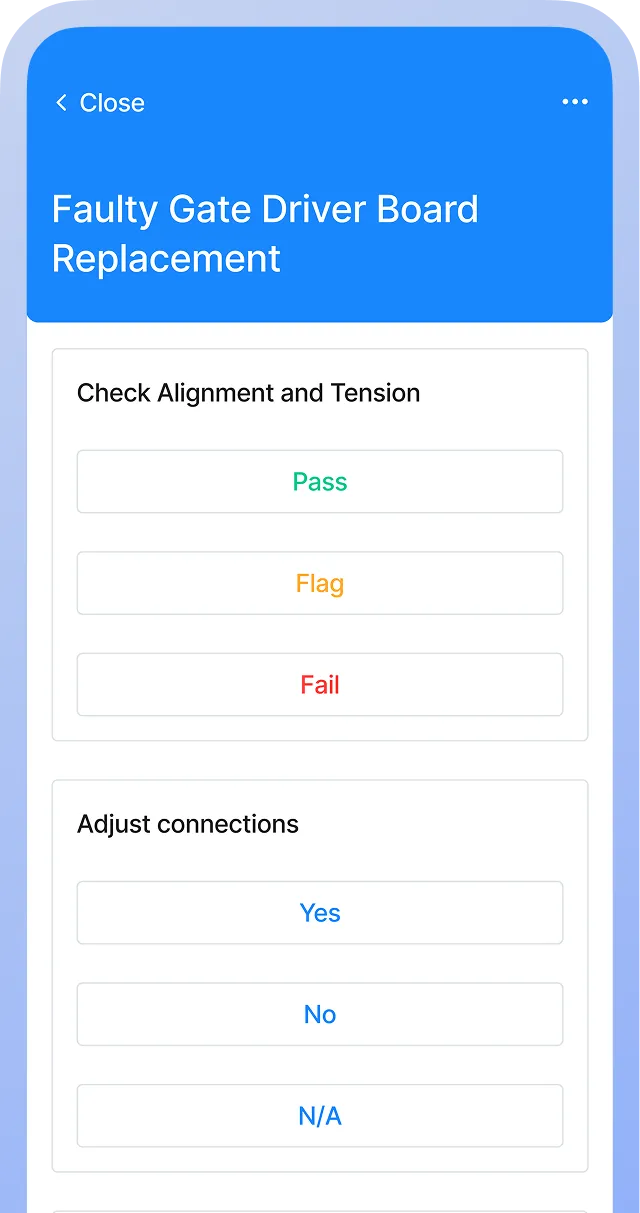
A computerized maintenance management system (CMMS) turns this checklist into a repeatable digital workflow. Your team can assign inspections to each device by serial number, schedule recurring work orders, and attach test results and photos. Plus, every inspection, failed test, and repair stays in a time-stamped device history, which gives you an audit trail ready for surveyors and regulators.


Medical device inspection checklist
Preparation
Physical inspection
Electrical safety testing
Performance testing
Accessories
Incoming and event-driven inspections
Failed devices and repairs
Documentation and compliance
This checklist is to be used only by those with appropriate training, expertise, and professional judgment. You are solely responsible for reviewing this checklist to ensure that it meets all professional standards and legal requirements, as well as your needs and intent.
When should you inspect a medical device outside the PM schedule?
Inspect a device before patient use whenever it arrives new or on loan, comes back from repair, takes a drop or spill, gets a software or firmware update, or falls under a recall. These five events change its condition between scheduled dates, so the last inspection record no longer reflects device performance at the point of patient care. NFPA 99, which CMS adopted in its 2012 edition, requires electrical safety testing of patient-care equipment before it goes into service and after any repair or modification.
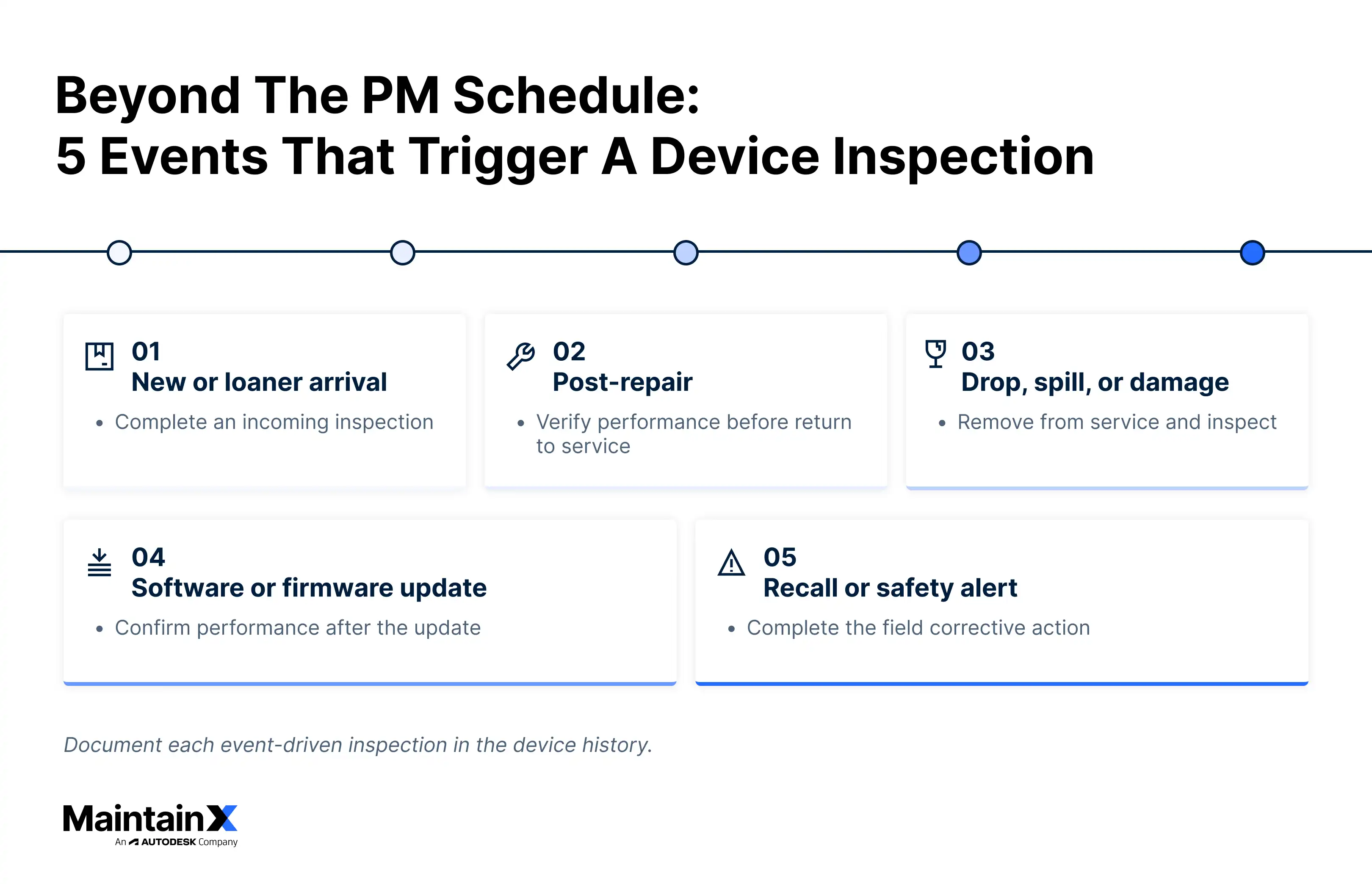
Here’s what to check after each event:
- New or loaner arrival: Complete an incoming inspection and add the device to your inventory before it reaches a unit. A loaner that skips biomed has no baseline, so your team can’t tell later whether a fault came with it.
- Post-repair: Confirm the original fault is resolved and verify performance with electrical safety and functional testing before the device returns to service. Outside service reports go into the device history, but your team still runs its own verification.
- Drop, spill, or damage: Remove the device from service and inspect it, even when there’s no visible damage. Fluid that gets into an infusion pump’s housing can corrode a connector weeks after the outside has been wiped clean.
- Software or firmware update: Confirm performance after the update, including alarm settings, since an update can change the defaults clinicians rely on.
- Recall or safety alert: Complete the manufacturer’s field corrective action and record it against each affected serial number.
Keep comprehensive documentation of each event-driven inspection in the device history. That timestamped record gives your team one piece of evidence that covers several agencies’ requirements.
What should you do when a medical device fails inspection?
When a medical device fails inspection, remove it from service, open a work order linked to the inspection record, and keep the device out of service until that work order closes with a passing post-repair test. Surveyors from TJC, CMS, and state agencies audit that whole chain: what was found, who found it, when the device came out of service, what was done, and when it returned to safe operation.
To give every finding traceability from discovery to return to service, follow these steps:
- Tag and sequester: Remove the device from service at the point of discovery, tag it, and tell the clinical department so nobody swaps it in for other devices on the floor.
- Attribute and timestamp: Record the technician, the reading, and the acceptance limit it missed.
- Link the work order: Open the corrective work order from the inspection itself, so the finding, the follow-up, and the fix share one history.
- Retest and release: Close the work order only after post-repair testing passes, then log the return to service.
Linked records also show you patterns a single failure hides. If three patient monitors on the same unit fail enclosure leakage on the same cord type within a month, treat it as one root cause to investigate and a preventive action to take. Your quality control and quality assurance processes depend on that kind of data collection.
How do you set risk-based inspection intervals for medical devices?
Set each device’s inspection interval by risk: Follow the manufacturer’s recommendation by default, and change it only through a documented AEM program. CMS’s S&C 14-07 memo allows a different interval when qualified staff decide, based on a risk assessment, that it’s safe.
Risk depends partly on where a device is used. CMS’s own example is a slightly miscalibrated scale, which is a minor issue in an adult outpatient clinic and a serious one in a NICU. In practice, the tiers usually sort out like this:
- High-risk and life-support equipment: TJC requires you to inspect, test, and maintain all of it. CMS allows it in an AEM program, and surveyors review that equipment most closely.
- Imaging, radiologic equipment, and medical lasers: These aren’t eligible for AEM, so keep them on the manufacturer’s schedule.
- New equipment: Follow the manufacturer’s schedule until you have enough maintenance history to support a risk-based decision.
- Lower-risk equipment with clean histories: These are the strongest candidates for longer intervals under AEM.
For every AEM decision, document how you scored the device, who made the call and what qualifies them, and why the interval is safe.
Why use a CMMS for medical device inspections?
A CMMS keeps every inspection, finding, and repair in one device history, so a single record can answer TJC, CMS, and NFPA 99 requirements without duplicate compliance workflows. MaintainX captures technician identity, timestamps, readings, and photos with each inspection, and links maintenance actions directly to the inspection that found the problem, so your quality records stay complete.
Risk-based scheduling gets easier to manage, too. Your team can set inspection frequencies by device tier, trigger event-driven inspections when a device returns from repair or arrives on loan, and flag overdue devices before they become survey findings. When surveyors arrive, you can pull a complete device history in seconds instead of assembling paper service reports from several binders.
Book a tour with MaintainX to see how a modern CMMS handles digital inspection checklists, risk-based schedules, and linked corrective work orders for every device.
Medical device inspection checklist FAQs
What does the FDA check during an inspection of medical devices in hospitals?
The U.S. Food and Drug Administration doesn’t survey hospital equipment programs the way TJC and CMS do, so an FDA inspection of a hospital centers on user facility reporting under 21 CFR Part 803, known as Medical Device Reporting (MDR). Hospitals must report device-related deaths to the FDA and the manufacturer, report serious injuries to the manufacturer, and file an annual summary with the FDA. Keep clear records of how device failures are identified, investigated, and reported. The FDA’s Quality Management System Regulation (QMSR) under 21 CFR Part 820, which replaced the Quality System Regulation and incorporates ISO 13485:2016, is a different set of rules: It governs the quality management system (QMS) medical device manufacturers use, from incoming materials to final product inspections.
This information is for informational purposes only and does not constitute compliance or legal advice. Confirm the reporting requirements that apply to your hospital with the FDA, your device manufacturers, and your compliance or legal team.
Who is qualified to perform medical device inspections in hospitals?
Biomedical equipment technicians, clinical engineers, and manufacturer-certified service staff usually perform medical device inspections. Qualification rests on documented training and competency for each device type. Surveyors expect technician attribution on every record, and CMS requires records of the qualifications of anyone making AEM decisions.
What documentation must be retained for medical device inspections?
Retain the equipment inventory, inspection and maintenance records, technician names, timestamped findings, and corrective actions. Include recall responses, incident reports, and your AEM risk assessments, since TJC and CMS surveyors each look for different pieces of the chain of evidence.
What should be included in a medical device inspection checklist?
A medical device inspection checklist should include device identification, physical inspection, electrical safety testing, performance and functional testing, accessory checks, and event-driven inspections. Add technician sign-off, timestamps, pass/fail results, and corrective-action tracking so each item doubles as proof for TJC, CMS, and NFPA 99 requirements. Review the manufacturer’s maintenance instructions and any state or accreditor requirements that apply to your hospital for additional items to add to your checklist.
What is the difference between preventive maintenance and inspection for medical devices?
Inspection verifies that a device is safe and working now, while preventive maintenance is scheduled servicing, such as part replacement or calibration, that prevents future critical failures. Many programs combine them in one visit, but document each so surveyors can see both were done.

Marc Cousineau is the Senior Content Marketing Manager at MaintainX. Marc has over a decade of experience telling stories for technology brands, including more than five years writing about the maintenance and asset management industry.