

Not all maintenance tasks are created equal. In industrial facilities, some regular maintenance items are cosmetic and lower risk. Some are not. Failure to complete certain critical tasks can endanger the safety of facility workers or lead to other severe consequences.
For this reason, routine industrial maintenance requires a structured, systematic approach. The maintenance checklist on this page can help ensure critical tasks are completed, while building an audit trail that proves due diligence during inspections, insurance claims, and regulatory reviews.
Key takeaways
- Categorizing inspection tasks by consequence (life-safety, compliance-required, asset-protective) helps teams prioritize effectively, and prevent violations.
- Proactive facility maintenance can prevent small issues from cascading into major repairs and system failures.
- Storing maintenance checklists in a computerized maintenance management system (CMMS) creates audit trails that show due diligence during inspections, insurance claims, and regulatory reviews.
How to use this checklist
Customize for your facility
This maintenance checklist provides a useful starting point for most industrial facilities. But every operation is different. You'll want to adjust inspection frequencies for key preventive maintenance tasks based on your equipment age, production environment, and local regulations.
For instance, manufacturing plants with heavy machinery typically require more frequent mechanical inspections, while warehouses may emphasize building envelope and loading dock items.
Use a CMMS
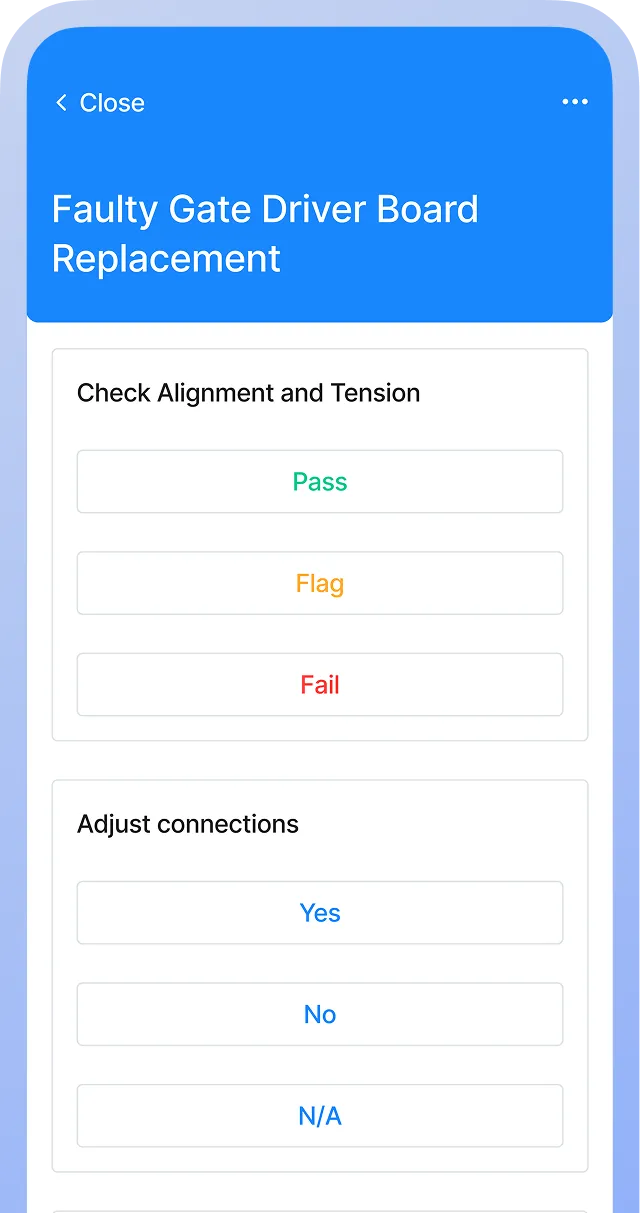
Upload this digital maintenance checklist to a CMMS to simplify completion tracking and create automatic audit trails. With a CMMS, technicians can complete inspections on mobile devices, attach photos of deficiencies, and trigger work orders for repairs without returning to an office, all of which streamlines maintenance and tracking workflows.
Over time, a CMMS becomes a single source of truth for historical maintenance data, making it easier to spot recurring issues and other trends.


Maintenance checklist
Building envelope and structure
Mechanical and HVAC systems
Plumbing and water systems
Electrical and lighting
Life safety and fire protection
Common areas, offices, and amenities
Site, grounds, and parking
Documentation and compliance
This checklist is to be used only by those with appropriate training, expertise, and professional judgment. You are solely responsible for reviewing this checklist to ensure that it meets all professional standards and legal requirements, as well as your needs and intent.
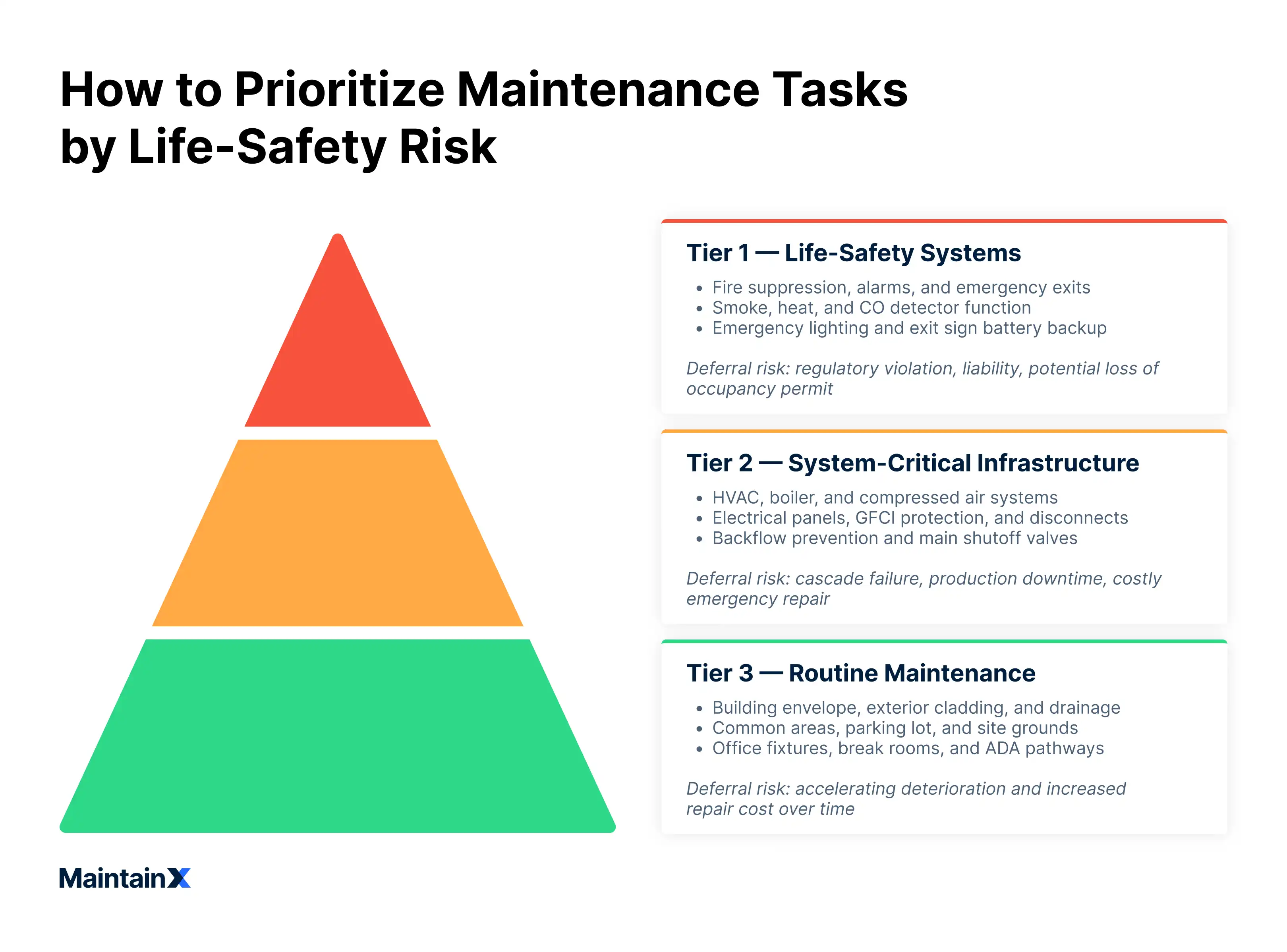
How to prioritize preventive maintenance tasks by life-safety risk
Some maintenance tasks carry more risk than others. Experienced facility managers distinguish between necessary repairs and longer-term maintenance priorities by grouping issues into four tiers based on consequence severity:
- Life-safety critical: This category includes any item where failure can lead to injuries or fatalities, including fire suppression systems, emergency exits, electrical hazards, and fall protection equipment.
- Compliance-required: This category includes EPA discharge limits, NFPA inspections (particularly NFPA 25 and NFPA 72 standards), and OSHA-mandated equipment checks.
- Asset-protective: This category includes security systems, HVAC filter changes, storm windows, roof drainage, and bearing lubrication.
- Cosmetic or low-risk: This category includes paint touch-ups, landscaping, and minor fixture replacements.
When resources are tight, this framework can help teams direct resources toward tasks that prevent injuries, regulatory violations, and catastrophic equipment loss first.
This prioritization framework also provides a framework to help technicians escalate tasks that would otherwise seem routine. A clogged roof drain that feeds into a fire suppression riser room jumps from tier three to tier one, for instance.
How deferred maintenance creates cascading system failures
Industrial building systems are deeply interdependent, which means that one deferred maintenance task can quietly (and quickly) generate three new problems. For example, a skipped condenser coil cleaning may raise discharge pressure, which strains the compressor, shortens its service life, and spikes energy costs.
Roofing issues also cascade, though often at a slower pace, making the long-term effects less visible. Postponing air filter replacement or membrane repairs allows moisture into insulation, which degrades deck fasteners, which compromises structural load ratings. By the time the leak reaches the warehouse floor, the repair scope has grown by an order of magnitude.
The ripple effects of deferred maintenance are one reason why $1 spent on preventive maintenance can avoid $5 or more in reactive costs.
Documentation requirements: Building an audit-ready maintenance record
Completed, time-stamped preventive maintenance checklists and inspections are an organization's primary defense during OSHA investigations, insurance claims, and litigation.
Effective maintenance records typically capture:
- Who performed the task
- When it occurred
- What was found
- What corrective action followed
Timestamped photos, technician signatures, and linked work orders stored within a maintenance checklist further strengthen that record, especially when regulatory bodies like NFPA and EPA require evidence of completed inspections.
The goal is a maintenance trail that proves due diligence without scrambling, whether the audience is an auditor, an adjuster, or an attorney.
Why industrial and warehouse facilities choose MaintainX
Paper maintenance checklists and spreadsheets can track tasks in the moment, but they rarely hold up under the scrutiny of an audit. Regulators and insurers often notice gaps like missing signatures, lost forms, and inconsistent formatting, and they can penalize your facility as a result.
MaintainX replaces a fragile or incomplete paper trail with timestamped, photo-verified digital records tied to specific assets and locations. Maintenance teams can assign risk tiers to work orders and attach regulatory references to recurring tasks. When an auditor walks through the door, the team can pull inspection histories that prove compliance in seconds.
For industrial and warehouse facilities managing hundreds of assets across large footprints, MaintainX makes managing preventive maintenance tasks easy. Book a tour today to see it in action.
Maintenance checklist FAQs
What should be included in an industrial facility maintenance checklist?
Include risk-stratified items covering life-safety systems, compliance-required inspections, asset-protection tasks, and cosmetic repairs. Effective maintenance checklists tie each task to specific regulations (such as NFPA, EPA, and OSHA) and include documentation fields that create audit trails for insurance claims and regulatory inspections.
Note: This is a general informational summary only and does not constitute legal, regulatory, or compliance advice. Consult a licensed inspector, qualified contractor, or legal counsel to determine the specific obligations applicable to your jurisdiction and equipment.
How often should a warehouse facility be inspected?
Inspection frequency for a given maintenance task depends on the equipment type and associated risk category.
- Life-safety systems require daily or weekly checks.
- Compliance items follow regulatory schedules and standards.
- Asset-protective tasks run monthly or quarterly.
High-consequence equipment inspections always take priority over cosmetic maintenance when resources are limited.
What are the mandatory compliance inspections required for industrial and warehouse facilities?
Requirements vary by jurisdiction, but typically include fire suppression systems (NFPA), emergency exits, electrical systems (OSHA), stormwater management (EPA), and hazmat storage.
Facility managers should always reference local codes and industry-specific regulations when planning maintenance tasks and schedules.
How do you build a preventive maintenance checklist for a warehouse facility?
Start by identifying life-safety and compliance-critical systems, then add asset-protective tasks based on manufacturer recommendations. Assign frequencies that match consequence severity. Inspect forklifts daily, HVAC systems monthly, and roofs annually. As inspections and maintenance occur, document everything in a CMMS to establish regulatory compliance and prove due diligence.
What are the most commonly deferred maintenance items in industrial facilities, and what do they cost?
Roof repairs, HVAC maintenance, and dock equipment are the most deferred. It’s difficult to make a universal estimate for the cost of a given deferral, but due to the high likelihood of cascading system failures, preventive maintenance is almost always less expensive than reactive repairs.
For instance, small roof leaks cascade into structural damage. Skipped HVAC maintenance creates emergency failures costing five times the scheduled service rates. Deferred tasks typically multiply in cost and consequence several times over.
How do you manage maintenance across multiple warehouse locations?
Standardized preventive maintenance checklists ensure consistent compliance across sites. Storing them in a centralized CMMS tracks completion rates and flags missed inspections.
Regional managers can use preventive maintenance checklists to identify which locations defer critical tasks and compare facility performance, while documentation centralization protects the organization during multi-site audits.
What is the ROI of preventive versus reactive maintenance in industrial facilities?
Studies suggest that preventive repairs typically avoid five dollars in reactive costs per dollar spent. Scheduled maintenance extends asset life and maintains compliance.
Documented preventive programs also reduce insurance premiums and create legal protection when failures occur.

The MaintainX team is made up of maintenance and manufacturing experts. They’re here to share industry knowledge, explain product features, and help workers get more done with MaintainX!

.webp)