
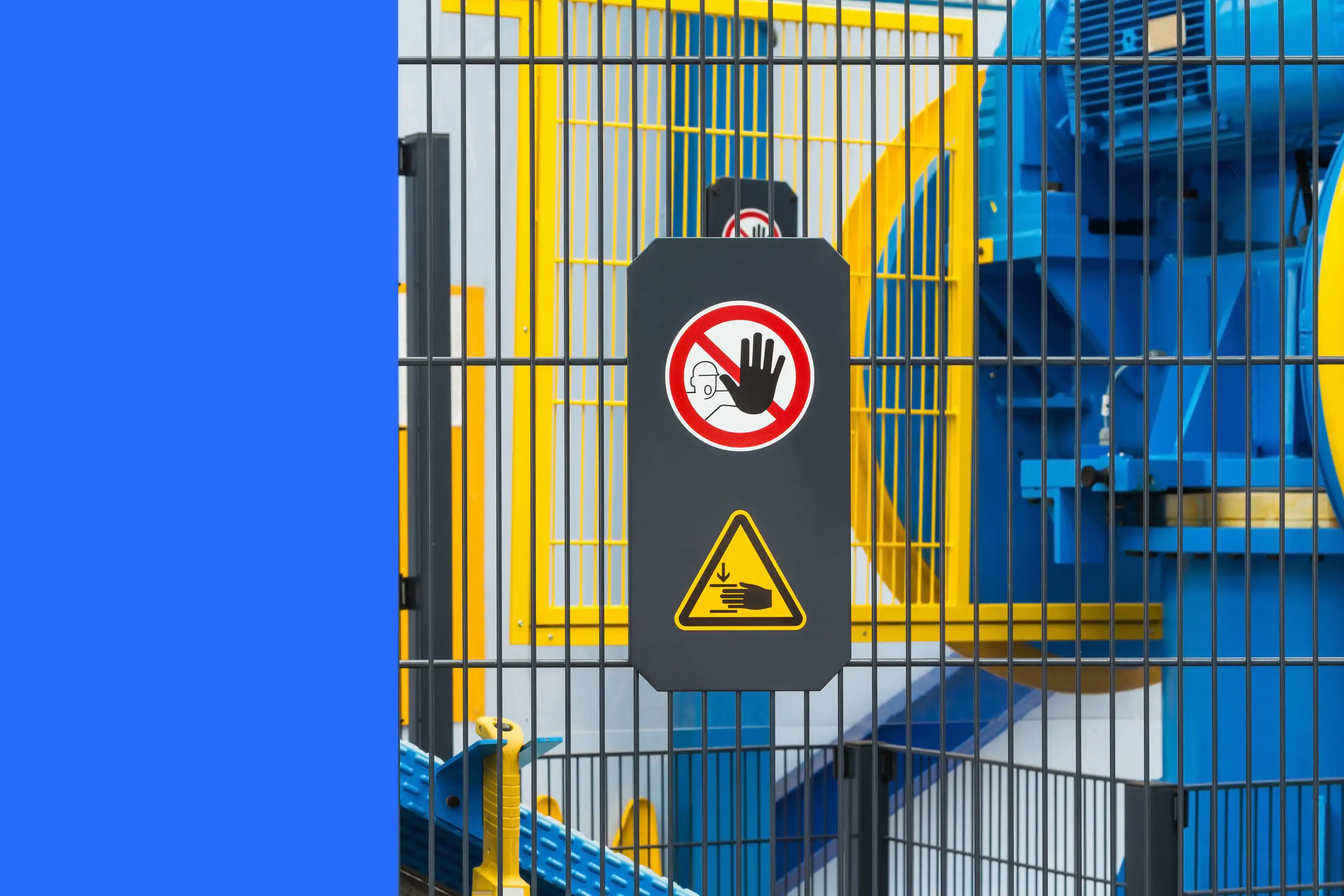
The most effective machine guarding inspections focus on the moments guarding actually fails: post-maintenance reinstallation, production changeovers, and equipment modifications. This downloadable checklist and guide organizes inspection items around those high-risk triggers, so teams can catch gaps before they lead to safety hazards or compliance risks.
Key takeaways
- Machine guards most often fail during post-maintenance reinstallation and production changeovers, making event-triggered inspections more effective than guard-type checklists alone.
- Separating daily operator visual checks from monthly maintenance assessments prevents the common miscommunication where everyone assumes someone else verified guard integrity.
- Tracking guard inspections electronically connects findings directly to corrective workflows, ensuring missing guards get reinstalled, documented, and verified before machines restart.
What is machine guarding?
Machine guarding refers to physical barriers, devices, and safety systems installed on machinery to prevent contact with mechanical hazards and hazardous moving parts, including point-of-operation hazards, power transmission equipment, and rotating components, complementing the use of personal protective equipment.
Unlike PPE, machine guards provide a physical barrier. Typically required under OSHA 29 CFR 1910.212, machine guarding applies to all manufacturing equipment regardless of age. Older machines must meet current standards, particularly after modification or rebuilding.
Note: This article is meant for informational purposes only. Check current OSHA guidelines to fully understand your responsibilities and compliance requirements.
How to use this checklist
Customize for your facility
This checklist is meant to be a template that you can adjust or adapt as necessary. Consider your specific application and any relevant OSHA or industry-specific standards. Stamping presses, injection molding machines, CNC equipment, and material-handling systems each require different guard configurations. High-mix, low-volume operations typically require more flexible point-of-operation guarding approaches than dedicated production lines.
Use a CMMS
A computerized maintenance management system (CMMS) helps teams handle high volumes of machine guarding checks. When records are logged and stored in a centralized database, it’s easier to identify patterns, like repeated bypass attempts on specific equipment, and show due diligence during regulatory audits.

Machine guarding checklist
Daily operator guard checks
Point of operation guards
Power transmission and rotating parts
Safety devices and interlocks
Post-maintenance guard verification
Bypass and tampering detection
Lockout/tagout integration
Documentation and compliance
This checklist is to be used only by those with appropriate training, expertise, and professional judgment. You are solely responsible for reviewing this checklist to ensure that it meets all professional standards and legal requirements, as well as your needs and intent.
Common machine guarding violations and their trigger events
Machine guarding violations consistently rank among the most-cited issues in general industry. Most violations don't stem from a facility never installing guards. They happen at predictable moments.
The most common triggers are easy to recognize. Operators remove guards during production changeovers to swap tooling and don't replace them before restarting. Equipment modifications introduce gaps when new components no longer fit the original guard design. Routine cleaning creates exposure, too, if interlocks get bypassed and no one verifies the reset before the machine goes back into service.
Recognizing these trigger events shifts inspections from a passive walk-through into a targeted response. Rather than relying on a fixed maintenance calendar alone, effective programs add verification steps after activities most likely to leave guards missing.
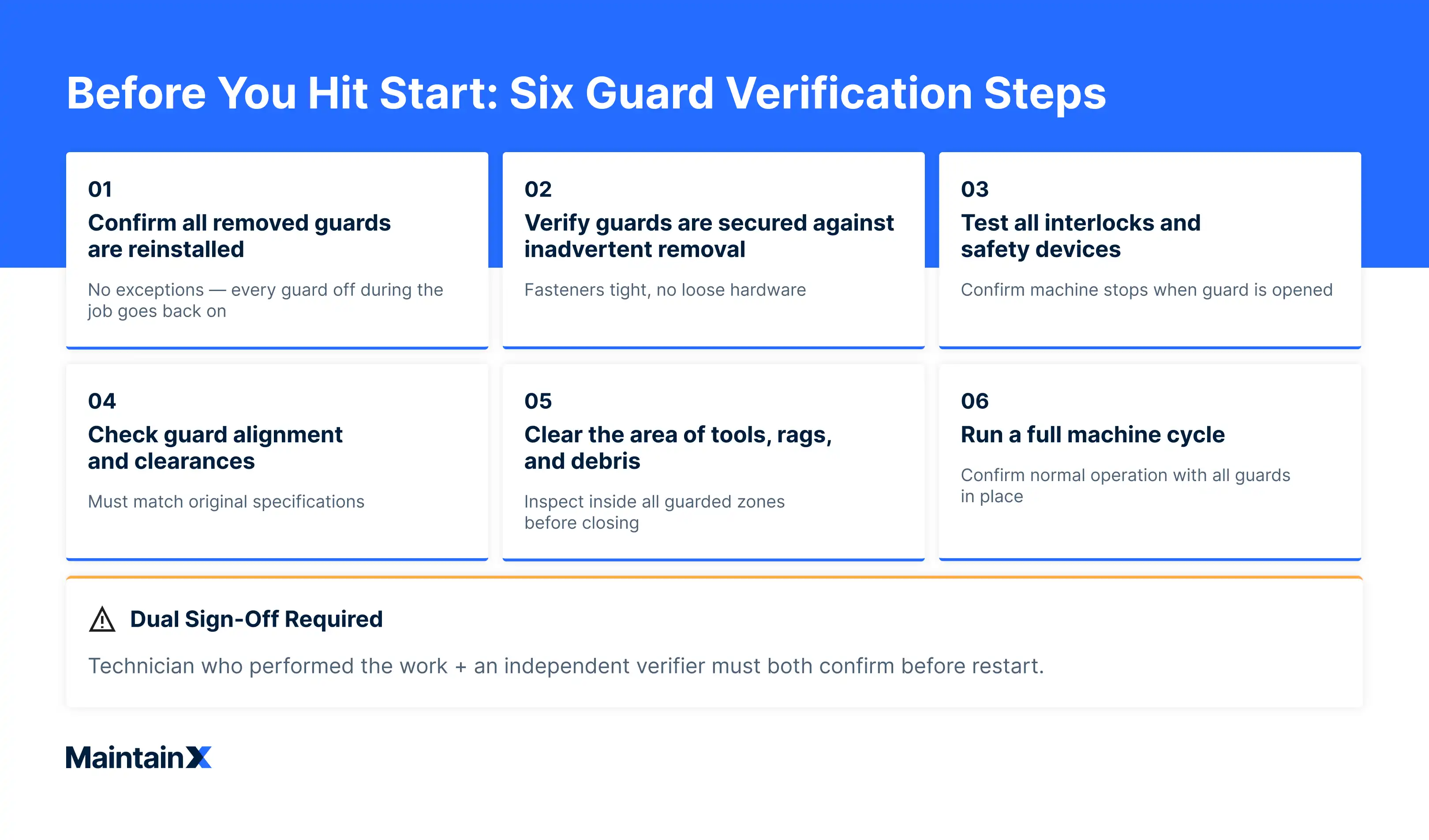
Post-maintenance guard verification: Close the reinstallation gap
Maintenance work is one of the most common reasons guards get removed. Technicians pull them to access bearings, belts, or drive components, then move on to the next work order. The guard sits on a shelf, and production restarts without it.
A dedicated post-maintenance verification step is key to minimizing risk. Before signing off on any work order involving guard removal, technicians should confirm every guard is physically reinstalled, fasteners are secure, and interlocks function correctly. A second set of eyes from the operator or a supervisor adds another layer of accountability.
Verification that guards are reinstalled works best when it's embedded directly in the work order workflow rather than treated as a separate task. When the work order requires reinstallation confirmation to close the ticket, the step doesn't get skipped during busy shifts.
Machine guarding inspections and lockout/tagout compliance
Machine guarding and lockout/tagout (LOTO) procedures are deeply connected, yet many facilities manage them as separate checklists. Guard removal is often the first step in a LOTO sequence, and reinstallation should be the last. When the two aren't coordinated, guards come off during maintenance and don't make it back on before the machine restarts.
During guarding inspections, teams should verify that each machine's written LOTO procedure explicitly references its guards. If a procedure calls for removing a barrier guard on a press, the energy control steps should list reinstallation as a condition for releasing the lockout, not leave it as an assumed follow-up.
Coordinating the two creates a built-in verification point. When operators perform LOTO, they can visually confirm guard condition and placement before returning the machine to service.
Standardize machine guarding inspections with a CMMS
Paper-based machine guarding checklists and inspections can work in small shops, but often struggle to scale. Different shifts interpret checklist items differently, findings get filed without follow-up, and no one tracks whether a flagged issue actually reached resolution.
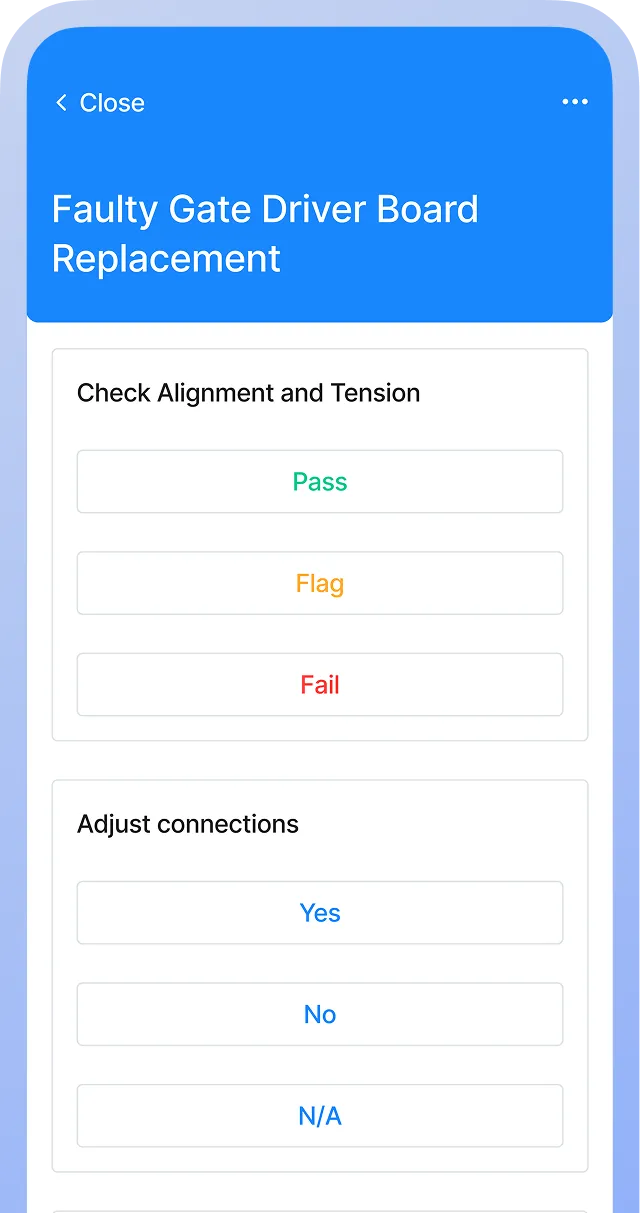
MaintainX brings consistency to the inspection process. Digital checklists ensure every inspector follows the same steps, and photo attachments document guard condition at the point of inspection. When someone flags a missing or damaged guard, the platform can automatically generate a corrective work order, assign it, and set a priority level.
This closed-loop inspection workflow is where the real value sits. The inspection itself only identifies problems. MaintainX drives the fix, tracks completion, and builds an audit trail that proves compliance over time.
See it in action by booking a tour:
Machine guarding inspection checklist FAQs
How often should machine guarding inspections be conducted?
Operators typically perform daily visual checks during machine startup, maintenance teams conduct monthly detailed assessments, and post-event inspections verify guard reinstallation after any modification or maintenance work.
What are the most common machine guarding violations in manufacturing?
Missing or bypassed guards rank highest, particularly after maintenance when guards aren't reinstalled. Inadequate protection around rotating parts, nip points, and modified equipment that creates new pinch points without updated safeguards also accounts for frequent citations.
How do you train employees on machine guarding safety?
Connect each guard to the specific injury it prevents. Show proper operation, explain why bypassing creates hazards, and clarify inspection responsibilities, whether operators handle daily checks or maintenance performs monthly assessments.
What should you do if a machine guard is damaged or missing?
Immediately lock out and tag the machine, preventing operation until the guard is repaired or replaced. Document the finding, create a work order for corrective action, and verify guard reinstallation before returning equipment to service.

The MaintainX team is made up of maintenance and manufacturing experts. They’re here to share industry knowledge, explain product features, and help workers get more done with MaintainX!

.webp)