

A well-designed trailer inspection checklist should do more than satisfy DOT requirements. It should trigger repair workflows that actually keep trailers in service. Regular inspections are a key part of preventive maintenance, but if they’re not connected to follow-up actions, then fleet managers are doing little more than checking a box.
This guide includes downloadable trailer inspection checklists for pre-trip, post-trip DVIR, and annual periodic inspections. We’ve made them available to print out and use on their own, but for best results, import them into a computerized maintenance management system (CMMS) to connect inspection items to preventive maintenance workflows.
Key takeaways
- Trailer inspections become compliance tools when defects trigger repair workflows. Most violations occur in the gap between identifying a defective clearance lamp and certifying its repair.
- Consistent pre-trip inspections and DVIR documentation directly influence roadside inspection outcomes. Actual measurements like brake pushrod stroke create defensible compliance records that generic 'checked' entries cannot.
- A CMMS helps track pre-trip checks, post-trip DVIRs, and annual periodic inspections, preventing compliance gaps that arise when teams conflate these distinct regulatory requirements.
How to use this checklist
Customize for your facility
Adjust inspection frequencies based on your trailer types, operating conditions, and regulatory requirements. Before finalizing your schedule, consult relevant safety guidelines and regulatory documentation, including FMCSA regulations, manufacturer maintenance manuals, and industry safety standards, as these provide critical benchmarks for your inspection criteria and intervals.
Fleets with higher-mileage trailers often schedule more frequent mechanical inspections based on actual usage patterns rather than calendar intervals alone. Reefer operations typically need more frequent temperature control checks, while flatbed operations require focus on cargo securement.
Staying current with these resources ensures your program remains compliant and that no safety-critical components are overlooked, particularly when accounting for state-specific requirements alongside federal DOT standards.
Use a CMMS
Digital platforms help fleets track inspection compliance across multiple locations and trailer units. Using this trailer inspection checklist with a CMMS centralizes DVIR records, automatically schedules periodic inspections, and retains records for the required periods. Among other benefits, this creates a verifiable audit trail that may help satisfy DOT inspection requirements.


Trailer inspection checklist
Pre-trip safety inspection
Coupling area verification
Post-trip DVIR items
Weekly detailed walkaround
Monthly brake and mechanical service
Cargo securement inspection
Annual DOT periodic inspection
Documentation and compliance
This checklist is to be used only by those with appropriate training, expertise, and professional judgment. You are solely responsible for reviewing this checklist to ensure that it meets all professional standards and legal requirements, as well as your needs and intent.
The repair certification requirement most fleets miss
Under FMCSA regulations (49 CFR 396.11), fleets must typically repair and certify any defects affecting safety before that trailer returns to service. A driver or mechanic signs off on the repair, and that certification becomes part of the inspection record.
Compliance gaps tend to appear here. Inspectors document the problem, but the repair certification never closes the loop. The trailer goes back on the road with an open defect record, which creates liability during roadside inspections and audits.
Effective fleets treat each defect notation as the start of a work order, not the end of an inspection. The repair triggers a documented workflow: assign, fix, verify, certify. Without that chain of evidence, even a well-executed inspection program leaves the fleet exposed.
How documentation affects your CSA score
Every roadside violation feeds into your CSA score through the FMCSA's Safety Measurement System. Vehicle maintenance violations carry significant weight, and they stay on record for 24 months.
A strong inspection program builds a paper trail that keeps your CSA percentile in a favorable range, directly affecting your carrier rating and insurance costs.
Pre-trip and post-trip inspections should catch the same issues that CVSA officers look for at weigh stations: brake adjustment, tire condition, lighting, and securement devices. When those inspections are documented thoroughly, you create a timestamped record showing the defect was identified and corrected before it became a roadside violation, which can make a meaningful difference during audits or post-incident reviews.
Documentation quality matters too. Investigators review DVIR records for completeness and timeliness. Missing signatures, skipped items, or gaps between inspection dates all raise flags and can turn a minor compliance question into a larger one.
Build an inspection-to-work-order workflow that prevents roadside failures
An ideal inspection program should look something like this: An inspection checklist identifies problems. A work order workflow fixes them. Connecting the two is what separates compliance-on-paper from actual roadside readiness.
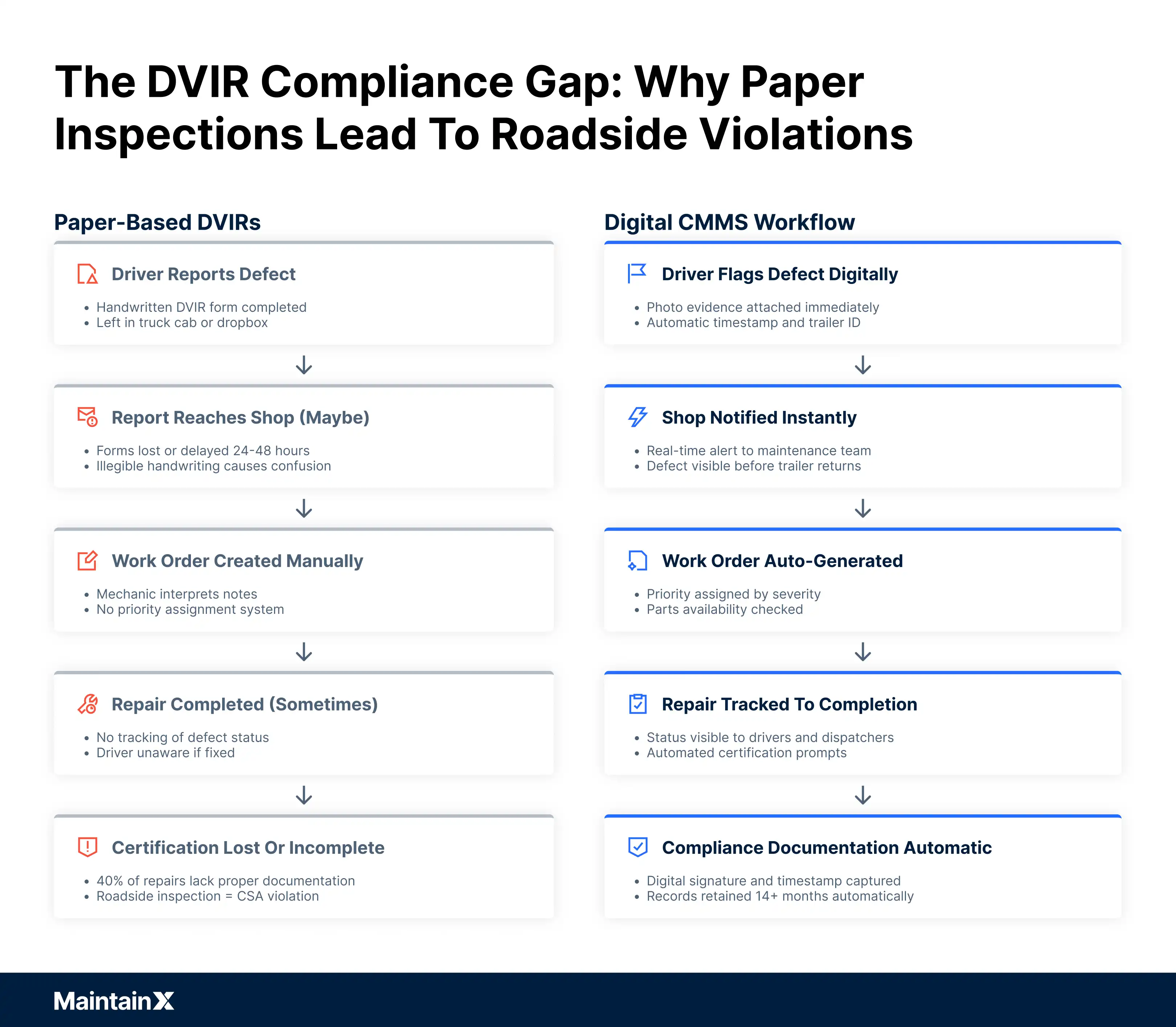
Treat every flagged defect as a work order trigger. When a driver notes a cracked mud flap or worn brake lining on a DVIR, that finding should immediately route to maintenance with the trailer ID, defect description, and severity level attached. A CMMS can automate this handoff, creating and assigning work orders directly from inspection findings so nothing gets lost between the driver and the shop.
Fleets that rely on verbal handoffs or sticky notes between drivers and mechanics often lose defects in the gap. A structured workflow, supported by a CMMS, closes that gap and produces the audit-ready documentation regulators expect.
Manage multi-trailer compliance with a CMMS
It’s possible to build an effective inspection program using paper records. But when managing a large trailer fleet, things get complicated fast. Each trailer has its own DVIR cycle, annual periodic inspection date, and open defect history. Spreadsheets and clipboard systems struggle to keep pace once the fleet grows beyond a handful of units.
MaintainX centralizes trailer records in one place. Each asset carries its full inspection history, open work orders, and upcoming compliance deadlines. Automated reminders flag annual inspections before they lapse.
But the real value shows up in the connection between inspections and repairs. When a driver submits a DVIR through the platform, any noted defect can generate a work order automatically. Maintenance teams see it immediately, and the repair certification links back to the original inspection record. That closed-loop documentation is what auditors and roadside inspectors want to see.
Learn how MaintainX makes digitizing checklists and inspections easy. Better yet, book a call to see it in action.
Trailer inspection checklist FAQs
What does a DOT trailer inspection consist of?
DOT trailer inspections cover all critical components. Inspectors examine the frame and hitch for cracks, damage, and secure attachment, and verify that safety chains are properly connected and holding. Mirrors, lights, and signals, including turn signals and brake lights, are checked for proper function. Tires get particular attention, with inspectors looking at tread depth, wear patterns, and age to ensure compliance. The load and weight are confirmed to be within legal limits, and the spare tire, jack, and lug wrench are checked to make sure they're present and in usable condition. All safety equipment must be accounted for and in good working order.
How often are trailer inspections required by federal regulations?
Federal regulations require two types of inspections. Drivers must complete a pre-trip and post-trip inspection every day the trailer is in operation, documented through a Driver Vehicle Inspection Report (DVIR). Separately, trailers must undergo a full periodic inspection at least once every 12 months, performed by a qualified inspector who evaluates all safety-critical systems.
Both inspection types carry distinct documentation requirements. DVIRs must be completed daily and retained for a set period, while annual inspection records must be kept on file and available for review. Staying current on both is essential for CSA compliance and passing roadside inspections.
These requirements reflect U.S. federal regulations. If you are operating in Canada, the UK, or another jurisdiction, inspection frequencies, documentation standards, and compliance frameworks will differ. Always refer to the regulatory body governing your region to ensure your inspection program meets local legal requirements.
Who is qualified to perform an annual trailer inspection?
Annual inspections must be performed by technicians certified under FMCSA Part 396.19 standards. In practice, this is typically an ASE-certified mechanic or an inspector trained by an equipment manufacturer. The inspector must be familiar with FMCSA criteria and document all findings on official inspection forms, which are then kept on file as part of the trailer's compliance record.
What are the most common trailer inspection failures?
Brake system defects, inoperative lights, and worn tire tread cause most roadside inspection failures. Missing mud flaps, damaged air lines, and insecure cargo also trigger violations. Pulling to one side during braking is a sign of brake system issues that require immediate attention. These issues directly impact CSA scores and affect carrier safety ratings.
How should trailer inspection records be maintained for compliance?
Keep annual inspection reports for 14 months and DVIR records for three months at the terminal where trailers operate. Records must show both identified defects and certification that repairs were completed before trailers returned to service.
What happens if a trailer fails inspection?
Remove failed trailers from service immediately until a qualified mechanic completes and certifies repairs. Commercial trailers must not be operated until they meet all regulatory compliance requirements and are certified as safe for use. Drivers cannot operate defective equipment. Repair certification closes the compliance loop. Operating without it creates significant regulatory violations.

The MaintainX team is made up of maintenance and manufacturing experts. They’re here to share industry knowledge, explain product features, and help workers get more done with MaintainX!




.webp)