

A standardized warehouse cleaning checklist helps cleaning staff document and understand what needs to be cleaned and when. Structured by zone and tied to maintenance workflows, routine cleaning can help operations document and spot wear before it leads to downtime or safety hazards.
Below, we’ve provided a warehouse cleaning checklist that you can customize for your facility, as well as some best practices for leveraging it as part of a comprehensive preventive maintenance program.
Key takeaways
- Treat cleaning crews as frontline observers who can catch maintenance issues early. With the right tools, they are, effectively, an early-warning system for damaged racks, hydraulic leaks, and compromised dock seals.
- Digitizing cleaning logs in a CMMS gives you comprehensive, date-stamped maintenance records that can automatically trigger work orders when damage is noted.
- Different warehouse zones carry distinct risk profiles. Receiving docks need a pest-prevention focus, storage aisles require combustible dust monitoring, and battery-charging areas demand ventilation checks.
How to use this checklist
Customize for your facility
This checklist covers warehouse operations broadly and should be edited to reflect the needs of your facility. Adjust frequencies based on your operation: Cold storage facilities need different protocols than dry goods warehouses; food-grade facilities should add temperature-controlled area sanitization.
Consider your warehouse layout when scheduling tasks. High-traffic zones near shipping docks may need daily attention, while back storage areas work on weekly cycles. Add industry-specific requirements like GMP compliance for pharmaceutical operations or hazmat protocols for chemical distribution.
Use a CMMS
Make the most of this checklist by using it with a CMMS.
With a CMMS, warehouse cleaning can go from paper checklists to automated workflows. A CMMS schedules recurring tasks, assigns responsibilities, and creates audit trails for compliance. Cleaning staff can track completed tasks, document issues with photo verification, and flag maintenance issues from the warehouse floor.


Warehouse cleaning checklist
Receiving and loading docks
Storage and racking areas
Shipping and staging zones
Battery charging and fuel areas
Hazardous materials and chemical storage
Restrooms and break areas
Office and administrative spaces
Material handling equipment cleaning
Safety and emergency systems
Documentation and compliance
This checklist is to be used only by those with appropriate training, expertise, and professional judgment. You are solely responsible for reviewing this checklist to ensure that it meets all professional standards and legal requirements, as well as your needs and intent.
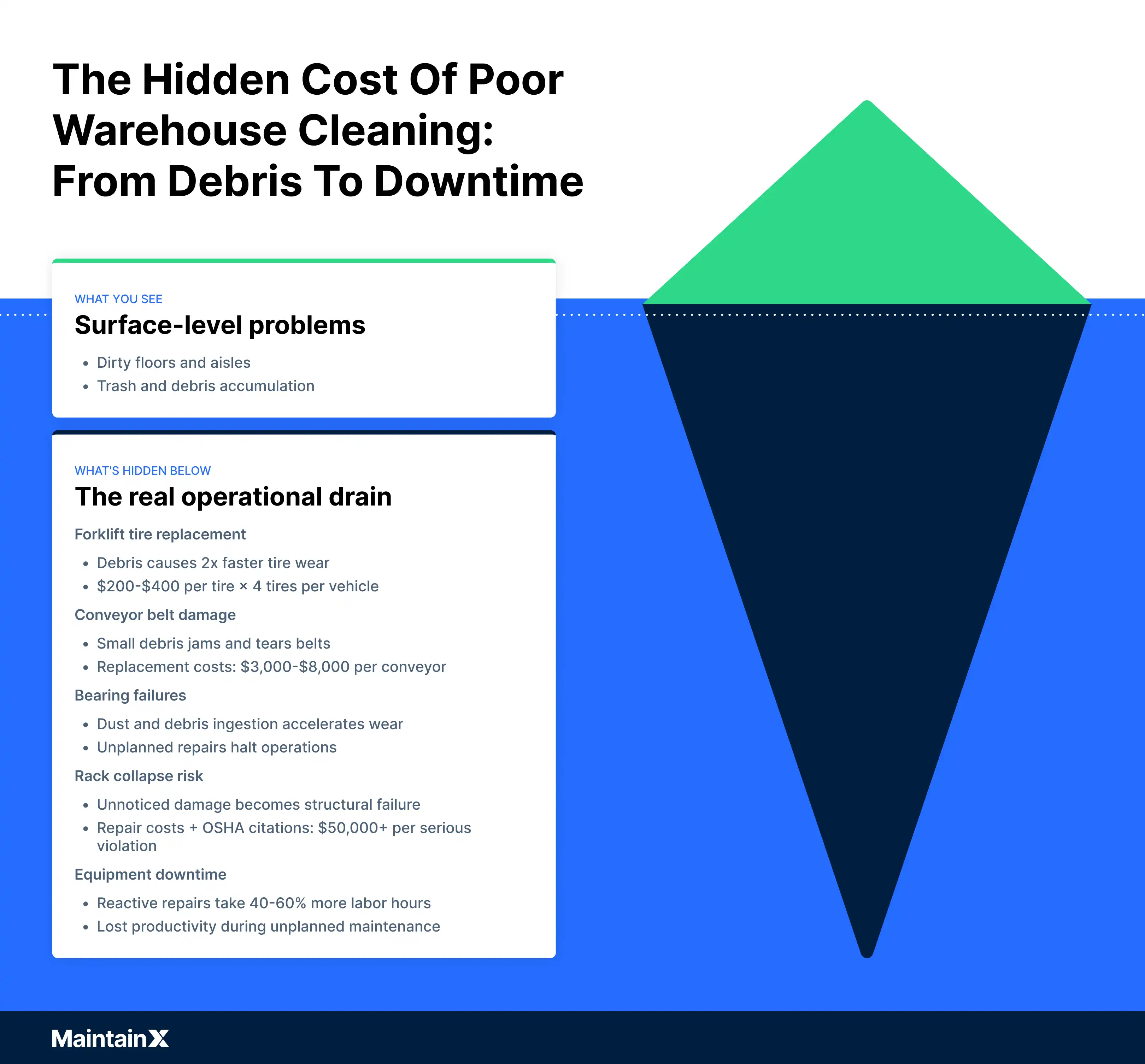
The hidden cost of poor warehouse cleaning
Skipped or inconsistent cleaning rarely stays a cosmetic problem for long. Debris in forklift travel paths accelerates tire wear and can damage undercarriage components. Dust buildup on electrical panels increases fire risk. Blocked sprinkler clearance zones, even temporarily, create violations that OSHA inspectors and fire marshals catch quickly.
The financial exposure compounds in both directions. Equipment repair costs climb when preventable damage shortens asset life. Compliance penalties escalate when facilities can't produce documentation proving consistent housekeeping standards.
Cleaning logs serve as a paper trail that protects the operation during audits. A dated, zone-specific record showing completed tasks and reported hazards turns cleaning into measurable evidence. Facilities that treat cleaning documentation as seriously as maintenance records tend to perform better in both unannounced inspections and insurance reviews.
How to train cleaning staff to identify early warning signs
Cleaning crews move through every zone of a warehouse on a predictable schedule, making them natural first responders to developing problems. But only if they know what to look for.
Effective training pairs each cleaning task with a short observation prompt. While sweeping storage aisles, staff can note cracked floor surfaces or leaning racking. While wiping down dock areas, they can flag torn door seals or pooling water. Keep observations simple and specific. Don’t ask anyone to diagnose a mechanical failure.
A brief weekly huddle between cleaning staff and maintenance management reinforces this habit. Supervisors can review what staff reported, confirm which items reached maintenance, and share outcomes. When a cleaning tech sees their observation lead to a repaired conveyor belt or a fixed dock leveler, they can better understand the importance of their work and the impact they have on big-picture goals.
Five equipment issues cleaning crews spot first (and how to route them to maintenance)
Five common problems that often get caught by cleaning crews first include:
- Hydraulic fluid puddles beneath forklifts or dock levelers
- Unusual grinding or squealing from conveyor motors
- Loose bolts, guards, or safety covers on machinery
- Flickering or failed lights in high-traffic zones
- Cracked or buckled flooring near heavy equipment paths
Spotting these issues is only half the battle. Without a clear reporting path, observations stay informal and often go unrecorded. The most effective approach is to give cleaning staff a simple way to log findings on the spot, tagged by zone and equipment type, so maintenance receives a concrete, actionable report rather than a secondhand description days later.
A CMMS makes this straightforward, letting crews submit findings from a mobile device that route directly to the right maintenance queue, closing the gap between observation and repair before small issues escalate.
Digitize warehouse cleaning with a CMMS
Paper checklists capture what happened, but they rarely connect that information to other workflows. MaintainX turns cleaning tasks into structured data tied to specific warehouse zones, equipment, and schedules.
With a CMMS, when a cleaning tech flags a damaged dock seal or an oil leak, the observation can generate a work order that routes directly to the right maintenance technician.
Over time, digital records reveal patterns. If a particular storage zone consistently shows floor damage, that signals a deeper issue worth investigating. If dock areas need emergency cleanups every Monday, scheduling adjustments can address the root cause.
Learn how MaintainX turns checklists and inspections into actionable intelligence. Book a tour here:
Warehouse cleaning checklist FAQs
What are OSHA's requirements for warehouse housekeeping and cleanliness?
OSHA typically requires clear aisles, designated waste disposal, dry floors, and orderly storage under 1910.22 Walking-Working Surfaces standards. Maintaining clear walkways is essential to prevent workplace injuries and slip hazards, especially in high-traffic and cold storage areas where ice buildup or condensation can occur. Review necessary documentation to ensure all requirements are met.
How often should different areas of a warehouse be cleaned?
High-traffic zones like receiving docks and shipping areas need daily cleaning, while storage aisles typically require weekly attention. A comprehensive warehouse cleaning schedule organizes cleaning tasks by daily, weekly, monthly, and quarterly intervals to ensure all areas are maintained efficiently and safely.
Weekly warehouse cleaning tasks involve deep cleaning floors, dusting shelves, checking safety equipment, and restocking supplies. Monthly warehouse cleaning tasks should focus on larger systems, preventative upkeep, and deep cleaning, while quarterly tasks may include more extensive maintenance and cleaning.
It is also important to regularly clean equipment like forklifts and pallet jacks to remove dirt, grease, and debris, and to wipe down and dust racks frequently to keep surfaces clean and organized. Perform air quality maintenance by cleaning HVAC systems and replacing filters. Maintenance bays and equipment areas demand immediate cleanup after spills. Frequency depends on operational intensity and material handling volume.
What is the 5S checklist for warehouse cleaning and organization?
The 5S methodology structures warehouse cleaning and organization as follows: Sort (remove unnecessary items), Set in Order (arrange tools logically), Shine (clean and inspect), Standardize (establish procedures), and Sustain (maintain practices). Facilities use 5S to integrate cleaning with operational efficiency.
After implementing 5S, it is important to identify key areas within the warehouse, such as aisles, racks, material handling equipment, cold storage, dispatch and receiving areas, canteen, and toilets, and assign specific tasks to staff for each area. A typical warehouse hygiene checklist template covers these key areas and includes tasks for aisles, dispatch and receiving areas, toilets, and mechanical equipment.
Making the cleaning checklist easily accessible, for example, in a digital format or a central location, helps staff quickly find and follow procedures. Assigning responsibilities for each cleaning task ensures accountability and consistent maintenance of warehouse cleanliness.
How do you handle and dispose of hazardous waste during warehouse cleaning?
Segregate hazardous materials in designated, labeled containers according to compatibility. Maintain Material Safety Data Sheets at collection points.
When handling hazardous waste, ensure the use of appropriate safety equipment to protect staff. Cleaning tasks in hazardous areas should be clearly defined and assigned only to trained staff. Train cleaning staff on required PPE and spill response. Document all disposal through manifests to create compliance evidence and track waste streams.
What should a daily warehouse cleaning checklist include?
Daily warehouse cleaning tasks should include floor sweeping in high-traffic zones, dock plate inspection, emergency exit clearance, and spill cleanup verification. In addition, cleaning tasks must cover emptying trash bins in break rooms and canteen areas, as well as ensuring daily cleaning of surfaces, tables, and floors in the canteen to prevent food contamination. Toilets, sinks, and floors should be cleaned multiple times a day to maintain hygiene and a pleasant environment for employees.
High-touch surfaces such as railings, scanners, light switches, and time clocks should be sanitized daily. Train cleaning staff to report equipment leaks, damaged racking, or safety hazards they observe, turning routine cleaning into an early-warning system.

The MaintainX team is made up of maintenance and manufacturing experts. They’re here to share industry knowledge, explain product features, and help workers get more done with MaintainX!

.webp)