
%20checklist_FEATURE_3x.webp)
A total productive maintenance (TPM) checklist works best when every item acts as a workflow trigger, routing findings to the right response instead of just logging a pass or fail. Built on core TPM principles and borrowed from lean manufacturing, this approach helps manufacturing teams connect each inspection to measurable gains in overall equipment effectiveness (OEE).
Key takeaways
- TPM checklists function as early detection systems for equipment health. Routine cleaning and lubrication checks reveal leaks, consumption trends, and other abnormalities that signal developing failures before they cause unplanned downtime.
- A digital checklist captures patterns a single inspection misses, helping your maintenance teams track recurring findings and launch focused improvement projects that address root causes instead of just symptoms.
- Organizing checklist items by their OEE impact helps equipment operators prioritize maintenance tasks and clarifies when to perform basic maintenance autonomously versus escalating to maintenance specialists.
How to use this checklist
Customize for your facility
Treat this checklist as one piece of a comprehensive maintenance strategy rather than a standalone form. Make sure it aligns with your regulatory landscape, tolerance requirements, and product specifications.
Adapt item frequency based on equipment criticality and production volume. A high-speed packaging line, for example, often needs more frequent autonomous maintenance checks than batch processing equipment. Then, factor in your regulatory landscape when customizing inspection items. Medical device and food processing facilities typically need stricter documentation standards than general manufacturing plants.
Use a CMMS
A digital checklist simplifies TPM execution across multiple shifts and production lines. Maintenance managers and maintenance personnel can assign checklist items by role, track completion rates, and link findings directly to work orders, with automated reminders keeping routine maintenance tasks on schedule without manual coordination.
Using this checklist with a computerized maintenance management system (CMMS) also creates an audit trail that connects equipment condition data with OEE metrics and failure history. That visibility helps you identify which TPM activities deliver the strongest impact on manufacturing efficiency and operational efficiency, supporting continuous improvement decisions across your manufacturing process.


Total productive maintenance (TPM) checklist
Autonomous maintenance
Planned maintenance
Quality maintenance
Safety, health, and environment
Focused improvement and loss tracking
Training and skills development
Early equipment management
Documentation and compliance
This checklist is to be used only by those with appropriate training, expertise, and professional judgment. You are solely responsible for reviewing this checklist to ensure that it meets all professional standards and legal requirements, as well as your needs and intent.
From checklist finding to root cause: The TPM closed-loop workflow
Every abnormal finding on a TPM checklist is a signal worth tracking, and the most effective manufacturing teams treat each one as a workflow trigger that routes to the right response. Here's how that works:
An equipment operator flags an issue during autonomous maintenance. That finding generates a work order, which a technician investigates as part of routine maintenance. The technician's notes feed back into the checklist design, sharpening future inspections and targeted improvements. This closed loop turns routine maintenance tasks into a continuous improvement engine.
Without it, the same problems show up week after week: A bearing runs hot, someone notes it, and nothing changes. With a closed loop, that repeated finding becomes evidence for a focused improvement project. The checklist stops functioning as a compliance form and starts driving real corrective action across the Six Big Losses, protecting equipment reliability along the way.
%20checklist_3x.webp)
Common TPM implementation mistakes that keep teams stuck in reactive maintenance
Building and deploying checklists in isolation is one of the fastest ways to undermine TPM. When maintenance engineers design inspection items without operator input, the checks often miss what your frontline workers actually see and hear during daily operations on their own equipment.
Treating every item with equal weight causes similar damage. Not all checks carry the same production impact, and teams that map each item to a specific OEE loss category can prioritize findings and allocate resources where they matter most, rather than defaulting back to reactive maintenance every time something breaks.
Overloading checklists creates its own set of problems. Long, exhaustive lists lead to checkbox fatigue, where operators rush through items without genuine observation. Shorter, role-specific checklists tend to produce better data and stronger employee involvement across manufacturing companies of any size.
Many teams also collect findings but never review the trends. A single abnormal reading is easy to dismiss on its own, but the same reading appearing five times in a month points to a chronic issue worth investigating before it turns into one of the unexpected breakdowns that a proactive maintenance strategy is designed to prevent.
Measure TPM checklist ROI: Connecting checklist data to lower maintenance costs
Completion rates show whether people are doing the checks, but they don't reveal whether the checks are actually improving equipment efficiency. Mature TPM programs track a layered set of metrics that connect checklist activity to production outcomes.
Start with completion rates and on-time percentages as baseline indicators, then look deeper at how many findings generate work orders and how quickly those work orders close. These metrics reveal whether the closed-loop workflow is functioning the way it's supposed to and whether your maintenance practices are actually driving production efficiency.
The real payoff shows up in overall equipment effectiveness trends over time. Teams that consistently act on checklist findings typically see reductions in unplanned downtime and quality defects within the first few months, along with fewer defects reaching customers and enhanced product quality on the line. Tracking which of the Six Big Losses each finding addresses helps connect frontline observations to measurable gains in equipment performance, and that connection is what makes the case for lower maintenance costs and stronger operational excellence over time.
Why a mobile-friendly CMMS helps maintenance managers sustain TPM
TPM depends on operators performing checks at the machine, not at a desk, and paper-based checklists create delays between finding an issue and reporting it. Those delays break the closed-loop workflow that makes TPM effective in the first place.
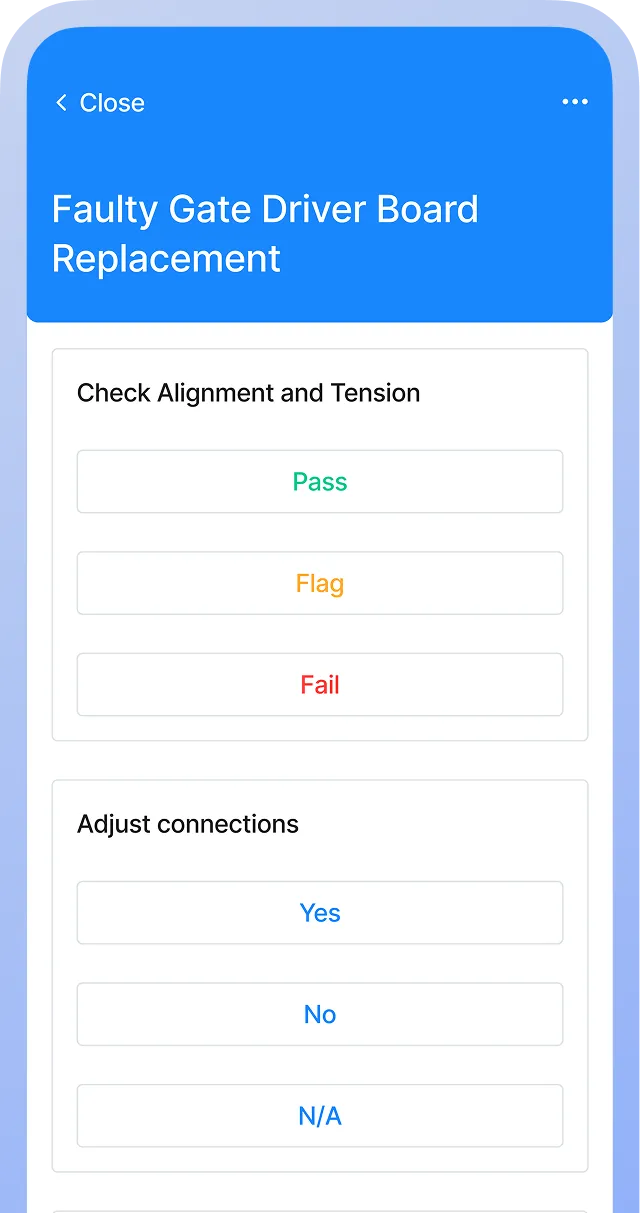
MaintainX puts checklists on the devices machine operators already carry. Findings trigger work orders immediately, with photos and notes attached, technicians receive escalations in real time, and maintenance managers can monitor completion rates without chasing down clipboards or relying on administrative departments to compile paper logs.
Book a tour to see MaintainX in action today.
Total productive maintenance checklist FAQs
What is the difference between TPM and traditional preventive maintenance?
TPM enables operators to perform routine inspections and basic maintenance, while traditional maintenance relies solely on technicians. This operator involvement catches issues earlier and builds equipment ownership across the frontline team.
How do you start autonomous maintenance in a TPM program?
Start by training operators to clean, inspect, and spot abnormalities on their own equipment. Define clear escalation points where operator authority ends and maintenance requests begin, creating a structured handoff.
What OSHA requirements must be included in a TPM checklist?
Typically, include lockout/tagout verification, machine guarding checks, emergency stop functionality, and hazard communication for chemical handling. Safety items should appear first, reinforcing that compliance protections come before production concerns.
How often should TPM inspections be conducted?
Operators typically inspect critical equipment daily at shift start, with weekly deep cleans and monthly precision checks. Technicians conduct detailed inspections quarterly or based on runtime hours, depending on equipment criticality, failure history, and production impact.
What are the pillars of TPM, and how do they relate to inspection checklists?
The eight pillars are autonomous maintenance, planned maintenance, quality maintenance, focused improvement, early equipment management, training, safety, and administrative. Checklists translate these principles into daily inspection routines that prevent the Six Big Losses.
How does TPM compliance support ISO 9001 and ISO 55000 certification?
TPM checklists create the documented evidence auditors typically look for: systematic inspection records, corrective action trails, and continuous improvement loops. This audit trail shows that your facility manages assets proactively and maintains quality controls throughout production.
What metrics should be tracked using a TPM checklist?
Track checklist completion rates, findings per inspection, time-to-resolution for flagged issues, and repeat failure patterns. Connect these to OEE components: availability losses from breakdowns, performance losses from minor stops, and quality losses from defects.

The MaintainX team is made up of maintenance and manufacturing experts. They’re here to share industry knowledge, explain product features, and help workers get more done with MaintainX!



.webp)