

Most maintenance teams know what’s needed to stop breakdowns and keep machines running at their best. They have preventive maintenance plans, PM schedules, parts kits, and the technical know-how. But despite a strong strategy, they find themselves doing more reactive maintenance than preventive.
In fact, while 64% of maintenance teams say they use preventive maintenance, 51% say they spend most of their time on reactive tasks, according to the 2026 State of Industrial Maintenance.
Maintenance teams are stuck in a cycle of endless breakdowns despite decades of advocating for a proactive approach. The reason is a lack of access in three areas: equipment, information, and resources.
This article explores those three areas, how a lack of access can weaken even the most well-planned maintenance strategy, and ways for your team to overcome these obstacles.
Where maintenance teams lack access, why it’s a problem, and how to solve it
1. No access to equipment
Work may be planned and scheduled, but that doesn’t always mean maintenance is given access to a machine to complete that work. Because maintenance is often at the whim of production, preventive tasks are frequently delayed or skipped if a line is behind schedule.
Why it’s a problem
There isn’t an industrial company in the world that hasn’t sacrificed maintenance for the immediate needs of production. If a massive order needs to be fulfilled and it means a monthly inspection is pushed by a couple of days, the risk is often worth the reward. But a costly problem is created when this once-in-a-while sacrifice becomes a daily habit.
Facilities become stuck in a cycle: Maintenance is skipped, equipment breaks down, equipment is run harder and longer than it should to make up for stoppages, which means more missed maintenance and breakdowns. Downtime rises, production misses targets, and equipment gets strained, while maintenance is blocked from putting a preventive plan into action.
More organizations are getting stuck in this run-to-fail cycle as their equipment ages and is unable to keep up with extended production cycles. In fact, 30% of maintenance leaders said aging infrastructure was to blame for increased downtime, while 46% said downtime costs went up because of wear and tear on critical assets, according to the 2026 State of Industrial Maintenance.
What causes it
Maintenance is often denied access to equipment for one reason: it’s difficult to prove the long-term value of preventive maintenance compared to the clear and immediate value of running equipment.
A production team can say, “We’ll make 2,000 more units today if we skip that PM.” The value formula is straightforward. However, a maintenance manager needs more evidence to demonstrate that a consistent schedule of PMs allows the team to increase output across a longer time period. When presented with this choice, production wins most times, especially when margins are thin and competition is fierce.
It’s not just a misunderstanding of the value of maintenance, but the unwillingness to trade one risk (we might miss our production goals for today) for a bigger one (we might miss our production goal every month this year).
How to solve it
It requires strong data to convince plant managers, operations leaders, and executives that maintenance should sometimes be prioritized over production.
Don’t start with foundational maintenance metrics, like downtime or mean time to repair (MTTR), but with the KPIs tracked by production-minded people. For example, the primary target for an entire site might be weekly output.
The next step is to connect preventive maintenance work to this production target. If you do consistent PMs on equipment and track KPIs like failed inspections, corrective work orders, and asset availability, you can use this as proof that preventive maintenance increases production over time.
If you don’t have this data, the best way to understand the potential impact of preventive maintenance is to collect failure data (failure type, downtime, lost production) and provide a data-backed estimate of how a PM program would improve asset availability, throughput, and output.
The last step is to align with the production team before presenting any data or making a request. Identify KPIs you can share and how each team impacts them. Decide on a regular schedule to review KPIs, set a joint strategy, and discuss conflicts.
Here’s how that might look in practice:
- You analyze all failure modes on production equipment over a three-month period
- You see 60% of total downtime was caused by five failure types
- You create a proof of concept PM plan that includes weekly inspections to prevent these failures
- You estimate that the PM plan would increase net uptime and throughput by 20%
- You set daily 10-minute standups with production to align on schedules, and weekly meetings to align on progress, roadblocks, and metrics.
This is a very clean example and the real-world is often messier. There are well-established procedures, tensions, and relationships. But strong data and consistent communication are the best tools for cutting through those obstacles to improve access to equipment.
2. No access to information
There’s a lot of information maintenance teams need on a daily basis, whether it’s troubleshooting guidance for a never-before-seen error code or a production schedule needed to adjust next week’s PM plan. If this information is inaccurate, incomplete, or completely missing, it can turn a simple job into an hours-long quagmire.
Why it’s a problem
Downtime, lost production, and late deliveries can often be traced back to a lack of information. Exhibit A: 31% of maintenance leaders said downtime increased at their operation due to poor knowledge transfer or training, and 28% said a lack of necessary skills was the culprit, according to the 2026 State of Industrial Maintenance.
The cost of inaccessible information is often hidden. Issues are rarely logged, broken processes are accepted as status quo, and problems look small in isolation, but add up to have a massive impact. This makes it difficult to not only spot problem areas, but muster the resources to fix them.
For example, a technician may spend 20 extra minutes troubleshooting an issue because they don’t have easy access to an asset’s repair history. If they did, they would see how the same issue was fixed last month. Those 20 minutes are frustrating, but quickly forgotten. However, multiply it by two incidents a week and you’re suddenly looking at over 30 hours of extra downtime every year.
Then there’s a lack of access to the data generated by machines. While a lot of facilities are capturing this system through MES, SCADA, and PLC systems, 38% of teams aren’t making use of it to trigger maintenance. The data is available, but without a way to understand or action it, maintenance teams have to rely on time-based PMs at best and reactive maintenance at worst.
What causes it
There are three big reasons maintenance teams lack access to information:
1. A growing shortage of skilled labor: More than 70% of maintenance teams were understaffed in the last 12 months and 37% are chronically understaffed (often or almost always shorthanded), according to our survey of over 200 maintenance leaders. One-third of respondents said employee turnover is driving staff shortages. The people with the expertise and experience are leaving in larger numbers, taking their know-how with them.
2. A reliance on outdated systems and information: Many systems maintenance teams use to manage work are not well-suited for easily collecting, organizing, and viewing information. For example, tagging assets with a QR code is a simple way to give technicians access to asset information at the point of work. But you need that data to be accurate, standardized, and stored on a central platform, not on paper, spreadsheets, or software that isn’t mobile friendly.
3. A reactive cycle that stops teams from making progress: The first two factors can be difficult to address, but well within the realm of the possible if teams invest in them. However, many maintenance teams are stuck firefighting for most of the day. They deal with emergency breakdowns and attempt to chip away at their backlog without any time for additional projects, like making work and asset data accessible. In fact, 75% of maintenance teams are still in the early stages of digitizing knowledge, according to MaintainX’s 2026 maintenance labor report, with the primary reason being that they lack the time and resources to move faster.
How to solve it
The best way to bridge the information accessibility gap is to find small areas to focus on and get started. Spending the first 15 minutes of every day cleaning, standardizing, or making information accessible will eventually produce a body of reliable maintenance data. Use this approach to begin:
- Pick a starting point: List critical assets, frequent tasks on them, and any missing information.
- Prioritize what to document: Identify knowledge that would be hardest to recover if someone left.
- Document high-impact knowledge: Capture and centralize it in a standard format.
- Repeat: Focus on consistency and progress instead of complexity and perfection.
Here’s what this process can look like in practice:
- Day 1: Choose an upcoming work order with an undocumented or incomplete procedure.
- Day 2: Have a technician record a voice note when completing the work. It can be stream of consciousness—you just need a realistic baseline from an experienced tech.
- Day 3: Transcribe the voice note with AI or skip this step if your CMMS has voice-to-text tools.
- Day 4: Use AI to turn the transcript into a procedure. Some CMMS software have this capability, which keeps everything in one place and skips the step of adding to a shared system.
- Day 5: Review the procedure with the technician, revising where necessary. Add the finished procedure to a central location, like your CMMS or a shared digital folder.
The next step is to make all this information easily accessible to frontline staff. This requires three things: a single place where knowledge lives, a standard format that makes it easy to find and use, and a habit of keeping it current. Here are four ways to build this foundation for your team:
- Centralize: Pick one place where all maintenance and asset information lives. Enforce the simple rule that if it's not there, it doesn't exist.
- Standardize: Create a simple template for SOPs and use it for everything. Consistency reduces cognitive load for technicians and makes it faster to create SOPs.
- Build onboarding: Teams with formal onboarding programs ramp new hires nearly twice as fast as those without them. Build a structured introduction to your systems, assets, and information.
- Maintain: Assign ownership of key procedures and build a simple review cycle into your PM schedule. If a procedure is wrong or incomplete, updating it is part of closing it.
Here’s what this exercise can look like in practice:
- Run a search test: Pick your most critical asset and five common PMs or failure modes. Ask a technician to find the procedure for each one. Wherever they get stuck is your accessibility gap.
- Put information at the point of work: Reduce the number of clicks or steps needed to find information. For example, add QR codes to assets that link to relevant procedures in a CMMS.
- Create a system for flagging quick fixes: Every time a technician finds something wrong with an SOP, have them flag it with a pass/fail field in a work order. Review and update flagged procedures weekly.
3. No access to resources
There’s often not enough money, people, or tools for maintenance teams to complete the work required to keep equipment running effectively. Teams and budgets are stretched thin while a reliance on sticky notes, whiteboards, and software from the ‘90s doom any attempt at efficiency. The maintenance team is left running from one breakdown to another while never addressing the root cause of anything.
Why it’s a problem
Dwindling maintenance budgets and faulty tech stacks can often be traced back to staffing gaps because of the reactive tradeoffs they force on maintenance teams, which include:
- Downtime: 46% of chronically understaffed maintenance teams say unplanned downtime increased due to being shorthanded.
- Contractor spend: 48% of facilities rely on contractors to fill staffing gaps, raising spend and slowing response times.
- Overtime: 43% of chronically understaffed teams do more overtime, which increases maintenance costs and turnover rates.
Additionally, over 60% of chronically understaffed teams are deferring lower-priority work, increasing the risk of future failures. With these financial pressures squeezing maintenance teams, it’s no surprise that the top challenge cited by maintenance leaders in the 2026 State of Industrial Maintenance was a lack of budget, which was mentioned by 40% of respondents.
Many maintenance teams are betting on technology investments to mitigate these issues, but the labor shortage is preventing digitization from taking hold. Chronically understaffed teams are 46% more likely to report that labor shortages are slowing tech adoption. A lack of budget was also cited as a major obstacle to investing in critical technology, like AI and equipment monitoring devices.
What causes it
Many of the root causes of these resourcing issues overlap or interconnect. For example, having a smaller budget might mean no money to hire another technician, leading to more critical breakdowns requiring specialized contractors, which gobbles up more budget. Here are the major reasons maintenance teams often lack access to the proper resources:
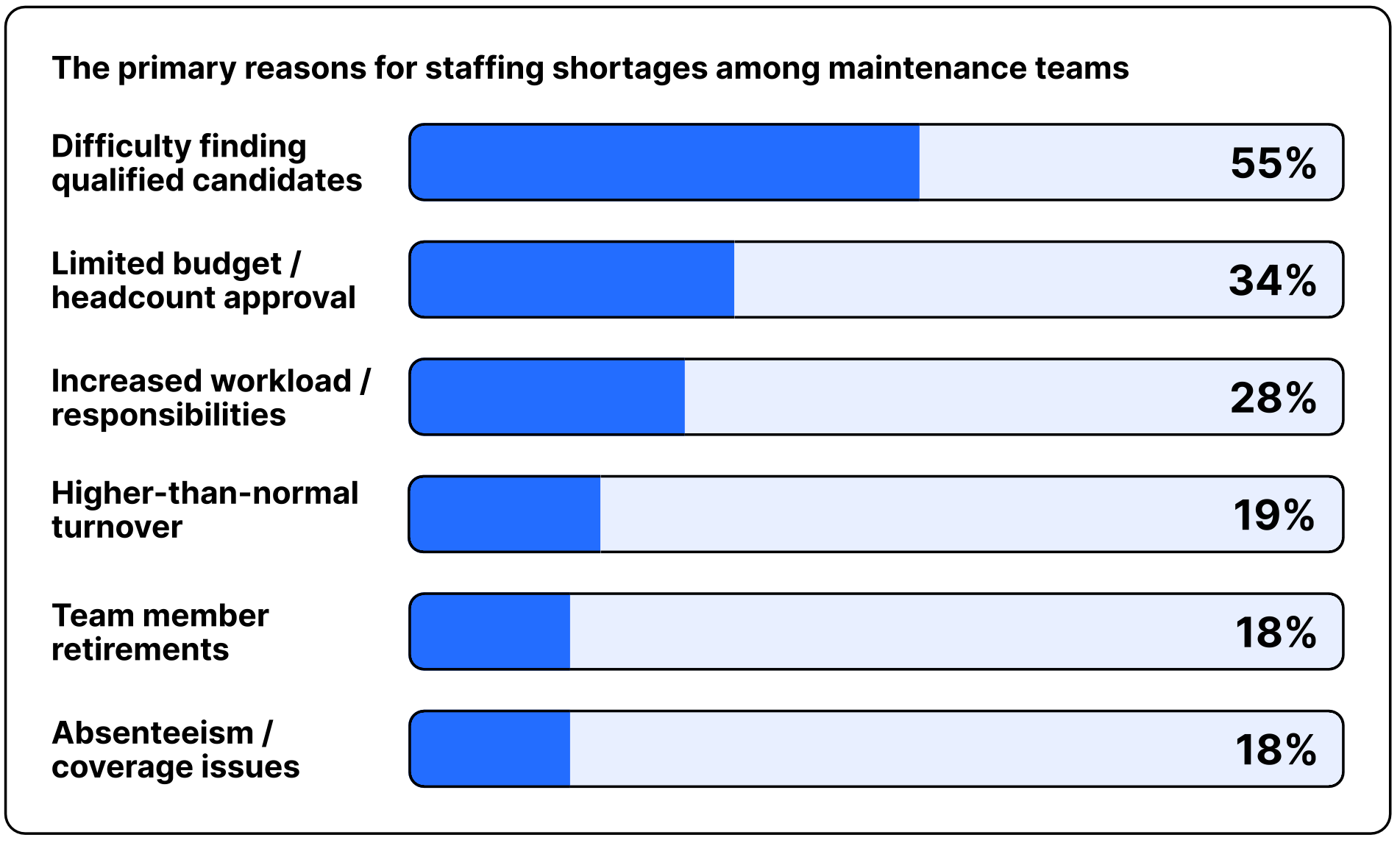
- A lack of staff: 55% of teams said finding qualified candidates is their primary staffing challenge, while 34% said limited budget or headcount approval was keeping them shorthanded. Even when teams find someone to fill an open role, many still run below capacity for months—42% of teams need three months or more to fully onboard frontline staff.
- A lack of budget: While 51% of maintenance leaders say they expect budgets to increase in the next 12 months, their costs will also rise. The cost of downtime in particular is going up, with 39% of leaders saying it increased in the last year. Maintenance teams may have more money, but each dollar buys less. The two biggest factors driving this trend are the rising cost of parts and shipping along with the increased cost of labor.
- A lack of effective systems: Many maintenance teams lack the resources to maximize the effectiveness of their existing tech stack. For example, 58% of teams are using AI, but still face obstacles in unlocking its full value. The biggest challenges to adopting maintenance tech, as cited by maintenance leaders, were integration issues, a lack of budget to expand usage, and skill gaps. Maintenance teams have less time and money to make technology successful by standardizing data and integrating it with other systems.
How to solve it
You can find a great resource on how to build a case for more maintenance resources in this article, and get a customizable proposal template to match. But convincing management and executives to boost your budget isn’t always the most viable option.
So when maintenance teams can’t get more budget and can’t add headcount, the only lever is efficiency. Here are a few ways maintenance teams can increase capacity for their frontline staff:
- Use AI to eliminate manual work: List the tasks frontline staff do outside of high-skill technical work. For example, writing work order notes or creating end of shift reports. Look for ways that AI can make these tasks faster or eliminate them. For instance, AI can summarize all notes from the day into an end of shift report, saving each technician half an hour of extra work.
- Invest in training and knowledge capture: Teams with formal onboarding programs get 67% of new hires productive within 90 days compared to 58% of all teams, according to the MaintainX report on labor shortages. Organizations with strong knowledge capture do even better—70% of those teams get new hires to full productivity in 90 days or less. Continuous training also helps teams increase capacity. Maintenance leaders who said they rarely delay work were 45% more likely to cross-train frontline staff.
- Lean into standardization: Having a single, consistent process for all frontline duties means less time thinking about what to do and how to do it. This frees your highly skilled workers to spend their time and brain power on tasks only they can do. Pick one process, no matter how small, and standardize it. Something as simple as auditing procedures that include manual meter readings and ensuring they use the same directions will increase efficiency and accuracy.
- Find the bottlenecks in your processes and schedule: Ask technicians what roadblocks they regularly encounter on the job. Maybe the parts retrieval process takes too long or they always need to log information twice for every job. Keep a running list of these obstacles, and tackle them based on potential impact and the effort required to implement a solution. Then you can scrutinize your preventive maintenance schedule. Look at inspection failure rates to spot PMs to do less often without increasing failure or compliance risk. Ensure there are no duplicate tasks.
- Integrate operators into maintenance: Having a technician with 20 years of experience spend an hour of every shift on routine checks is not the best use of their time. That’s why enabling operators to complete routine checks and maintenance tasks will multiply your team’s capacity. Operators aren’t waiting on maintenance and maintenance can focus on high-skill jobs. While this is a core pillar of total productive maintenance, it doesn’t need to be complex. Start with one line, give operators a simple, guided SOP for one task, then expand your efforts.
Reframe your maintenance strategy around access
Most maintenance teams know their operation’s assets inside and out, and have no shortage of ideas for improving everything from storeroom setup to the timing of PMs. Yet, these same teams are often stuck spending their day on firefighting because they lack access to equipment, information, or resources. Even the most well-planned maintenance program will fall short without access to those three components.
Solving this issue isn’t easy. It takes time, which is another thing that’s in short supply for maintenance teams. But by starting small, targeting the right areas of improvement, and building momentum, it’s possible to create more access over time. The effort is well worth the opportunity to unlock the full potential of the maintenance team.

Marc Cousineau is the Senior Content Marketing Manager at MaintainX. Marc has over a decade of experience telling stories for technology brands, including more than five years writing about the maintenance and asset management industry.




.webp)