

If downtime, and the cost of it, has recently increased at your facility or company, you’re not alone. Of 689 maintenance and operations leaders surveyed for the Modernizing Maintenance in Manufacturing report, 78% said unplanned downtime either increased or stayed the same over the past year. And even worse, 80% said the cost of that downtime either stayed flat or increased.
All of this can seem like you’re working hard just to stand still. But that doesn’t necessarily mean your maintenance program is broken or that you’re investing in the wrong places, especially because you’re part of the large majority of teams right now.
So, what can you do? Where are the bottlenecks and breakages in your operation? This post breaks down what's driving an uptick in downtime across manufacturing, why each hour costs more than ever, and what teams are doing to avoid both downtime and rising costs.
Why downtime, and its costs, are getting worse for most manufacturers
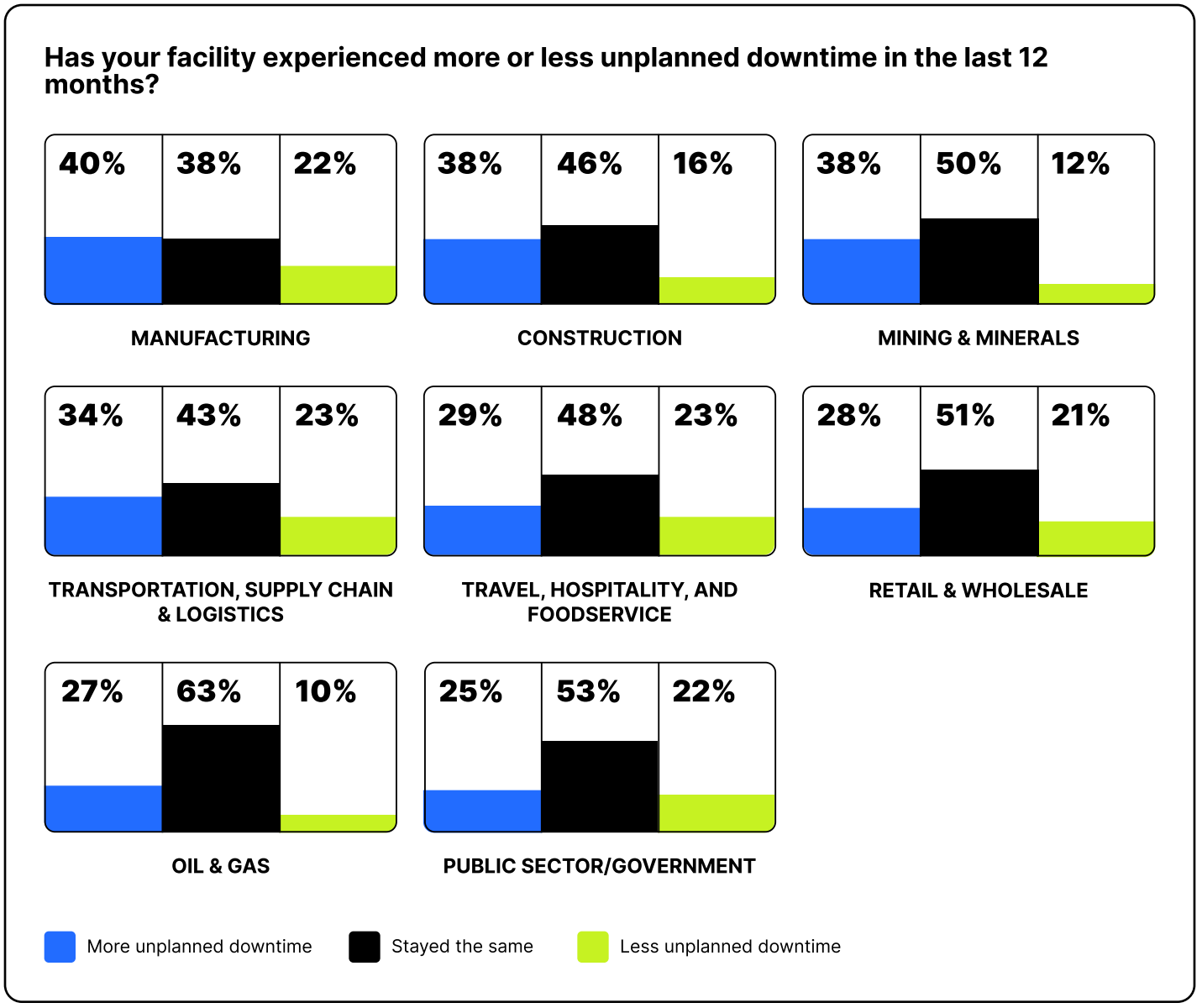
Of the manufacturing leaders surveyed, 40% said they had more or significantly more unplanned downtime than the year before, compared to 34% across all industries. Another 38% said things stayed the same. Only 22% saw an improvement.
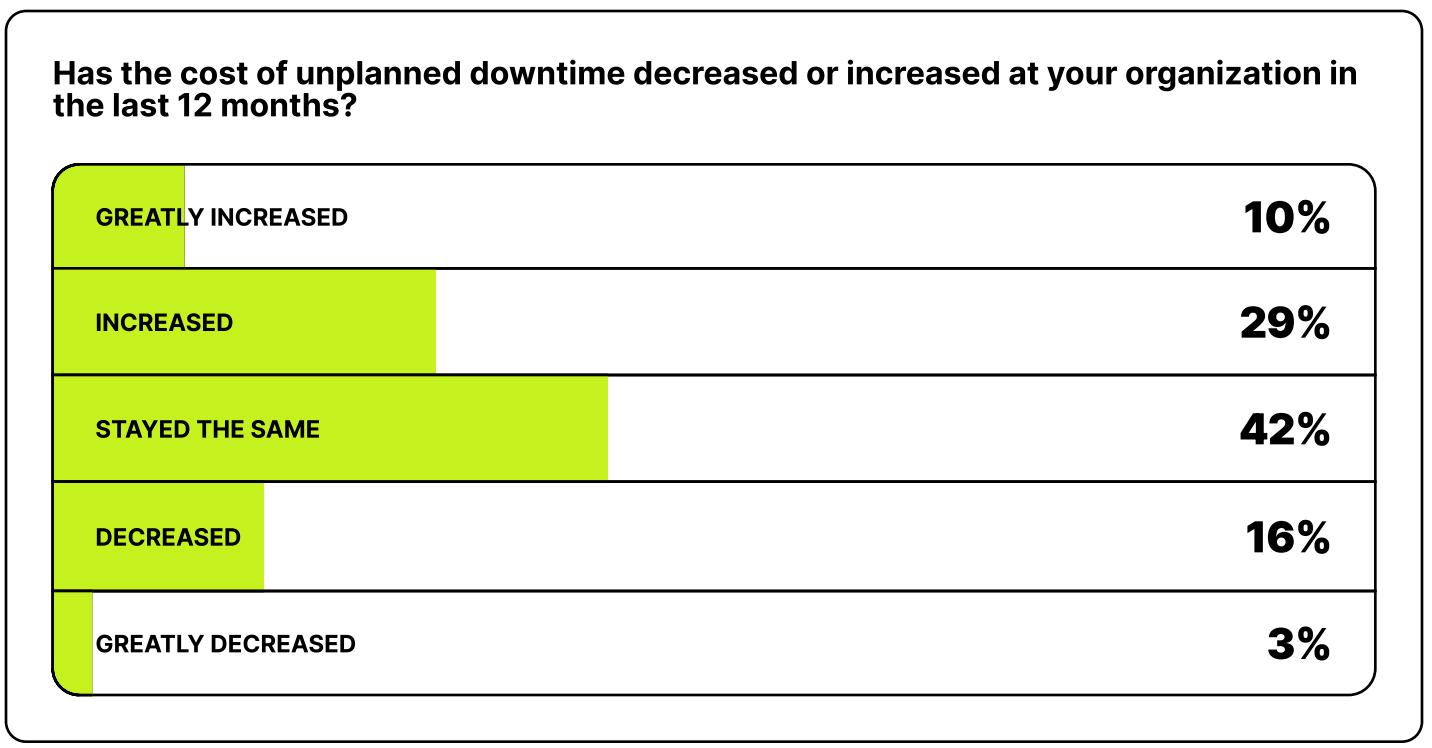
Not only is downtime rising or stalling for most manufacturers, but each minute of that downtime is costing those companies more:
- 39% said the cost of downtime increased
- 42% said it stayed the same
- 19% said it decreased
There were five top reasons that downtime increased for manufacturers, including:
- Equipment downtime: 52%
- Inventory stockouts: 33%
- Poor knowledge transfer or training: 31%
- Labor shortages: 31%
- Operator error: 30%
Here’s a closer look at the root causes behind these drivers of downtime:
Strain: Equipment failure
A well-planned preventive maintenance strategy is supposed to head off of equipment failure. But the data uncovers a gap between these plans and execution. Nearly half of manufacturing teams (49%) spend less than 40% of their maintenance time on planned work.
Supply: Inventory stockouts
Inventory issues are easy to overlook because it doesn't look like a maintenance failure. The work order is ready, the technician is available, and the equipment is available, but the part isn’t on the shelf. A planned job turns into an emergency, the asset stays down longer than it should, and rush shipping inflates costs.
Skills: Training, labor, and people
Three of the top five reasons for increased downtime are about people. Labor shortages and poor knowledge transfer both climbed the list compared to previous years, which is a double blow to manufacturers who are losing both people to keep machines running and the knowledge that makes troubleshooting efficient. Training and operator error can also be attributed to a thin crop of incoming technicians. Training can often fall by the wayside in favor of on-the-job training that addresses immediate issues, while operators are being asked to do more routine maintenance without the tools, processes, or knowledge to be effective.
Why each hour of downtime is costing more for manufacturers
Among manufacturers who said their downtime costs went up, the top three reasons were:
- Parts and shipping costs: 54%
- Wear and tear on critical assets from increased production time: 50%
- Lack of capacity to make up lost production: 48%
Let’s investigate each factor and why they’re such wide-spread issues for manufacturers right now.
Running assets harder and longer
Half of the leaders surveyed point to wear and tear as a cost driver, and more manufacturers cite it than the cross-industry average. Production demand is part of the reason. Increased production demand is one of the top challenges limiting maintenance improvement (28%). When a line runs longer to hit its numbers, the equipment pays for it. Every added shift is more wear, and less time to do the planned work that would have slowed the wear down.
Age makes it worse. U.S. Bureau of Economic Analysis data shows the average age of private nonresidential fixed assets in the U.S. exceeds 16 years, and the average age of structures is 24 years. A lot of plants are running equipment that was built for a different production load, and it shows in the failure rate.
No slack to recover lost production
Nearly half (48%) say they lack the capacity to make up for lost production time, and manufacturers cited this more often than the average across industries.
Downtime isn't a delay you catch up on later. That output is gone, or you recover it with overtime, an added shift, or expedited shipping to keep a customer commitment. The maintenance event may last four hours, but the cost keeps accumulating well after the machine restarts.
This is also why downtime is a business problem, not just a maintenance one. For a plant manager, it shows up as missed schedule attainment. For an executive, it shows up as lost revenue.
Parts costs compound cultural breakages
The market sets the price of parts, but your maintenance practices set the volume. There are a few primary reasons why systemic gaps in maintenance processes are compounding the rising cost of parts:
- Running assets harder. Components that run longer between stops reach end of life sooner and need to be replaced more often.
- Gaps in training and procedures. A wrong torque spec, a misdiagnosis, or the wrong part installed can mean a part fails early or gets replaced when it didn't need to be.
- Emergency buying. When a part fails and there's no spare on the shelf, you pay for expedited shipping and often a premium price. Part of what shows up as "shipping costs" is really a symptom of unplanned work.
Three ways that top maintenance teams are reducing downtime for manufacturers
When maintenance leaders were asked what has helped reduce unplanned downtime at their facility, there were three main answers:
- Improved maintenance strategy: 50%
- Improved training quality and frequency: 47%
- Automation or new technology adoption: 43%:
These elements pull on two levers: frequency and duration. These teams have fewer breakdowns, and shorter ones. Here’s a deeper look at what this means for your maintenance operation:
A better maintenance strategy usually means a more deliberate one
Half of leaders credit an improved strategy, but having a plan on paper is one thing and acting on it is entirely different. Bridging this gap for manufacturers comes down to matching the approach to the asset.
Preventive maintenance is the anchor: 68% of manufacturers use it, a slight uptick from the 64% across industries. But manufacturers also treat reactive maintenance as a deliberate choice more often than average (36% vs. 30%). A low-cost, low-risk asset can be cheaper to run to failure than to maintain. Teams that get this right save their more advanced approaches (usage-based, condition-based, predictive) for the assets where failure is most costly or most dangerous.
In practice, an improved strategy looks like ranking assets by criticality, deciding what level of maintenance is assigned to each tier, and then protecting the planned work that strategy calls for.
Technology helps when the team can use it
Manufacturers are more likely than other industrial companies to be increasing their tech investments in the next 12 months: 44% plan to invest in automation or new technology (vs. 38% overall), and 30% plan to enhance condition monitoring (vs. 24%).
The caveat is the one running through the whole report. When manufacturers were asked about the biggest barrier to stronger returns on maintenance technology, the top answer was limited staff or expertise (24%). Technology reduces downtime when someone is there to act on what it flags.
Training is the lever that's also a cause
Training is a top lever manufacturers can use to decrease downtime and repair costs because it multiplies the other factors mentioned above. A well-trained technician carries out a PM task correctly the first time, which means fewer repeat failures and fewer parts replaced unnecessarily. A team that knows how to read condition monitoring alerts can schedule the fix before the asset fails.
Fewer repeat repairs shorten the time assets spend down, and fewer wasted parts bring spend down with them.
Three ways that top maintenance teams are reducing costs for manufacturers
Here are the top three ways manufacturers are reducing the cost of each minute of downtime:
- Improved parts and inventory management: 70%
- Total productive maintenance and lean initiatives: 59%
- Implementation of EAM/CMMS software: 41%
Parts and inventory management
This is the highest-impact effort for manufacturers. Getting the right parts to the right place at the right time comes down to a few key habits. Stock spares for your most critical assets first. Set reorder points based on how fast parts are used and how long they take to arrive. Tie parts to the work orders that will need them, so a planned job doesn't start without them.
TPM and lean
TPM shifts some basic care (cleaning, inspecting, lubricating) to the operators who run the equipment every day. That does two things. It catches small problems earlier, and it frees up technicians for higher-value work. It also speaks to two common issues mentioned by manufacturers as drivers of downtime: operator error and limited technician capacity. Engaging operators in equipment care addresses both.
CMMS and EAM software
EAM and CMMS software help support the previous two components. Parts and inventory visibility, PM scheduling, and work history all live there, or don't live anywhere. Software doesn't do the work, of course. It makes the work visible, so the team can see what's overdue, what's waiting on a part, and where the repeat failures are.
A 90-day plan maintenance teams can use to reduce downtime and costs
Here's a simple 90-day sequence built on what top maintenance teams are doing to help manufacturers reduce downtime and costs.
Days 1-30: Get parts ready for your most critical assets
Start here because parts and inventory management is the most-cited way manufacturers reduce downtime costs (70%), and because a stockout can turn any other improvement into a stalled job. It's also the move where you can see results fastest.
Keep the scope small. You don't need to fix your whole storeroom in a month.
- Rank your assets by criticality. Which machines, if they stopped, would stop the line or create a safety risk? Pick your top ten.
- Check spares for those ten. For each, identify the parts most likely to fail, and confirm you have them on hand or a reliable lead time.
- Look at the last 90 days of emergency work orders. How many waited on a part? That number is your baseline.
- Track the share of work orders delayed by a missing part, and time to repair on your critical assets.
Days 31-60: Protect planned work on those same assets
Once parts are reliably available for critical assets, the next constraint is time. A PM program only reduces downtime if the work gets done, and for nearly half of manufacturers (49%), less than 40% of maintenance work is planned. That’s why your priority at this stage is to align with the operations team and secure access to equipment when PMs are needed. Here are a few ways to improve the amount of planned work that gets completed on time:
- Agree on downtime windows with production. A PM can't happen if nobody will release the asset. Get the windows on the calendar for your critical assets.
- Reschedule, don't drop. Set a rule that a missed PM on a critical asset gets a new date and an owner.
- Measure planned-work percentage. If you don't know your number, that's the first finding. You can't improve what you can't see.
- Track planned-work percentage and on-time PM completion for the critical-asset group.
Days 61-90: Train for the tools and decisions you already have
Training has the best pay off when workflows are already stable enough to train on. Teaching people a process that changes every week doesn't stick. The most useful place to start with training is with the technology you already own.
- Train on the tool. Make sure technicians can complete a work order, pull up asset history, and find a procedure without help.
- Train on the data. If you have condition monitoring or sensors, make sure someone knows what an alert means and what to do about it.
- Capture knowledge from your most experienced people. Turn what a veteran technician knows into a checklist, a procedure, or a note in the work order history before it walks out the door.
- Track how many technicians are fully using the system, and how many alerts turn into work orders.
Investing in maintenance only pays off with an investment in people and processes
Manufacturers are already investing heavily in modernizing maintenance, and they plan to keep going. But tools and strategies don't reduce downtime on their own. They work when a team has the parts, the time, and the skills to act on them.
In many plants, the pieces of that puzzle live in different places: alerts in one system, work orders in another, parts information somewhere else, and knowledge in the head of a technician who's about to retire. The teams most likely to gain ground are the ones connecting those pieces, so that data reaches the people making maintenance decisions.
Downtime isn't going to fix itself, and you can't control everything that drives it. But you can control how ready your team is when something fails.

Marc Cousineau is the Senior Content Marketing Manager at MaintainX. Marc has over a decade of experience telling stories for technology brands, including more than five years writing about the maintenance and asset management industry.




.webp)