

American manufacturing is growing, but the labor needed to keep that growth running is getting harder to find. New facilities, more complex equipment, and tighter production expectations are all colliding with a shortage of skilled maintenance workers.
We surveyed 211 maintenance and operations leaders to find out how that collision is impacting industrial companies. This article is all about the most important lessons and insights that were captured.
1. Being understaffed is now the baseline for maintenance teams
More than 70% of maintenance teams surveyed said they have been understaffed at least sometimes in the last 12 months while 37% said they are chronically understaffed, meaning they are often or almost always shorthanded.
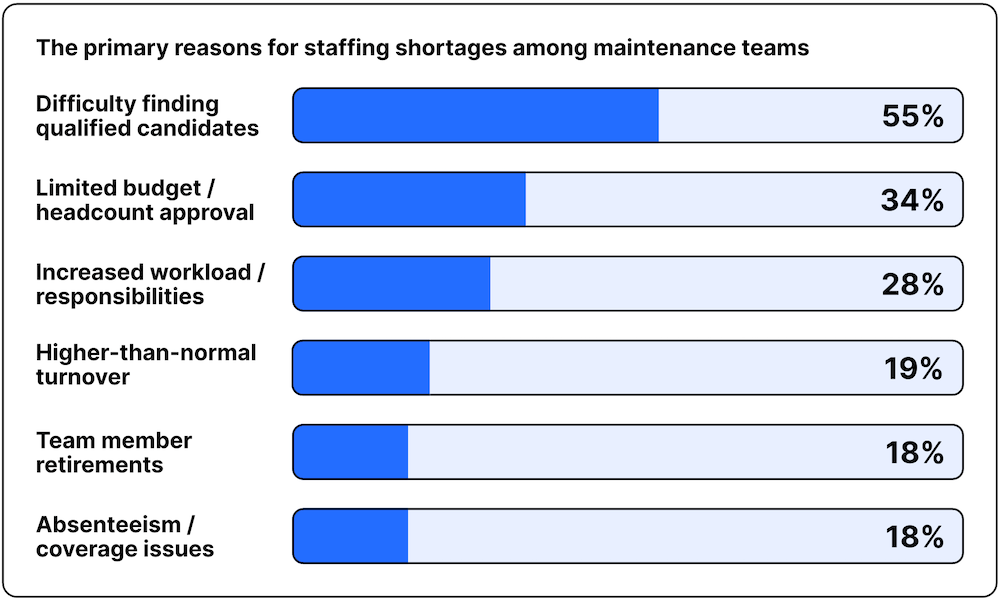
55% of teams said finding qualified candidates is their primary staffing challenge, 22% higher than the next most common reason (limited budget or headcount approval). There aren’t enough candidates with the technical skills to maintain increasingly complex automation, robotics, and industrial infrastructure entering the field to meet demand.
Staffing shortages are being compounded by multiple factors. Approximately 33% of teams said they are losing people to retirements, higher-than-normal turnover, or both. New hires aren't closing the gap fast enough to compensate, with 72% of roles taking 60 or more days to fill and 42% of new staff taking more than three months to fully ramp.
This is the baseline many maintenance leaders are working from. They’re not just trying to work through their daily to-do list while trying to improve their operations, but also trying to do it all while missing the people needed to keep pace.
That changes the way maintenance teams approach planning and execution. A strategy that assumes full staffing will not hold up in the face of constant labor gaps.
2. There aren’t enough new maintenance workers to keep up with retirements
Among the 211 maintenance leaders surveyed, 67% said that their staffing shortages had nothing to do with budget or approval for additional headcount. The leading reason for labor gaps was finding qualified candidates (55%), while 33% said that turnover, retirements, or both were impacting their staffing levels.
If the main problem were budget, teams could make a case for more headcount and push for approval. But when qualified candidates are hard to find in the first place, hiring alone can’t solve understaffing.
The broader labor market points in the same direction. The U.S. Bureau of Labor Statistics projects about 54,200 openings a year for industrial maintenance workers through 2034.
The increase in departing staff and a lack of new candidates is creating a double drain on maintenance teams. There's no cavalry coming: the pipeline of skilled maintenance technicians is shrinking.
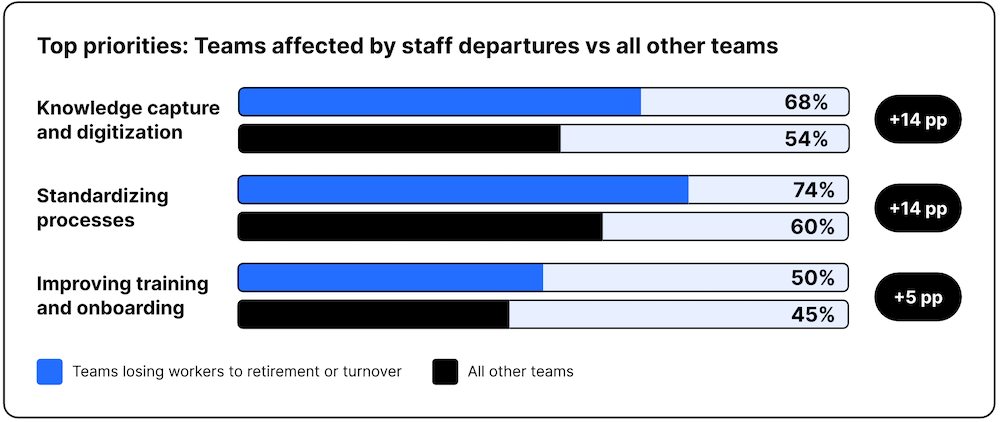
One way teams can tackle this problem is by developing formal processes for capturing and digitizing knowledge. Teams that have already lost workers to retirement and turnover are more likely to be incorporating that strategy into their maintenance plans with 68% listing knowledge capture as a top priority compared to 54% of other teams. They're also more likely to prioritize process standardization (74% vs 60%), and improved training and onboarding (50% vs 45%).
The shortage should be treated like a structural constraint. The teams that adapt will be the ones that build repeatable ways to transfer knowledge, train faster, and make work easier to execute.
3. The shortage of skilled maintenance workers is putting a financial strain on industrial companies
The survey highlights three clear financial consequences of having a chronically understaffed maintenance team:
- Downtime: 46% of chronically understaffed maintenance teams say unplanned downtime is increasing due to being shorthanded.
- Contractor spend: 48% of facilities rely on contractors to fill staffing gaps, raising spend while slowing response times.
- Overtime: 43% of teams are doing more overtime, leading to higher maintenance costs and turnover rates. In fact, teams using overtime to cope with staffing gaps were more likely to cite higher-than-average turnover as a reason (41% vs. 27%).
Each tradeoff may be manageable on its own. Together, they create a difficult financial loop. Short staffing delays work. Delayed work increases risk. Risk turns into downtime, contractor spend, or overtime. Those costs make it harder to invest in the systems that would reduce pressure on the team.
Solving the skilled labor shortage shouldn’t be an effort contained to just the maintenance department. It’s a matter of financial health for the entire organization and the broader industrial sector.
4. Understaffing is one of the biggest obstacles to digitization in maintenance
More than 65% of chronically understaffed maintenance teams said digitization is a top priority. These teams understand that better systems can help them do more with the people they have. The problem is that the teams under the most pressure often have the least capacity to implement those systems. This creates a digital failure loop.
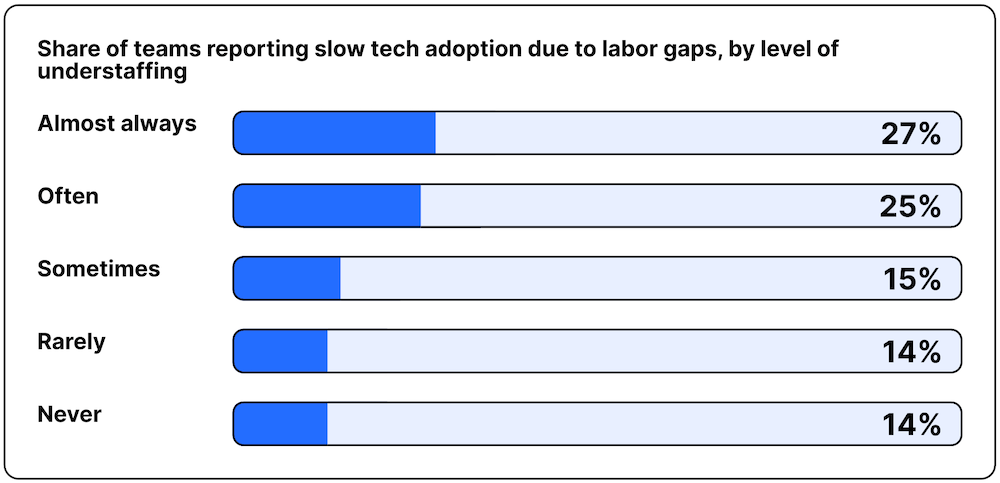
Chronically understaffed teams are 46% more likely to say labor shortages are slowing their ability to adopt technology. They know better systems, data, and workflows are part of the answer. But the day-to-day workload prevents them from implementation, training, and change management.
This is creating a split between two types of teams. One group is building systems that make labor more scalable, consistent, and connected to data. The other is stuck reacting to staffing gaps, which delays the investments that could help them absorb those gaps.
5. The strongest teams aren’t trying to hire themselves out of shortages
The teams navigating the labor shortage best are not necessarily better staffed. They are developing better systems.
The survey compared teams that were avoiding direct financial consequences from understaffing with teams experiencing two or more consequences, such as downtime, overtime, or contractor spend. The difference was not simply headcount. It was how the teams trained, shared knowledge, and invested in tools.
The more resilient teams ramp new hires faster. 70% of teams avoiding direct financial consequences get new hires to full productivity within 90 days, compared with 57% of teams experiencing two or more financial consequences. Faster onboarding gives maintenance leaders capacity back sooner.
The strongest teams are also more likely to cross-train. Teams that were rarely or never shorthanded were more likely to cross-train staff than understaffed teams (48% vs. 33%), giving them more flexibility when someone is out, a critical asset goes down, or work shifts unexpectedly.
Respondents who were rarely or never shorthanded were also three times more likely to invest in software, knowledge digitization, and AI at the same time. Together, these investments help teams make maintenance knowledge easier to find, work easier to standardize, and decisions easier to support with data.
Not every team needs a massive transformation project. In fact, most short-staffed teams cannot afford that kind of disruption. The lesson is that systems create capacity. They help new technicians complete work faster, reduce time spent searching for information, and make analysis and action quicker.
What this means for you: Winning teams will maintain more than just equipment
The data points to a clear split. Some teams are absorbing the labor shortage. Others are being overwhelmed by it. The difference is not just staffing level. It’s whether the team has systems that make labor more scalable.
Teams that rely only on headcount are exposed when hiring slows, retirements accelerate, or turnover rises. Teams that invest in knowledge capture, onboarding, cross-training, and better maintenance data have more ways to protect uptime and control costs when staffing is tight.
Building these systems starts by asking these questions:
- Which tasks depend on one experienced technician?
- Which procedures live mostly in someone’s head?
- What makes it harder to train new hires?
- Which work gets deferred when the team is short?
- Which technology projects keep stalling?
Those questions show where better systems can create the most capacity.
The skilled labor shortage is not going away soon. But maintenance leaders are not powerless. The teams that come out ahead will be the ones that treat knowledge, process, training, and data as assets worth maintaining.

Marc Cousineau is the Senior Content Marketing Manager at MaintainX. Marc has over a decade of experience telling stories for technology brands, including more than five years writing about the maintenance and asset management industry.
.webp)
.png)


.webp)