

Regular vehicle inspections are the backbone of fleet reliability. Inspections are a chance to spot issues before they lead to downtime, and to track trends that can impact your overall maintenance costs.
The checklists on this page are customizable templates that will help you standardize and systematize inspections across your fleet. Download and use them on their own, or import them into a computerized maintenance management system (CMMS) for use as part of a broader preventive maintenance program.
Key takeaways
- Fleet inspections that classify defects by severity (immediate out-of-service versus monitor-and-schedule) prevent minor issues from compounding into roadside violations.
- Recording inspection measurements like tire tread depth and fluid quantities, rather than pass/fail marks, creates the trend data that enables predictive maintenance. Digital checklists in a CMMS automatically route findings and preserve audit trails.
- The daily DVIR establishes a legal chain of custody where driver findings must be certified repaired before the next shift, ensuring defects don't slip through crew transitions.
How to use this checklist
Customize for your facility
This checklist covers standard inspection items for fleet vehicles like commercial trucks, delivery vans, and tractors. Long-haul fleets may need more frequent brake checks, while delivery vans require additional cargo area inspections. Adjust items based on the specifics of your fleet.
Consider both state regulations and federal FMCSR requirements as well. Add manufacturer-specific inspection points from your vehicle manuals, and always follow appropriate safety best practices when conducting inspections: Use wheel chocks, wear appropriate PPE, and report hazards immediately.
Use a CMMS
The checklists below are available to download and print out, or to use on a tablet or mobile device. For best results, however, we recommend importing them into a CMMS. A CMMS captures inspection data in real time, flags recurring defects by vehicle or component type, and automatically generates follow-up work orders. This transforms what would otherwise be a “check-the-box” compliance obligation into a key part of an ongoing preventive maintenance program.


Fleet vehicle inspection checklist
Daily pre-trip inspection
Daily post-trip and DVIR
Weekly operational checks
Monthly maintenance review
Quarterly safety inspection
Annual DOT compliance inspection
Documentation and compliance
Disclaimer: This checklist is to be used only by those with appropriate training, expertise, and professional judgment. You are solely responsible for reviewing this checklist to ensure that it meets all professional standards and legal requirements, as well as your needs and intent.
How pre-trip, post-trip, monthly, and annual inspections connect
Each inspection tier catches what the others miss. Pre-trip inspections flag issues before a vehicle leaves the yard. Post-trip reports capture problems that developed on the road. Monthly inspections dig deeper into wear patterns across brakes, tires, and fluid systems. Annual inspections provide a full baseline.
Treating these as separate obligations creates visibility gaps. A post-trip defect that never reaches the monthly review cycle is a defect that festers. When all four tiers feed into one maintenance workflow, findings at any level trigger the same response: triage, assignment, repair, and verification.
This connected approach also builds a richer data set. Recurring brake wear flagged during post-trip checks across multiple vehicles may point to a route-specific problem or a supplier quality issue. That insight only surfaces when inspection tiers share a single system of record.
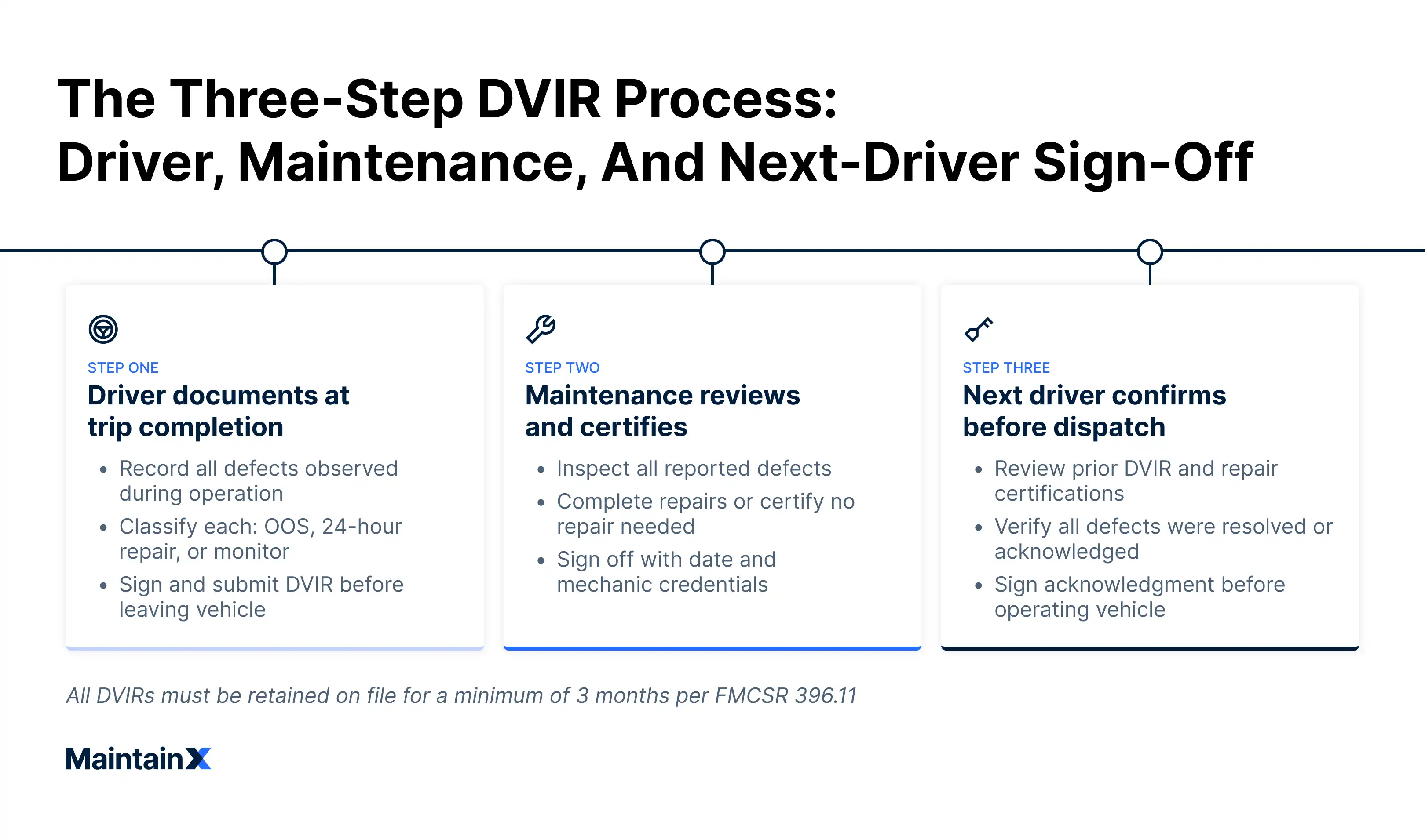
The three-step DVIR process: Driver, maintenance, and next-driver sign-off
A DVIR has three steps: The driver documents a defect, maintenance reviews and resolves it, then the next driver confirms the repair before departure.
Breakdowns in this chain are common. A driver notes a cracked mirror, but the report sits unread until the next morning. Or maintenance replaces the mirror, but nobody updates the record. The next driver assumes the issue persists and files a duplicate.
Each step needs a clear handoff. The driver's report should route directly to a maintenance lead. The repair should generate a closed work order with details. The next driver’s sign-off then serves as final verification. This loop protects CSA scores and gives auditors exactly the documentation trail they expect to see.
How inspection software turns findings into prevention patterns
A single failed brake lamp is a repair ticket. Twenty failed brake lamps across the same vehicle class over six months is a procurement issue.
Paper-based inspections bury this kind of insight. Digital inspection tools tag each finding by vehicle, component, driver, and date. Over time, that structured data reveals which parts fail most often, which routes accelerate wear, and which vehicle models carry the highest defect rates.
Fleet managers who standardize inspections across all drivers and vehicles see the clearest patterns. Use consistent checklists to generate consistent data. When every inspector follows the same items in the same order, the results become comparable and actionable.
The goal is to anticipate what will break next quarter and adjust purchasing, routing, or service intervals accordingly.
Fleet inspections are easier with a mobile CMMS
MaintainX is a mobile-friendly CMMS that meets drivers where they work: in the cab, at the fuel island, or on the dock.
Drivers can complete fleet vehicle inspection checklists on a phone or tablet, attach photos of defects, and submit reports that route instantly to maintenance leads. The faster a defect moves from discovery to work order, the less likely it is to escalate into a roadside violation or an out-of-service order.
Beyond speed, MaintainX creates consistent, time-stamped records of all maintenance and inspection work. Every completed checklist, every photo, and every sign-off lives in one searchable archive. A documentation trail can mean the difference between a clean review and a costly penalty.
See for yourself by booking a tour today:
Fleet vehicle inspection checklist FAQs
What is the difference between pre-trip, post-trip, and annual fleet vehicle inspections?
Daily pre-trip inspections are typically required by DOT compliance regulations before each shift to help drivers spot issues with brakes, tires, lights, steering, and other major systems before hitting the road.
Post-trip DVIRs document defects discovered during operation. A structured inspection process covering all major systems ensures regulatory compliance and vehicle safety.
Annual inspections provide thorough mechanical assessments. Together, these three types of inspections create a layered detection system that identifies problems at different stages of the vehicle lifecycle.
How do I create a standardized fleet vehicle inspection checklist for multiple vehicle types
To create a standardized fleet inspection checklist for multiple vehicle types, build one universal foundation and add vehicle-specific sections on top of it.
Start with components every vehicle shares: brakes, lights, tires, steering, and fluids. These form the core of your checklist and should appear the same way for every vehicle type, using consistent language and inspection order so drivers build reliable habits.
From there, add vehicle-specific sections for each type in your fleet. For example:
- Commercial trucks may need air brake system checks and fifth-wheel inspections.
- Delivery vans may require cargo area, lift gate, and door seal checks.
- Trailers need coupling devices, landing gear, and lighting connector inspections.
Use a consistent format across all versions: same layout, same terminology, same sequence. This makes training easier and reduces the chance of missed items when drivers switch between vehicle types.
How often should municipal fleet vehicles be inspected beyond federal requirements?
Many municipal fleet managers conduct daily inspections for high-use vehicles, such as refuse trucks, and weekly for lighter-duty units. This helps ensure safety compliance and regulatory standards are met. Frequency depends on duty cycle, vehicle age, and route conditions. More frequent inspections typically reduce roadside failures and extend asset life.
What should be included in a Driver Vehicle Inspection Report (DVIR) form?
DVIRs must document brake systems, steering, lighting, tires, and any defect affecting safe operation. The DVIR form should also include the vehicle identification number and odometer reading for accurate record keeping.
The form requires a driver’s signature, date, vehicle number, and carrier certification that defects were addressed or the vehicle is safe to operate. Using a standardized inspection checklist and inspection form ensures all required components are reviewed and documented.
Be sure to consult the applicable regulations to ensure your documentation meets current requirements.
How long should fleet vehicle inspection records be retained?
Federal regulations typically require records to be retained one year for routine inspections and three months for DVIRs. However, many carriers retain records for three to five years as protection during audits, insurance claims, and litigation, where inspection history becomes critical evidence. Check regulations for specifics.

The MaintainX team is made up of maintenance and manufacturing experts. They’re here to share industry knowledge, explain product features, and help workers get more done with MaintainX!




.webp)