

Regular injection mold maintenance is key to keeping production running. Using a maintenance checklist tied to shot-count intervals and specific part defects gives you a systematic way to trace common issues back to quality problems.
This, in turn, helps technicians with informed decision-making and creates ongoing maintenance records that double as audit-ready documentation. Use the checklist below to put these practices into action at your facility.
Key takeaways
- Connecting maintenance tasks to the defects they prevent helps technicians spot early warning signs of injection mold failure.
- Shot counts are an ideal structure for regular maintenance because they reflect actual mold wear, ensuring inspections happen when needed rather than on a fixed calendar.
- Part defects are diagnostic signals. Flash, sink marks, and drag marks each point to a specific mold component before disassembly begins.
How to use this checklist
Customize for your facility
The shot-count intervals in this injection mold maintenance checklist serve as baseline maintenance guidelines. Consider adjusting intervals for high-wear materials or highly regulated manufacturing applications.
You should also review your OEM mold specifications and production history when establishing maintenance intervals. Start by pulling your mold's OEM spec sheet and your last 90-day defect log. Look for patterns between shot counts and quality issues to determine where intervals should tighten.
Use a CMMS
Use this checklist on its own or import it into a computerized maintenance management system (CMMS). Integrated with your press controller or PLC, a CMMS can trigger mold maintenance inspections based on actual shot counts.
Technicians can document findings with time-stamped photos and measurements directly at the press, and work orders are generated automatically. Most organizations find digital systems reduce administrative time while improving maintenance consistency across multiple molds and production shifts.


Injection mold maintenance checklist
Pre-maintenance safety and lockout
Every-run mold checks
50,000-shot preventive maintenance
150,000-shot preventive maintenance
300,000-shot major maintenance
Machine-side checks for mold protection
Injection mold cleaning
Documentation and compliance
This checklist is to be used only by those with appropriate training, expertise, and professional judgment. You are solely responsible for reviewing this checklist to ensure that it meets all professional standards and legal requirements, as well as your needs and intent.
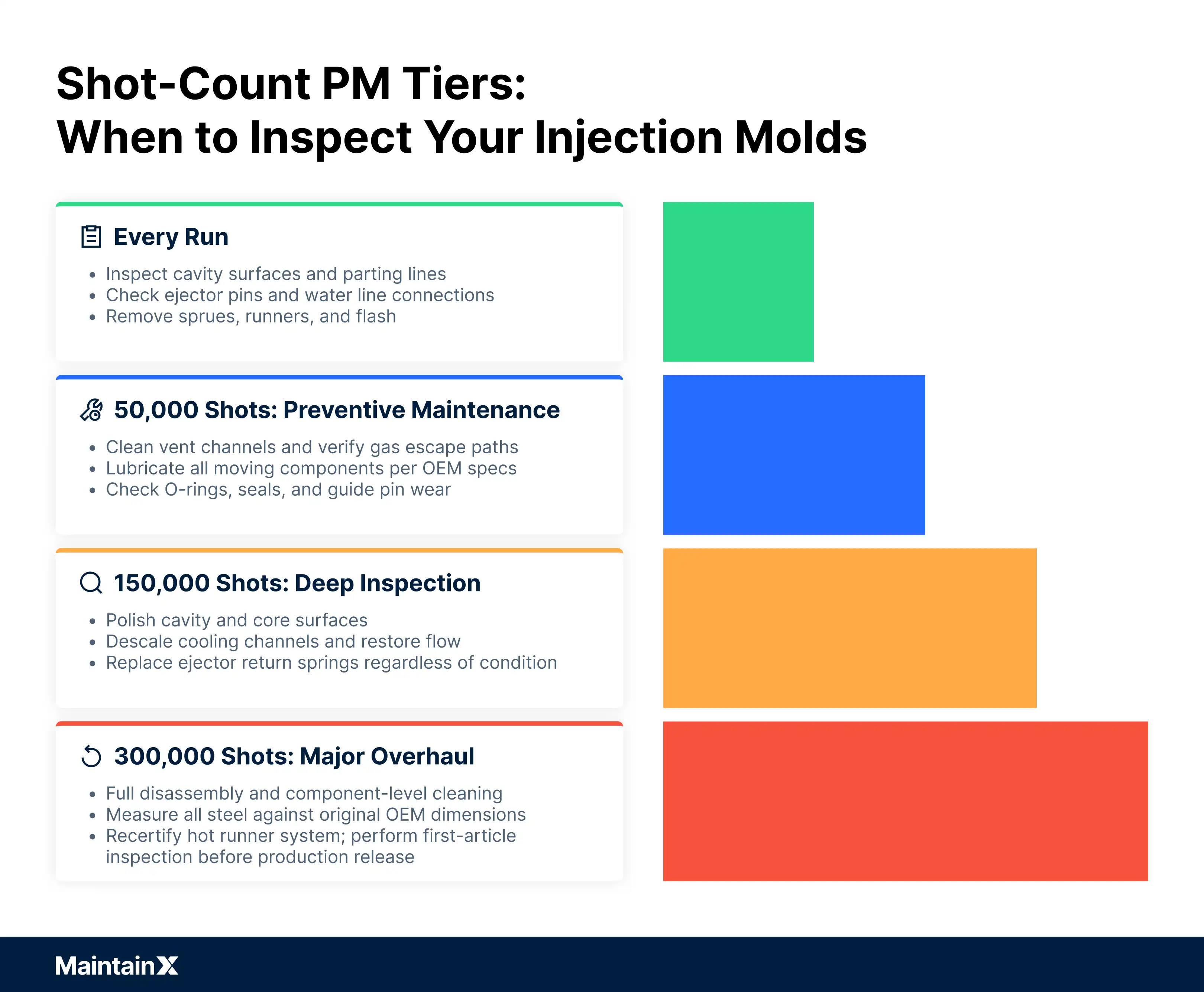
Shot-count mold maintenance tiers: Schedule inspections by tool usage, not calendar dates
Calendar-based schedules treat injection molding machines running 50,000 shots per month the same as ones running 5,000. That mismatch leads to either premature teardowns or missed maintenance windows.
A shot-count tier system scales your PM program to actual tool usage. Light tasks like parting line cleaning and ejector pin lubrication might happen every 10,000 to 25,000 shots. More involved work, such as full disassembly and cooling channel flushing, triggers at higher intervals.
Most modern press controllers track shot counts automatically, making tier-based triggers practical to set up and monitor.
How to diagnose injection mold problems from part defects
Part defects are symptoms. Reading them accurately points technicians to the right mold component before disassembly even starts.
Flash along a parting line often signals worn shutoffs or insufficient clamp tonnage. Sink marks can trace back to blocked cooling channels that slow heat removal. Drag marks on part surfaces typically point to damaged cavity finishes or misaligned ejector pins.
Defect-to-task reasoning turns quality rejections into actionable maintenance intelligence. Rather than scheduling a full teardown for every issue, teams can target the specific system most likely at fault.
Why cooling channel scale buildup leads to costly downtime
Cooling channels account for roughly 60% of total cycle time in injection molding. Even a thin layer of mineral scale inside those channels restricts flow and slows heat transfer.
The impact of this rarely shows up as a dramatic failure. Instead, it creeps in through longer cycle times, dimensional variation, and warped parts. A mold running two seconds slower per cycle across a 500,000-shot production run adds up fast.
Our injection mold maintenance checklist addresses cooling at every tier. At 50,000 shots, technicians compare cooling channel flow rates to a documented baseline to catch early restrictions. At 150,000 shots, channels are descaled, and flow capacity is verified against that same baseline. At 300,000 shots, channels are probed for blockage, corrosion, and wall thinning as part of a full mold teardown. Comparing inlet-to-outlet temperature differentials during production is one of the simplest ways to spot worn or damaged components between those intervals, before parts go out of spec.
Build a maintenance record system that survives quality audits
Quality standards like ISO 9001, ISO 13485, and IATF 16949 all typically require traceable maintenance records. Paper logs and spreadsheets can often technically satisfy this, but they may not hold up under auditor scrutiny when records are incomplete or hard to cross-reference.
MaintainX ties each injection mold maintenance task to the specific mold, shot count, technician, and date. That traceability makes it straightforward to show auditors exactly what was done, when, and by whom. Linking work orders to defect observations creates a documented feedback loop. When a quality issue surfaces, the maintenance history for that tool is already organized and searchable.
Building audit readiness into daily workflows removes the scramble that happens when certification reviews approach. The documentation becomes a byproduct of normal operations, not a separate burden.
Learn more about the benefits of using MaintainX for checklist and inspections and reporting by booking a tour:
Injection mold maintenance checklist FAQs
How often should you clean mold cavities and ejection components?
Cleaning intervals for injection molding tools depend on shot count and material type. High-volume injection molds typically need cleaning every 50,000-100,000 shots, while precision molds may require attention at 25,000 shots. Daily visual inspections catch wear patterns before they affect part quality.
What OSHA requirements apply to injection molding machines?
OSHA typically mandates lockout/tagout procedures during injection molding machine maintenance. Facilities must document safety training for technicians working with hydraulic systems, heated manifolds, and pressurized cooling lines to prevent injury.
Of course, regulatory requirements and best practices change often. Be sure to check the latest guidelines before conducting any maintenance on injection molding machines.
What is the typical lifespan of an injection mold?
Injection molds typically deliver 500,000 to one million shots with proper maintenance. High-cavitation tools or abrasive materials may reduce this to 300,000 shots, while hardened steel molds in controlled environments can exceed two million cycles before requiring rebuild. Regular preventative maintenance procedures can extend mold life.
How do you start a TPM program for injection molding?
To start a Total Productive Maintenance (TPM) program, assign daily cleaning and inspection to operators, then schedule escalating routine maintenance tasks for technicians at predetermined shot-count milestones. This is the core of an effective injection molding TPM program.
Tie every maintenance task to a shot-count interval rather than a calendar date, since mold wear is driven by cycles, not time. Build three tiers of responsibility:
- Operators perform daily cleaning, lubrication checks, and visual inspections at the press.
- Technicians handle deeper inspections and part replacements at defined cycle milestones (e.g., every 50,000, 250,000, and 500,000 shots).
- Engineers review defect patterns and trace recurring issues back to specific mold components to update PM intervals.
Track defects by mold and component from day one. This data tells you whether your intervals are correctly calibrated and which components are wearing faster than expected.
What are the most common injection molding machine maintenance mistakes to avoid?
Skipping cooling channel inspections leads to uneven temperatures and warped parts. Running beyond recommended shot counts without servicing degrades cavity surfaces. Failing to document mold maintenance history makes root cause analysis nearly impossible when quality issues emerge during production runs.

The MaintainX team is made up of maintenance and manufacturing experts. They’re here to share industry knowledge, explain product features, and help workers get more done with MaintainX!



.webp)