
A yearly flush of your tankless water heater should be part of your maintenance checklist, but that’s far from enough to keep your unit functioning and running efficiently. There is a wide range of maintenance tasks you should complete across daily, monthly, quarterly, and annual intervals. Each inspection layer should target specific failure modes, from scale buildup to Legionella risk.
A well-structured tankless water heater maintenance checklist helps to ensure routine and recurring tasks take place, while also creating a central, searchable documentation trail that protects warranties and satisfies compliance audits. Use the template below to help you build your checklist, and start tracking maintenance digitally for more efficient maintenance and optimal equipment upkeep.
Key takeaways
- Thorough inspections and regular maintenance of tankless water heaters help prevent sediment buildup, ensure optimal system performance, and keep energy bills low in commercial settings.
- Perform tankless water heater maintenance at tiered frequencies with daily visual checks to catch leaks and error codes.
- Record temperature readings and T&P valve tests in a computerized maintenance management system (CMMS) to create the audit trail that protects facilities during warranty disputes, insurance claims, and compliance reviews.
How to use this checklist
Customize for your facility
Use this checklist as a template and adapt it to your specific needs. To cite one obvious example: Gas units require combustion and venting tasks, while electric units don't.
Facilities with hard water typically need to be descaled quarterly rather than annually. Consider your local plumbing codes, manufacturer requirements, and warranty terms when setting maintenance intervals.
Use a CMMS
Upload this checklist to a CMMS to simplify preventive maintenance across multiple units and locations. Using a CMMS lets you automate task scheduling based on frequency tiers, send alerts when inspections are due, and maintain compliance documentation automatically, all of which help to streamline maintenance operations.


Tankless water heater maintenance checklist
Daily operational checks
Monthly inspections
Quarterly safety checks
Annual descaling and deep service
Gas venting and combustion (gas units)
Temperature management and Legionella control
Water quality and system efficiency
Documentation and compliance
This checklist is to be used only by those with appropriate training, expertise, and professional judgment. You are solely responsible for reviewing this checklist to ensure that it meets all professional standards and legal requirements, as well as your needs and intent.
Warning signs that mean immediate service is necessary
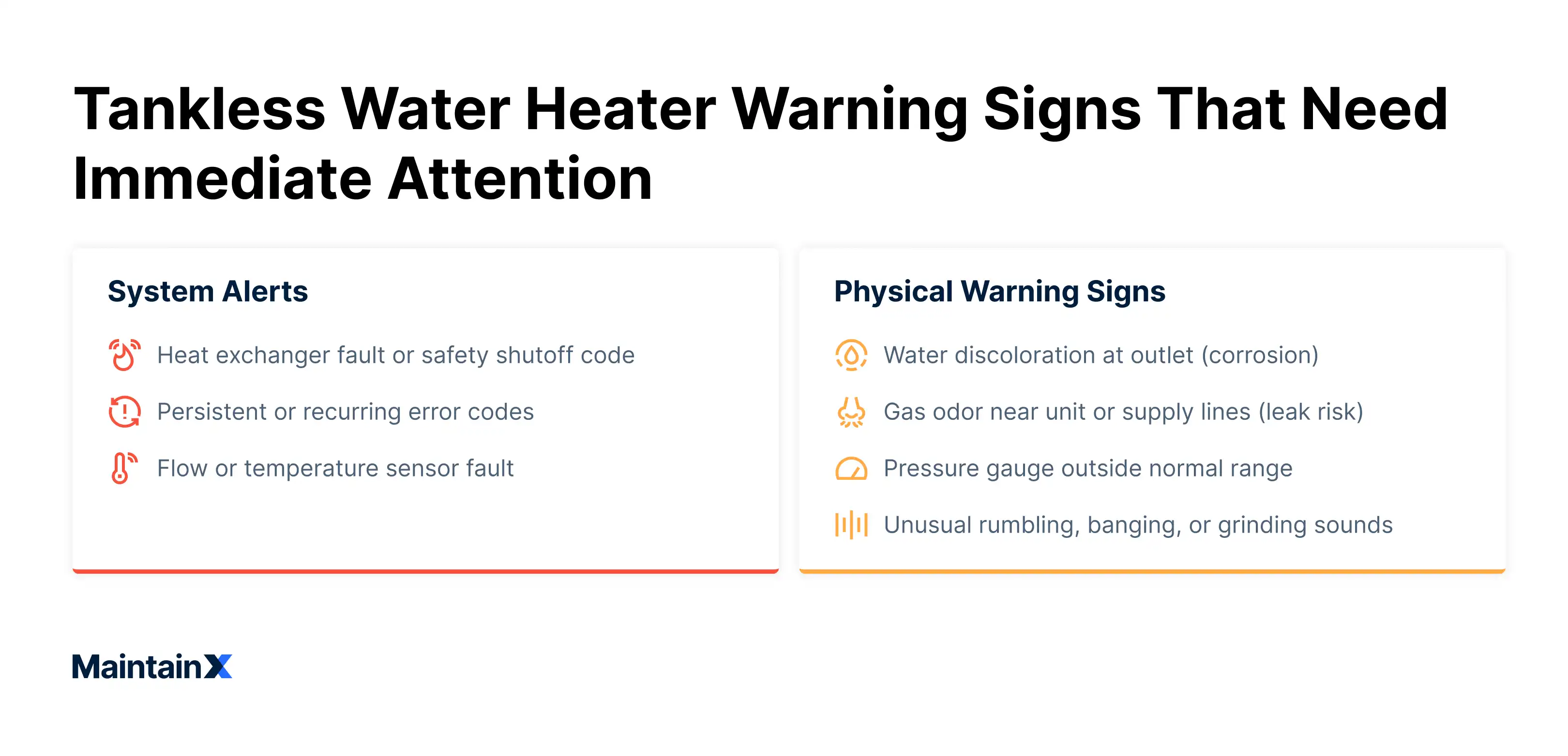
Some warning signs demand same-day attention, regardless of where you are in the maintenance cycle.
Look for fluctuating outlet temperatures, unusual rumbling or kettling sounds, visible moisture around fittings, and error codes flashing on the control board, all of which point to active failures. A sulfur or rotten-egg smell may also indicate bacterial growth inside the unit, which carries Legionella risk that should be addressed immediately.
Facilities teams must know these urgent warning signs and respond to them immediately. Waiting for the next planned interval risks an emergency replacement, or worse. If these indicators appear, pull the unit's maintenance history, note the issue, and escalate to a qualified technician before resuming normal operation.
Why TPR valve testing is your highest-stakes quarterly task
Temperature and pressure relief (TPR) valves exist for one reason: to prevent catastrophic overpressure events. A stuck or corroded TPR valve turns a water heater into a serious safety liability. A malfunctioning valve can also void insurance coverage and expose the organization to significant liability.
Quarterly TPR verification fits naturally into a tiered maintenance cadence, and the test itself is straightforward:
- Lift the lever
- Confirm water discharges freely through the drain line
- Verify the valve reseats without dripping
If it weeps or fails to release, replace it immediately rather than flagging it for the next cycle.
Document every test in a work order with the date, result, and technician’s name so these details are available for insurers and auditors.
Build a documentation trail that protects warranties and claims
On top of tracking completed tasks, maintenance records serve as essential evidence during warranty disputes, insurance claims, and compliance audits.
For instance, most tankless water heater manufacturers require proof of annual descaling and filter cleaning to honor warranty terms. Your team may have completed the work, but without the documentation, the manufacturer can still deny a claim. Unfortunately, some teams discover this too late.
Effective documentation ties each task to the specific failure mode it prevents. A quarterly TPR valve test log, for example, shows an insurer that the team actively managed overpressure risk. A monthly inlet filter inspection record shows the organization took steps to prevent flow restriction and overheating.
When documenting maintenance task completion, include dates, technician names, findings, and any corrective actions taken. This level of detail turns routine maintenance into a defensible service history that proves the facility team took required actions to inspect and repair the unit.
Track water heater maintenance with a CMMS
Managing daily, monthly, quarterly, and annual maintenance cadences is a complex process. Tracking those tasks across multiple units with spreadsheets or paper logs often leads to missed intervals and incomplete records.
MaintainX gives facilities teams a single platform to schedule recurring tasks at each cadence, assign them to qualified technicians, and capture completion data in real time. When a technician logs a TPR valve test or descaling event digitally, the system timestamps the record, keeping it accessible and audit-ready.
See for yourself how MaintainX turns checklists and inspections into documented risk protection. Book a tour today.
Tankless water heater maintenance checklist FAQs
What regular maintenance is required on a tankless hot water heater in commercial facilities?
Commercial tankless heaters require tiered maintenance:
- Daily outlet temperature checks
- Monthly inlet filter cleaning
- Quarterly burner inspection
- Annual descaling
Don’t treat maintenance as a single annual event. By addressing each task category at the appropriate cadence, you can address specific failure modes and prevent downtime.
How often should tankless water heaters be flushed in commercial buildings?
Flush frequency depends on water hardness. It should happen:
- Quarterly in areas with 10+ grains per gallon
- Semi-annually in areas with moderate hardness
- Annually in areas with soft water
High-demand facilities with heavy mineral content (typically defined as exceeding 7 grains per gallon) may also require monthly descaling to prevent heat exchanger scale buildup and efficiency loss.
What happens if you don't flush a tankless water heater regularly?
Skipped flushing causes mineral buildup that reduces flow rates, increases gas consumption, and voids manufacturer warranties. Eventually, neglecting this maintenance can lead to costly breakdowns and prevent your system from running efficiently.
Scale cracks heat exchangers, which can force a $1,500+ replacement, and creates temperature fluctuations that trigger safety shutdowns and compromise compliance with anti-scald regulations.
Are there specific compliance requirements for tankless water heater maintenance in commercial facilities?
Facilities must balance competing requirements: ASSE 1070 anti-scald standards limit outlet temperatures while Legionella prevention protocols require 140°F+ storage. Most jurisdictions require documented monthly temperature monitoring and annual inspections, with records serving as compliance evidence during audits.
Always reference local codes and industry-specific regulations when planning maintenance tasks and schedules.
What are the most common problems with tankless water heaters in commercial settings?
The top issues with tankless water heaters are:
- Mineral scale accumulation reducing capacity
- Ignition failures from dirty burners
- Error codes triggered by clogged inlet filters
- Temperature inconsistency from incorrect gas pressure
Most problems stem from deferred descaling or skipped quarterly inspections rather than equipment defects.
Who is qualified to perform tankless water heater maintenance in commercial buildings?
Licensed plumbers must handle gas connections and combustion adjustments, but facilities technicians can perform filter cleaning, temperature monitoring, and basic flushing procedures.
Most manufacturers require state-certified technicians for warranty work, so verify credentials before assigning tasks beyond routine inspections.
Note: This is a general informational summary only and does not constitute legal, regulatory, or compliance advice. Consult a licensed inspector, qualified plumbing contractor, or legal counsel to determine the specific obligations applicable to your jurisdiction and equipment.

The MaintainX team is made up of maintenance and manufacturing experts. They’re here to share industry knowledge, explain product features, and help workers get more done with MaintainX!

.webp)