

Commercial landscape maintenance requires greater scale, more comprehensive service, and more complex operations than residential yard care. Property managers must navigate the challenges of managing costs and keeping vendors accountable while ensuring compliance with local standards like FIFRA and state pesticide regulations to avoid litigation and liability.
A structured landscape maintenance checklist helps create documented, evidence-based inspection records that streamline recurring tasks. As a result, property managers can catch early-stage issues before they escalate into wider, more costly problems.
Below, you'll find a customizable maintenance checklist for commercial landscaping, as well as some guidance for streamlining inspections and maintaining accurate documentation across properties.
Key takeaways
- Routine landscape inspections catch deterioration early and can prevent issues that might otherwise escalate into code violations, property damage, or liability events.
- Documenting landscape maintenance tasks creates the regulatory audit trail that may be required under EPA and state regulations.
- Storing maintenance checklists in a computerized maintenance management system (CMMS) creates audit trails and helps track recurring issues.
How to use this checklist
Customize for your facility
This landscape maintenance checklist is a template, meant to offer the most value to the largest cross-section of users. Not everything in it will be relevant to every property.
Adjust the frequency of landscape maintenance tasks and inspections based on your climate, property size, and service requirements. Properties in coastal areas may need more frequent pruning and lawn care, while those with mature tree canopies require closer monitoring during storm season because of the risk of limb damage.
Add or remove inspection categories from the template based on your site. Consider things like water features, athletic fields, or native habitat areas. You should also match the checklist to local regulations for stormwater management and pesticide use.
Use a CMMS
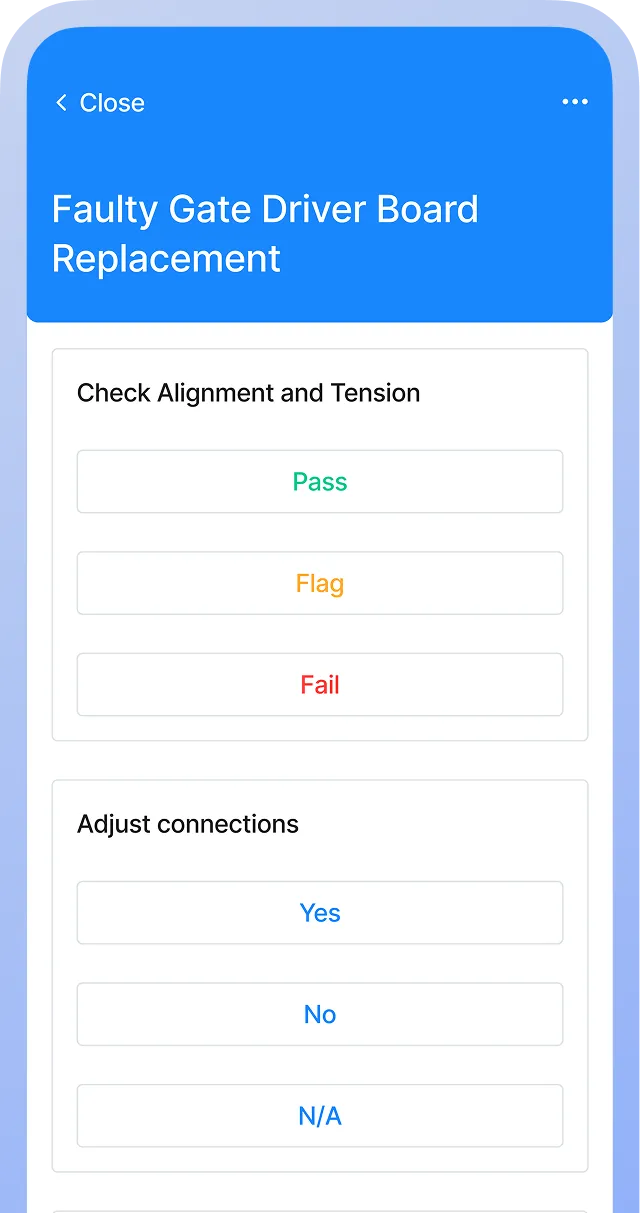
Upload this checklist template to a CMMS to help schedule seasonal inspections, assign tasks to landscape crews, and track contractor performance over time. Having central, searchable records in a CMMS helps to ensure vendor accountability.
A CMMS also streamlines operations for property managers and vendors. Workers can upload photo attachments to document site conditions before and after maintenance to create clear records of task completion. Automated work orders speed up deficiency correction, helping facility managers resolve problems in a timely and efficient manner, and prevent recurring issues.


Landscape maintenance checklist
Entrance and common areas
Lawn and turf areas
Trees, shrubs, and plantings
Irrigation systems
Hardscape, parking, and walkways
Stormwater and environmental controls
Equipment and worker safety
Documentation and compliance
This checklist is to be used only by those with appropriate training, expertise, and professional judgment. You are solely responsible for reviewing this checklist to ensure that it meets all professional standards and legal requirements, as well as your needs and intent.
Common landscape maintenance failures that trigger property damage and code violations
Landscape issues may start cosmetic, but they rarely stay that way. Here are a few examples:
- Clogged drainage inlets lead to stormwater pooling, which can damage pavement and building foundations.
- Overgrown root systems near utility lines create infrastructure risks that cost far more to fix than to prevent.
- Trip hazards from uneven walkways, obscured sightlines at vehicle entry points, and poorly lit pathways all carry slip-and-fall liability.
These conditions often develop gradually, so vendors can overlook them. A structured inspection workflow and landscape maintenance checklist are essential tools for preventing small problems from escalating into safety or structural issues.
Pest damage and unchecked erosion are two more failures that escalate quickly. A small washout near a retaining wall can become a capital repair within a single storm season. Regular inspections, paired with consistent documentation and photographic evidence of on-property issues and work completed, will all help catch these problems early.
Lawn care best practices to prevent water waste and property damage
Some of the most expensive landscape-related damage on commercial properties stems from irrigation failures. A single broken head or cracked supply line can saturate soil near foundations, erode grade away from buildings, and inflate water bills for weeks before anyone notices.
Effective inspection routines should include checking each zone for correct head alignment, verifying run times against seasonal schedules, and looking for soggy patches that signal leaks underground. Rain sensors and soil moisture controllers help reduce waste, but only when someone confirms they're calibrated and functioning.
Document irrigation conditions during each inspection to build a clear performance record. When a vendor's service-level agreement includes response times for leak repairs or seasonal adjustments, accurate documentation becomes the basis for accountability.
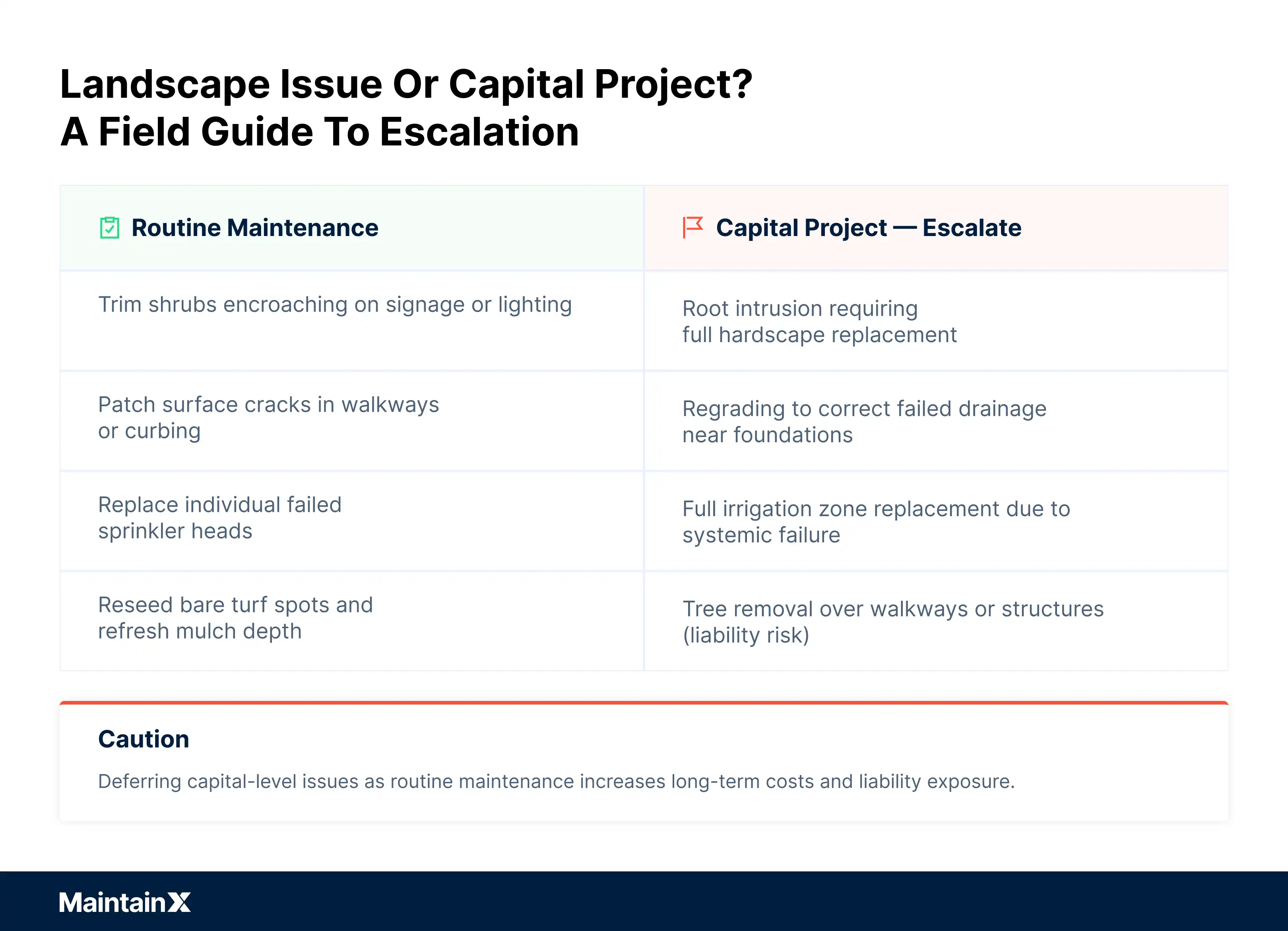
Routine maintenance vs. capital projects: When to escalate
Some landscaping tasks don’t belong on a routine maintenance ticket. They need more urgent and costly intervention. Knowing where routine care ends and where capital work begins helps property managers set realistic budgets and hold the right parties responsible.
Routine items include lawn mowing, edging, seasonal plantings, and minor irrigation repairs. Capital projects cover large-scale regrading, retaining wall replacement, full irrigation system overhauls, or mature tree removal requiring crane access.
But there is a gray area. For example, a drainage swale that needs reshaping, turf areas with persistent die-off, or hardscape sections with spreading cracks are expensive to fix, and may not require immediate intervention. A good rule of thumb is to escalate when a condition reappears across multiple inspection cycles despite corrective work orders.
Track landscape maintenance and seasonal tasks with a CMMS
Paper inspection forms and email chains make it difficult for property managers to spot trends or hold vendors to agreed-upon service levels. MaintainX provides a single platform to schedule inspections, log findings with photos, and generate corrective work orders tied to specific locations.
With all checklist and inspection documentation stored in one system, property managers can spot and address condition patterns quickly, keeping work quality high and proactively correcting problems.
Simplify quality assurance and keep centralized digital records of work completed for ongoing vendor accountability with MaintainX. Book a tour today.
Landscape maintenance checklist FAQs
What does commercial landscaping maintenance include?
Commercial landscape maintenance covers regular grounds care such as mowing, pruning, irrigation, pest control, and seasonal plantings to maintain a healthy and attractive landscape. It also includes inspection protocols that verify contractor performance and catch early-stage issues like drainage problems or erosion before they escalate into costly repairs.
How do you create an effective seasonal landscape maintenance schedule?
Effective schedules balance recurring routine tasks with condition-based triggers to ensure that teams complete essential maintenance on a seasonal basis. Facility managers typically align core services like spring cleanup, summer irrigation, and fall aeration with regional climate patterns, while building in inspection intervals that detect deteriorating conditions requiring immediate attention beyond standard seasonal work.
Using a landscape maintenance checklist helps property managers stay organized throughout the year, making it easier to track task completion and ensure nothing is missed each season.
What are the most common yard care and commercial landscape maintenance issues?
Irrigation failures and drainage problems are some of the most common issues with commercial landscape maintenance, and they often go undetected until damage appears. Weeds are also a common issue in commercial landscape maintenance, requiring timely control to prevent them from overtaking lawns and planting beds.
Through systematic inspections, property managers can uncover other common conditions such as poor contractor follow-through on detailed work, pest infestations spreading from neglected areas, and erosion threatening pavement or foundations.
What documentation should property managers maintain for landscape maintenance?
To support vendor accountability and liability protection, maintain inspection reports with photos, service completion records, and corrective action logs in a CMMS. This evidence proves contractor compliance with service agreements and establishes a defensible record for insurance claims or disputes.
How can property managers reduce landscape maintenance costs without sacrificing quality?
Proactive inspection prevents expensive emergency repairs. Catch irrigation leaks early, address drainage issues before erosion requires regrading, and track contractor performance metrics to avoid the costly ripple effects of landscape issues that start small and escalate over time.

The MaintainX team is made up of maintenance and manufacturing experts. They’re here to share industry knowledge, explain product features, and help workers get more done with MaintainX!



.webp)