

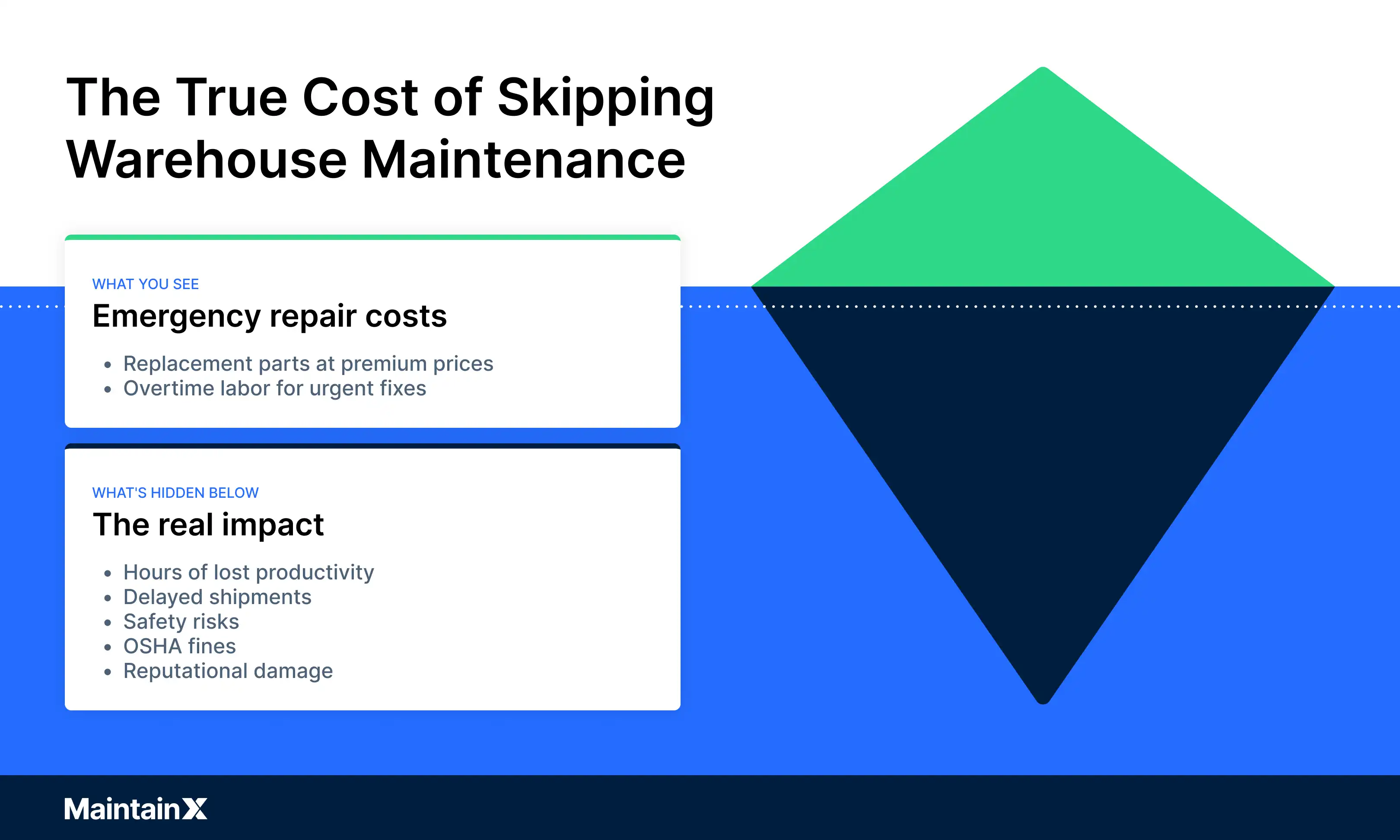
Your team’s gearing up for a high-volume shipping day. An hour in, one of the pallet jacks jams halfway onto the trailer, throwing the entire loading schedule off by almost two hours.
Incidents like this are common, and preventable. They cost organizations money, and compromise employee safety by exposing workers to hazardous conditions.
A subsequent inspection reveals the issue was simple: A loose hinge bolt had been slowly backing out for weeks. It’s a small, fixable problem that costs you a ton of money and possibly your reputation, leading to increased operational costs due to unplanned downtime and repairs.
Warehouse maintenance and inspections are crucial for maintaining high throughput. Regular maintenance, including routine inspection of equipment and infrastructure, prevents equipment failures, accidents, and regulatory fines, ensuring a safer, more efficient, and cleaner facility. Neglecting regular maintenance can result in operational downtime and higher repair costs, as minor issues escalate into major failures.
But starting a comprehensive maintenance program from scratch can feel overwhelming. To get you started, we created a free warehouse maintenance checklist.
Use this checklist as a starting point and tweak it based on your needs.
Key takeaways
- A warehouse maintenance and inspection checklist increases throughput, improves operational productivity, keeps equipment in good shape, and ensures maintenance schedules are up-to-date.
- Include inspections for material handling equipment, building systems, racking, safety gear, work zones, and maintenance procedures in your checklist to ensure high throughput and worker safety.
- Using a CMMS is the most effective way to manage maintenance and inspections.
How to use this checklist
Here’s a quick guide to help you make the best use of this checklist.
Customizing your checklist
The checklist we provide includes standard warehouse maintenance tasks. You’ll need to tweak it and add or remove tasks based on your warehouse’s layout, conditions, and equipment.
Using a CMMS
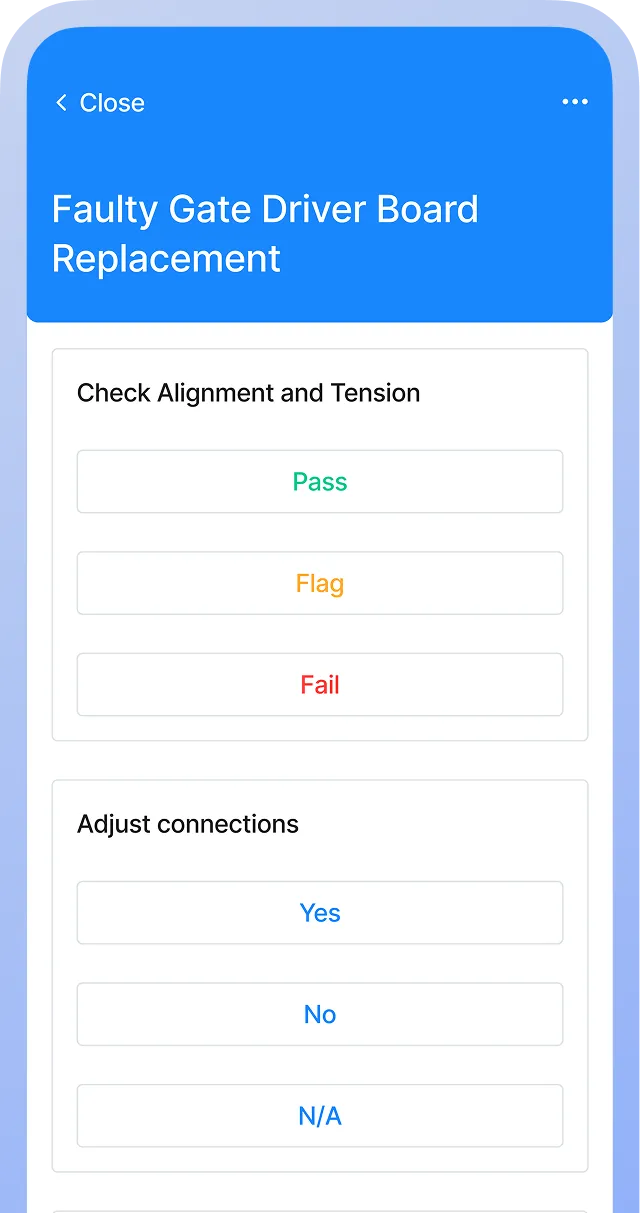
Instead of printing the checklist PDF and manually checking tasks off the list, consider using a computerized maintenance management system (CMMS). Integrating this checklist into a CMMS allows you to track maintenance tasks digitally and automate the maintenance workflow.


Core inspection areas for warehouse maintenance
Let’s look at some key areas you should inspect to keep your warehouse running safely and smoothly.
Remember, the items listed in each area serve as a general guideline. Your warehouse’s inspection needs may differ.
Material handling equipment
Building systems
Storage and racking systems
Safety and compliance areas
Operational zones and work areas
Warehouse cleaning
Documentation and reporting
*Disclaimer: This checklist is to be used only by those with appropriate training, expertise, and professional judgment. You are solely responsible for reviewing this checklist to ensure that it meets all professional standards and legal requirements, as well as your needs and intent.
Preventive maintenance strategies for warehouses
If you’re using this checklist to create a preventive maintenance program for your warehouse, here are some additional strategies to consider:
- Schedule routine inspections: Inspect your facility and equipment regularly to find problems early. With early detection, you can prevent, or at least reduce, unexpected equipment failures and minimize repair costs.
- Prioritize high-use and safety-critical assets: When performing maintenance, prioritize assets like forklifts, conveyors, dock equipment, HVAC systems, and electrical panels to minimize operational disruptions.
- Use CMMS data to predict failures: Track maintenance and asset condition data to find trends. If you notice something unusual, schedule an investigation when your warehouse is least busy. This gives you a chance to prevent breakdowns without letting planned downtime reduce your throughput significantly.
- Follow the manufacturer's guidelines: Pay attention to the manufacturer’s guidelines when scheduling maintenance to ensure compliance with warranty requirements.
- Check if parts and consumables are stocked appropriately: Keep high-turnover parts like filters, belts, and fuses on hand. Tracking inventory levels is easy if you use a CMMS, but this information may also be available in your ERP or inventory management platform.
Best practices for warehouse maintenance
Here are a few best practices that will help you avoid common problems associated with warehouse maintenance:
- Standardize inspection routines: Use the same checklists and procedures across shifts and teams. This will minimize missed steps and ensure cleaner handoffs between crews.
- Combine safety and maintenance checks: Instead of running two separate walkthroughs, merge safety inspections and maintenance checks into a single process. Addressing all needs in one walkthrough saves time and keeps your processes lean.
- Train staff to report hazards or maintenance issues: Frontline workers are often the first to spot problems like loose bolts and strange noises. Build a culture where they feel responsible and empowered to report these issues so you can fix them before they escalate.
- Keep maintenance zones clean and clearly marked: Organize workspaces to prevent trip hazards and make tools easier to find. Cleanliness also makes damages or leaks more visible during inspections and helps technicians complete tasks faster.
- Digitize inspection records for accountability and traceability: Avoid paper logs, as they’re often incomplete and easy to lose. Use a CMMS to centralize maintenance and inspection data to prepare audit-ready records for compliance and insurance.
How to leverage technology to improve warehouse operations
A cloud-based CMMS allows you to store data and manage workflows in a centrally accessible location. When your technician is on the shop floor trying to fix a broken machine, for example, they can quickly scan through the machine’s repair history on their phone.
Most CMMS platforms also integrate with common business tools like ERP systems. This integration enables you to automate previously manual processes.
Think about your parts inventory, for example. Whenever your technicians use spare parts, your CMMS records that consumption.
Your ERP doesn’t have any information about parts consumed for maintenance. But if you integrate your CMMS and ERP, the CMMS can automatically relay that information to your ERP and update inventory records.
Digitize and streamline your warehouse maintenance operations
If you’re trying to move from reactive to proactive maintenance at your warehouse, digitizing your maintenance operations with a CMMS is your best bet.
A CMMS gives the tools you need to reduce downtime, improve safety, keep assets in good shape, and streamline the entire maintenance workflow.
The top distribution center maintenance systems have a proven record of helping companies increase throughput and on-time delivery.
If you’re looking for a reliable CMMS and want to learn more about how MaintainX can help you, book a demo today.
Warehouse Maintenance Checklist FAQs
What is included in a warehouse maintenance checklist?
A warehouse maintenance checklist includes tasks for inspecting material handling equipment, building systems, storage racks, safety equipment, floors, loading docks, and documentation. It may also prescribe the frequency and the person responsible for each task. A comprehensive warehouse maintenance checklist should include a safety inspection checklist and a schedule of all maintenance activities to ensure regular, preventive upkeep and compliance with safety regulations.
How often should warehouse equipment be inspected?
It depends on usage and equipment type. For example, you may need to inspect your forklifts daily, conveyors weekly, and HVAC systems monthly or quarterly.
What are the most common maintenance issues in distribution facilities?
Misaligned conveyor belts, forklift wear, damaged pallet racks, lighting failures, and blocked safety exits are some of the common maintenance issues in distribution facilities.
How can a CMMS improve warehouse maintenance efficiency?
A CMMS streamlines maintenance by automatically scheduling inspections and work orders, tracking parts inventory, and logging repairs. It also gives teams real-time visibility into asset health, helping you prevent unplanned downtime.
What’s the difference between WMS and CMMS in warehouse operations?
A WMS manages inventory movement, picking, packing, and shipping workflows. A CMMS manages maintenance, inspections, asset health, and repair workflows.
How does preventive maintenance reduce downtime in logistics environments?
Preventive maintenance catches wear and failures early, helping you keep assets in good condition. It also allows teams to schedule repairs during off-peak hours, minimizing disruption caused by planned maintenance.

The MaintainX team is made up of maintenance and manufacturing experts. They’re here to share industry knowledge, explain product features, and help workers get more done with MaintainX!



.webp)