

In a warehouse, disorganization leads to hours of lost productivity. A disorganized warehouse suffers from slower fulfillment, inefficient receiving processes, higher costs, and safety hazards.
Warehouse organization is the practice of applying clear labeling, optimized layouts, and connected systems so every item and process has a place and a purpose.
A structured layout and smart inventory management prevent bottlenecks and wasted space. Maintaining optimal inventory levels is also essential for accuracy and responsiveness. Ultimately, efficient warehouse organization is a key factor in building a successful business.
Key takeaways
- Accurate inventory, optimized storage, proper organization, and streamlined workflows create the foundation for efficient, predictable operations and better inventory management.
- Smart floor plans, the right racking systems, and clear labeling turn your warehouse into an easy-to-navigate, low-risk environment, maximizing efficiency through optimized layouts and systems.
- Slotting, disciplined picking methods, and routine cycle counts reduce travel time and keep stock levels accurate without disrupting work.
- Repeatable processes, paired with the right digital systems, keep order sustainable as your operation grows.

What are the main principles of warehouse organization?
Every organized warehouse starts with three fundamentals: inventory management, storage optimization, and workflow processes.
Together, these principles form the backbone of efficient warehouse processes that help teams move faster, reduce errors, and keep stock exactly where it should be.
Inventory management
When inventory counts are wrong, everything else—from ordering to picking to scheduling—crumbles. Effective inventory management requires tracking what’s on hand, where it’s stored, and how often it moves.
In an efficient warehouse, every item has a unique identifier, a clear label, and a digital record. Barcodes or RFID tags link to a central system so workers can scan items in and out in real time. Instead of relying on memory or paper logs, teams use mobile devices to update counts instantly. When a part is used or a product ships, the system updates automatically. That means no double entries or other surprises during audits.
Storage optimization
The best warehouses treat storage space as a limited and precious resource. Storage optimization involves using space strategically to minimize travel time and maximize accessibility.
Fast-moving items belong near packing or shipping areas. Slower movers can sit higher or deeper in racks. Using the right storage methods and implementing vertical storage solutions will improve overall efficiency.
Imagine two warehouses with the same footprint. In one, items are stored wherever they fit. The domino effect is that forklifts must navigate narrow aisles and reverse back and forth around stacks of pallets. Workers have to stop frequently to move misplaced inventory out of the way.
In the other warehouse, every product is slotted by size, weight, and picking frequency. Heavy, bulky items sit on lower shelves. High-turn items are kept close to workstations. Aisles remain open at all times, and traffic moves in a designated direction.
That second layout is faster and safer. With fewer obstacles and less backtracking, forklift operators have clear sightlines and consistent paths. Workers spend less time climbing, bending, or reaching for items that are out of place. Defined travel lanes also reduce collisions and near-misses in high-traffic zones. Over time, that sense of order and predictability cuts the risk of injury and also improves throughput.
Workflow processes
Even the best layout falls apart without disciplined processes to support it.
Start by mapping the flow of goods through your facility. Identify bottlenecks, like staging areas where items pile up or zones that require frequent cross-traffic.
Standardize how workers receive, move, and record items at each stage. Visual cues, like color-coded zones and floor markings, help keep everyone aligned.
Digital tools then amplify these efficiency gains. A computerized maintenance management system (CMMS), or similar warehouse management system (WMS), can assign tasks, log completions, and alert teams to issues instantly. These systems improve efficiency and support automation of retrieval systems for inventory, enabling faster, more accurate picking and placement. Instead of chasing paper or radio calls, managers can see at a glance which orders are complete, which are delayed, and why.


How do I optimize warehouse layout and space?
An optimized warehouse layout is essentially a blueprint for how you efficiently move people, materials, and machines throughout your facility.
The right floor plan shortens travel and prevents congestion. Smart racking systems turn wasted air above valuable floor space into usable storage. Clear labeling and signage keep teams aligned and safe without slowing them down.
Together, these elements transform a warehouse from a confusing labyrinth into a smooth, predictable workflow.
Floor plan and aisle design
Start with the path materials take from receiving to shipping. Map out where products are unloaded, staged, stored, picked, packed, and shipped. A well-organized loading dock is crucial for efficient receiving, product inspection, and the smooth movement of goods throughout the warehouse.
Anywhere in that movement pattern where workers have to double back, cross lanes, or wait for equipment signals a layout problem. It's essential to optimize aisle space to ensure clear pathways for both workers and moving vehicles, such as forklifts, which improves safety and efficiency.
Keep main aisles wide enough for your largest equipment, with buffer space for pedestrians. Design your layout so forklifts and workers move in one direction whenever possible. Think of it like a controlled loop that reduces traffic conflicts.
Position high-demand items closer to shipping and receiving to shorten travel time. Keep staging areas clear and marked to prevent overflow from spilling into walkways.
Efficient layouts also make employee safety visible. Clear sightlines between zones let supervisors spot congestion early. Place mirrors at intersections and paint arrows on the floor to create well-defined pedestrian paths that reduce accidents and confusion.
Racking systems and storage solutions
Your racking system determines how efficiently your team uses every cubic foot of both horizontal and vertical space, and how safely they move within the warehouse.
Each of the following racking methods is built to support a different use case, and you’ll likely include a combination of all three within your facility.
Pallet racking
Pallet racking is ideal for uniform products that move often. Pallets, boxes, and shrink-wrapped cases of components are all likely to be found on a pallet rack. The adjustable beams in a pallet rack let you change shelf heights as product dimensions or volumes shift. Pallet racking also provides easy access to stored SKUs, allowing for quick and efficient retrieval of inventory. Because forklifts can access goods from the front of the pallet rack, workers avoid deep reaches or awkward lifting, which cuts down on injuries and saves time.
Cantilever racks
Cantilever racks have a central vertical column with long, horizontal arms extending outward like branches on a tree. Forklifts or side loaders can slide materials straight onto the arms of the machine without maneuvering around rack posts, which minimizes collisions and damage. Use them to keep oversized items out of the main traffic lanes.
Flow-through racks
Flow-through racks (sometimes called gravity racks) are built like slanted roller conveyors inside a shelving frame. Workers load items from the higher “infeed” side, and gravity carries each unit down to the lower “pick” side. These racks ensure workers always grab the oldest stock first, making them ideal for the food and chemical industries. They’re also useful in maintenance storerooms for high-turn consumables like filters, gloves, or lubricants.
Labeling and signage
If your warehouse layout is the map, labeling and signage are the legend. They tell workers where to go, what’s stored where, and how to move safely. A well-labeled, organized workspace ensures new warehouse employees can walk in, look around, and immediately understand how things flow.
Every aisle, rack, and bin should be labeled in large, high-contrast text that’s readable from a distance. Use consistent naming conventions. For example: Aisle 1, Rack A, Shelf 3, Bin 12. Place those labels in an easily accessible place where pickers can see them quickly and easily.
When it comes to color-coding zones, a blend of OSHA-mandated rules and industry best practices can guide your approach:
- Yellow: An OSHA standard that indicates aisle and traffic lanes, trip and fall hazards, and other areas that require extra caution
- Red: An OSHA standard that indicates the location of fire protection equipment, emergency devices, or dangerous materials
- Striped combinations (yellow/black or red/white): Most facilities use these colors to indicate hazardous areas that must be kept clear or to indicate restricted access areas
Inventory picking systems
Once you have a clean layout for your warehouse and a smart racking system for your inventory, it’s time to put in place the right method for picking your inventory.
Slotting strategies
A good slotting plan reduces travel time, limits congestion, and keeps workers in motion instead of in search mode. Start by analyzing product movement. Determine which items ship most often, which are frequently paired, and which are bulky and heavy.
Fast-moving items, or A-class stock, belong close to picking and packing zones. Ideally, they should be at waist height to minimize bending and reaching. Medium movement items (B-class) can sit farther back. Slow-moving C-class stock will then occupy higher or lower racks.
Let’s say a picker retrieves an order for replacement bearings, belts, and lubricant. In an optimized slotting plan, those three SKUs are near each other because they’re commonly ordered together. Clustering reduces walking distance and time per order. Over a full shift, that adds up to hundreds of steps saved and fewer opportunities for error.
Picking and packing processes
Picking is where most warehouse time is spent and where the most errors occur. Different picking methods support different use cases; here are a few of the most commonly used:
- Single-order picking: Single-order picking is best for operations that prioritize precision over speed. A single worker picks one complete order from start to finish before starting another. The slower pace reduces mix-ups and allows for extra quality checks. This method fits low-volume, high-value, or custom work environments like an aerospace parts distributor or medical device supplier.
- Batch picking: Batch picking is ideal for mid-volume facilities handling many small, repeatable orders. In batch picking, one worker collects items for multiple orders that share common SKUs, reducing repeated trips through the same aisles. It’s common in e-commerce and spare parts distribution centers. For example, a manufacturer’s maintenance storeroom might batch pick all weekly filter orders for its regional sites at once.
- Zone picking: Zone picking divides the warehouse into physical sections and assigns each picker to one area. Orders pass from one zone to the next until complete, like an assembly line. This approach fits large facilities with broad product ranges. This is most often used by third-party logistics providers and retail distribution centers. It reduces congestion and keeps pickers specialized.
- Wave picking: The wave picking method prioritizes speed. Orders are grouped and released in scheduled “waves” based on delivery windows, carrier pickups, or production cycles. The idea is to synchronize picking, packing, and loading schedules so every truck leaves the facility full and on time. Wave picking is commonly used by food and beverage distributors shipping perishable goods.
Cycle counting and inventory accuracy
Every warehouse needs a reliable way to keep inventory counts accurate, because if the numbers don’t match what’s on the shelves, shipments fall behind. Maintaining optimal inventory levels is possible through regular cycle counting, which helps ensure stock accuracy and prevents shortages or overstock.
Traditional full physical inventories try to fix this by shutting down once or twice a year to count everything at once. The problem is that they’re disruptive, time-consuming, and often outdated as soon as they’re finished. Errors can hide for months before anyone notices, and by then they’ve already cost time, labor, or money.
Cycle counting takes a different approach. Instead of stopping operations to audit every rack, teams check small sections of inventory on a rotating schedule while the warehouse keeps running. For example, fast-moving SKUs in Aisle 1 might be verified on the first Monday of the month. Back stock could be checked on Wednesday. Over the course of a month, every location is audited without ever halting work.
Warehouse organization best practices
To maintain an efficient warehouse, teams should follow structured practices that prioritize cleanliness, safety, and digital coordination. The most effective facilities adopt the 5S methodology, implement strict cleanliness and safety routines, and rely on a WMS or CMMS.
What is the 5S methodology?
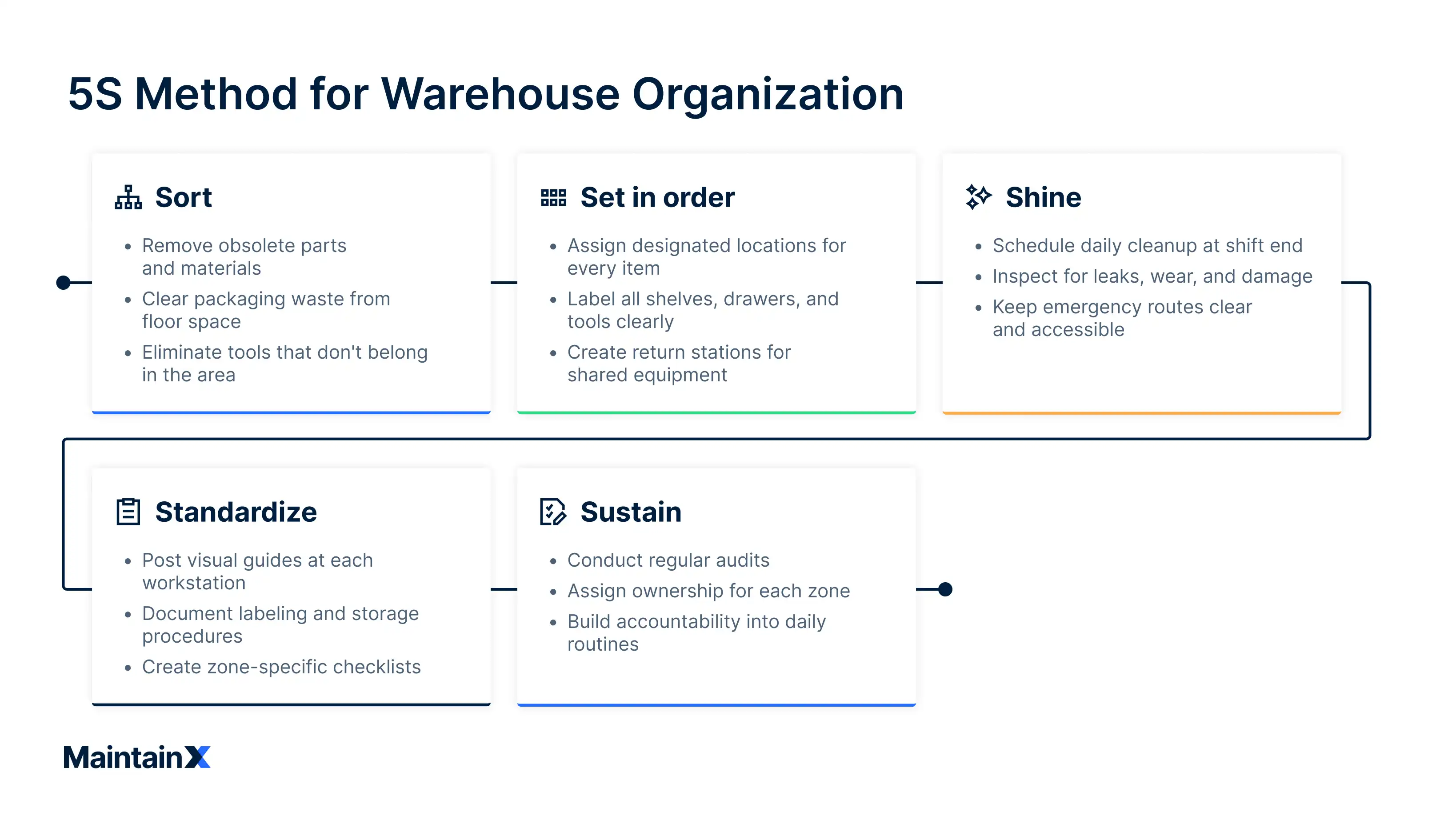
5S is a proven organizational framework developed in Japan and widely adopted in manufacturing and logistics. It creates discipline through five simple, repeatable steps:
- Sort: Remove everything that doesn’t belong. Clear out obsolete parts, tools, and packaging materials wasting valuable floor space.
- Set in order: Give every item a designated location. Label shelves, drawers, and tools so workers can find and return items instantly.
- Shine: Keep the workspace clean and inspect it regularly. Keep an eye out for leaks, wear and tear, or misplaced items.
- Standardize: Establish consistent procedures for labeling, storage, and inspections. Post visual guides at workstations so the system doesn’t depend on memory.
- Sustain: Regular audits, checklists, and team ownership make 5S into a culture rather than a chore.
Cleanliness and safety practices
A clean warehouse is a safe warehouse. Dust, spills, and clutter might seem harmless. However, they increase slip hazards, hide damage, and make emergency routes harder to navigate.
Routine housekeeping, visual inspections, and well-marked floor zones keep hazards from building up.
Schedule daily cleanup tasks at the end of each shift. Assign ownership for each zone so it’s clear who is responsible. Post visual checklists in each area.
Warehouse management systems vs. computerized maintenance management systems
Both WMS and CMMS improve warehouse organization, but they solve different problems. Understanding how they complement each other helps leaders choose the right tool—or decide to integrate both into their operations.
- Warehouse management systems: WMS track inventory movement as it flows through the supply chain. A WMS ensures orders move accurately and efficiently from dock to door by managing receiving, picking, packing, and shipping functions.
- Computerized maintenance management systems: CMMS focus on asset reliability and parts management. They track equipment health, schedule preventive warehouse maintenance, and monitor spare parts inventory. A CMMS ensures machines keep running and technicians always have the components they need.
In many operations, these systems overlap. For example, a CMMS may trigger a reorder for replacement filters when stock runs low. The WMS will log the incoming shipment and route it to the correct rack. Together, they form a loop so production assets stay reliable and no one scrambles for missing parts during downtime.
Digital tools for distribution and logistics
With a CMMS, inventory stays accurate because it’s tied directly to maintenance activity rather than being updated after the fact (if a picker remembers). Managers can also see from a single dashboard exactly how downtime, costs, and parts usage affect each other.
Learn more about how MaintainX supports distribution and logistics.
Warehouse Organization FAQs
What is the most efficient way to organize a warehouse layout?
Start by mapping the path materials take from receiving to shipping. Keep high-demand items near picking and packing zones, use one-way aisles to reduce congestion, and design clear staging areas that don’t block travel routes. Label aisles, racks, and bins so workers can navigate without stopping to ask.
To keep your warehouse organized, implement regular maintenance, schedule cleanings, and establish clear policies for inventory management. This ensures efficiency and accuracy throughout your operations.
How can a CMMS improve warehouse operations and maintenance efficiency?
A CMMS tracks equipment performance, schedules preventive maintenance, and logs every part used. When a repair is made, the system automatically updates inventory and triggers reorders if stock is low.
What’s the difference between WMS and CMMS in warehouse management?
A warehouse management system (WMS) tracks goods as they move through receiving, storage, and shipping.
A computerized maintenance management system (CMMS) keeps the equipment and infrastructure that support that movement in working order. Together, they ensure both your products and your assets flow smoothly.
How does the 5S methodology help maintain warehouse organization?
5S creates a repeatable structure: sort what’s unnecessary, set in order what’s left, shine by cleaning and inspecting, standardize procedures, and sustain through daily habits.
What are the best practices for improving inventory accuracy and picking speed?
Use slotting strategies to group frequently picked items close together, apply barcode scanning to confirm accuracy at every step, and adopt a cycle counting program to verify stock without shutting down operations.
Real-time updates through a CMMS or similar system keep digital records aligned with what’s on the shelves.
How often should warehouses review or reconfigure their layout for optimal performance?
Most warehouses benefit from a layout review every six to 12 months.
Also, review your layout anytime order volume, product mix, or equipment changes. Watch for signs like crowded aisles, delayed picking, or frequent restocking that may indicate the need to reconfigure your layout. When reviewing your layout, ensure employee safety by maintaining clear pathways and proper signage to prevent accidents and hazards.
Small adjustments, like re-slotting high-turn items or widening key paths, can restore flow without a full redesign.

The MaintainX team is made up of maintenance and manufacturing experts. They’re here to share industry knowledge, explain product features, and help workers get more done with MaintainX!




.webp)