
Every facility depends on equipment that runs safely and reliably. When teams don’t have the time, resources, or systems to stay ahead on maintenance, small issues quickly turn into downtime, higher costs, and safety risks.
A facilities maintenance management program gives your team a structured way to prevent those problems. It combines preventive maintenance, asset care, and compliance into a cohesive strategy that keeps operations stable and healthy.
Key takeaways
- Effective facilities maintenance management creates stability by replacing unpredictable repairs with a proactive, preventive approach.
- Clear, consistent workflows supported by accurate data help teams work with confidence and keep the entire operation running smoothly.
- A CMMS (Computerized Maintenance Management System) brings structure and visibility to maintenance work so teams can plan, execute, and improve with far less friction.
- Organizations that commit to preventive care and modern tools see meaningful gains in uptime, safety, and overall cost control.
What is facilities maintenance management?
Facilities maintenance management is the practice of keeping your buildings and the equipment inside them running well.
It includes a range of core services and support services designed to optimize property performance and reduce operational costs. A facilities manager plays a key role in aligning maintenance with business goals and ensuring efficient operations.
The goal is to run your facility without unnecessary downtime, safety risks, or surprise costs.
Defining facilities maintenance management vs. facility management
Facility management covers everything required to support the people who work in the building. That includes things like providing security or custodial work.
Facilities maintenance management, on the other hand, focuses specifically on the health and performance of physical assets. This includes production equipment and life and safety systems like your HVAC.
The role of maintenance in facility operations
A reliable maintenance program supports consistent product quality and ensures critical systems stay within safe operating limits.
Prompt attention to maintenance issues and efficient handling of service requests improves employee productivity and customer satisfaction. Recording data on asset health and parts usage gives operations leaders intelligence they can use to plan budgets and decide when to repair, overhaul, or replace equipment.
Accurate reporting is essential for tracking maintenance performance and communicating results to stakeholders. When maintenance teams perform well, every other division of the organization feels the benefits.
What are the core components of facilities maintenance management?
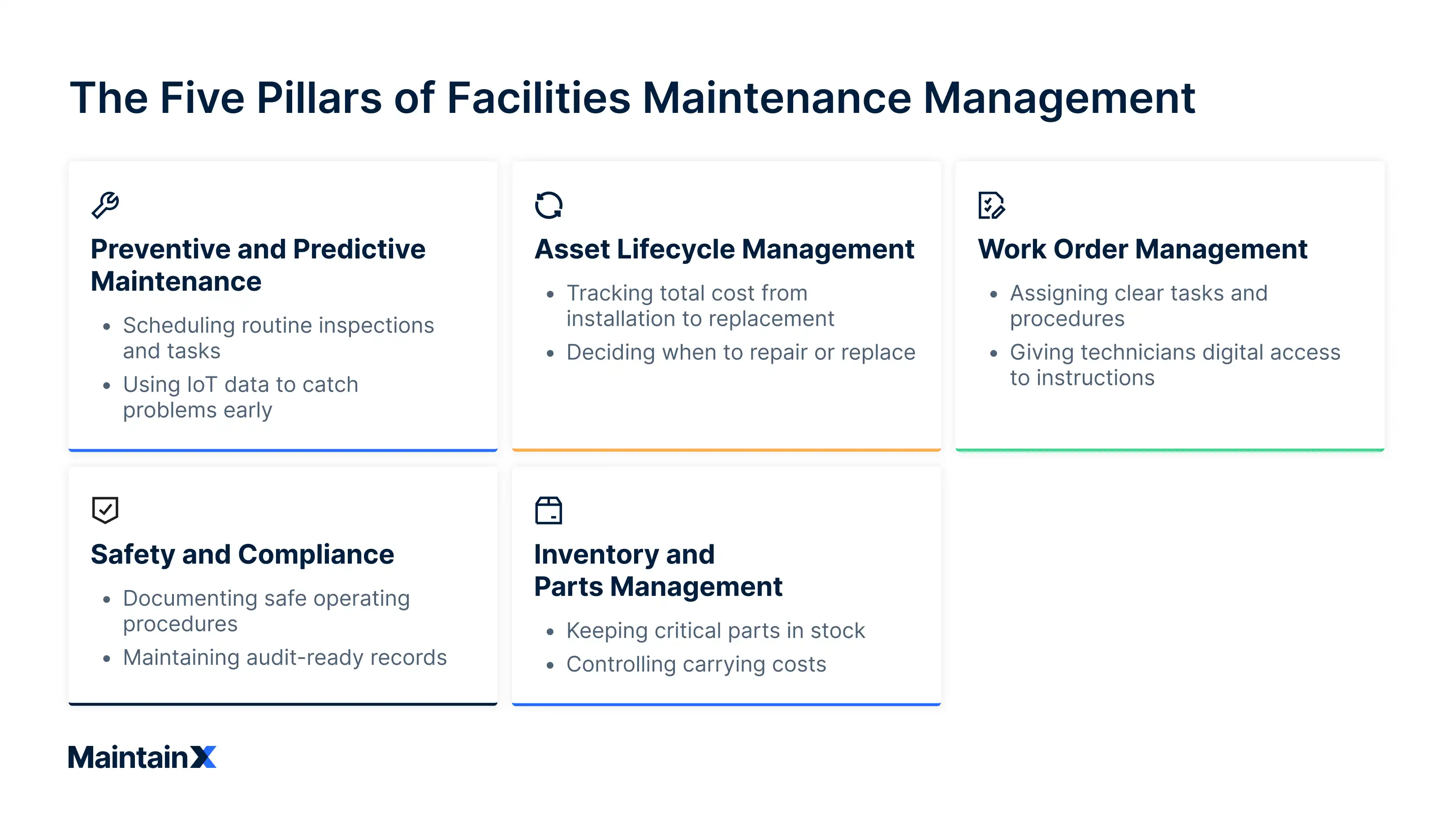
Facilities maintenance management centers on a handful of practices that give your team a repeatable way to plan work, control downtime, and make informed decisions about assets.
Preventive and predictive maintenance programs
Preventive maintenance uses scheduled tasks such as inspections, lubrication, calibration, and parts replacement to keep equipment running.
Predictive maintenance goes a step further. This type of maintenance program uses data from sensors or physical inspections to identify early signs of deterioration.
When you know an asset is trending toward failure, you can schedule the repair at the right time and avoid costly, rushed fixes or production interruptions.
Asset and equipment lifecycle management
Lifecycle management helps you understand the true cost and performance of every asset, from installation through replacement.
When you track repairs and downtime regularly, you can identify chronic issues and decide whether repeated repairs make sense or if it’s time to replace a machine.
Work order management and execution
Work orders define what needs to be done, who is responsible for the work, what parts are required, and how to complete the task correctly.
Clear work order processes reduce rework and inconsistent repairs. Digitizing those work orders speeds up the process and improves accountability.
With digital work orders, technicians can also access correct procedures, log notes, capture photos of the work, and check off tasks straight from their phones.
Safety, compliance, and regulatory adherence
Safety and compliance matter because a single missed step can put people at risk and expose the facility to fines or shutdowns.
A strong maintenance program gives technicians clear direction on how to handle equipment safely, verify operating conditions, and record what they did in a way regulators can rely on.
For example, say a technician wants to power down an ultrasound machine in an exam room. The documented steps on the checklist explain how to do that safely. After the work is done, the technician can add notes that explain how the steps were followed, who performed the work, and when the equipment was placed back in service.
That level of clarity makes audits far less disruptive and helps the facility maintain a controlled, predictable working environment.
Inventory and spare parts management
Reliable maintenance depends on having the right inventory, ensuring the parts you need are on hand when you need them.
Effective inventory management helps you track stockpiles, vendor lead times, and other data points. With this, you can avoid stockouts or duplication, control carrying costs, eliminate emergency purchases, and reduce delays during repairs.
Facilities maintenance management best practices
Several best practices keep facility maintenance work predictable and reduce the chance of equipment-related failures.
Implement a clear preventive maintenance schedule
A PM schedule helps surface issues earlier, so equipment stays in better condition. That might look like quarterly checks on the rooftop HVAC units so airflow problems are caught before they cause problems inside.
Standardize procedures and inspection routines
Standardized procedures and inspection routines make sure those scheduled tasks happen the same way at every site, which improves consistency and reduces onboarding time.
Record and analyze real-time data
Real-time data helps teams decide where to focus their effort and which assets need attention first. If a boiler has generated several temperature alarms in a short period, recording and reviewing that data helps the team prioritize that work, even if another task was scheduled ahead of it.
Collaborate across departments
Collaboration ties everything together.
Maintenance, operations, and safety teams all influence whether work happens on time and whether technicians have what they need to work safely and efficiently. Operations, for example, might communicate when rooms are available for maintenance to step in and work on a machine. The safety team can give everybody a heads-up about an upcoming audit, so maintenance can confirm everything is in good shape ahead of a visit.
These small points of coordination help the facility run smoothly and reduce surprises for everyone involved.


How do I measure the ROI of a facilities maintenance management program?
The most direct way to calculate maintenance ROI is to compare the cost of running your program to the savings it generates.
Add expenses like labor and parts, then compare those costs to the reductions you see in unplanned downtime and asset replacement.
If preventive maintenance extends asset life, reduces emergency labor, or cuts back on overnight shipping for parts, document those savings. Over time, this data makes it easier to justify investments in staffing, training, tools, and capital replacements.
Alongside financial calculations, you should monitor metrics that reveal whether your program is moving in the right direction. Equipment uptime, mean time to repair (MTTR), and the balance between preventive and reactive work help you understand whether the facility is becoming more stable and predictable.
Leaders also want visibility into how maintenance supports the company’s strategic goals. When you use reliable data to present trends, forecast future needs, and explain how maintenance impacts production, safety, or compliance, you strengthen your position at the decision-making table.
Common facilities maintenance management challenges (and how to overcome them)
Many facilities face similar challenges as they try to reduce downtime and run a proactive maintenance program.
Balancing PM with urgent repairs
One of the toughest of those challenges is balancing preventive maintenance with urgent, reactive work. Breakdowns interrupt schedules and pull technicians away from planned tasks.
The best way to regain control is to allocate time on the schedule for preventive work, prioritizing the assets that create the most disruption. As those issues get addressed, the volume of reactive work should start to decrease.
Standardizing work across facilities
Managing maintenance across multiple sites adds another layer of complexity. Each location may have different processes, technicians with varying skill levels, and competing expectations. That can all make it hard to compare performance across facilities and allocate resources effectively.
Standardized procedures and shared documentation help unify operations. When every site uses the same workflows and records tasks the same way, you know work is being performed consistently, and you're minimizing variation and error.
Meeting regulatory requirements
Another ongoing challenge is compliance. Audits, regulatory requirements, and safety procedures demand accurate records and consistent documentation. If those records are scattered across systems or routinely incomplete, you’ll lose time during audits and face higher risks during operations.
Digital work orders, automated recordkeeping, and clear standard operating procedures (SOPs) make it easier for technicians to follow the correct steps, and for supervisors to verify that work meets standards.
Finally, aging equipment creates its own pressures. As assets reach the end of their useful life, they fail more often, require more expensive parts, and push the team into a cycle of constant repairs.
Routine maintenance, condition monitoring, and accurate maintenance histories help you extend equipment life. However, eventually, you’ll need to make the decision to replace the equipment. Here, data showing cost trends, failure patterns, and downtime can help make the case for capital spending.
The role of technology in facilities maintenance management
Technology strengthens every part of a maintenance program by standardizing processes, speeding up workflows, and giving teams the data they need to make better decisions.
How CMMS platforms streamline maintenance operations
A CMMS brings structure to daily maintenance work. It centralizes maintenance schedules, work orders, asset histories, and documentation. That way, teams can plan and execute their tasks with fewer interruptions.
Automated scheduling keeps preventive maintenance work on track, while real-time dashboards help supervisors see workload and overdue tasks at a glance.
When technicians record data in the system, leaders gain a clear view of asset performance, labor costs, and long-term maintenance trends.
Using IoT sensors and telematics for condition-based maintenance
IoT sensors and telematics give your team continuous insight into how equipment operates.
Sensors capture temperature, vibration, pressure, and other critical signals that reveal early signs of wear.
When those readings shift outside normal ranges, maintenance can investigate before the issue becomes a failure.
Mobile-first tools that empower maintenance technicians in the field
Mobile access to maintenance data ensures technicians have the information they need wherever they’re working.
Instead of returning to a desktop to print work orders or update records, technicians can view tasks, record notes, upload photos, and follow SOPs directly from their phones or tablets.
Integration with asset management and enterprise systems
Maintenance data becomes even more valuable when it connects to the rest of the organization’s systems. Integrating your CMMS with enterprise resource planning (ERP) software, asset management platforms, and sensor networks creates a unified view of production, purchasing, inventory, and equipment performance.
When every team works from the same information, they can align budgets with real needs and make better decisions about repairs, replacements, and long-term capital improvements.
How to build an effective facilities maintenance management program
To build an effective facilities maintenance management program, start with a maintenance audit to identify critical assets and high-priority work.
This gives you a performance baseline and shows you where to focus your initial improvements. Many teams begin by targeting their most failure-prone equipment because early wins reduce reactive work and create momentum for broader change.
Once you know what needs attention first, digitize your maintenance workflows. Replacing paper schedules, whiteboards, and spreadsheets with a CMMS improves visibility into maintenance needs and reduces the risk of missed tasks.
As you record more data in your CMMS, you can leverage the software’s analytics to improve your maintenance performance.
A CMMS will show you work order histories and downtime trends. You can identify which tasks are taking longer than expected and which assets are consuming the most labor and parts. From there, you’ll be able to rebalance workloads and make stronger budget recommendations when it comes to equipment maintenance, repairs, and replacement.
Ready to strengthen your facility’s maintenance program? Explore how MaintainX supports facility management teams with standardized workflows, real-time data, and mobile tools that keep operations running smoothly.
FAQs
What does a facility maintenance manager do?
A facility maintenance manager oversees the maintenance program for a building or operation.
They plan and schedule preventive maintenance, manage technicians, track work orders, coordinate repairs, and ensure the facility meets safety and regulatory requirements.
They also monitor asset performance, manage budgets, and recommend when to repair, overhaul, or replace equipment.
What are the main types of maintenance in facilities management?
Most facilities rely on several approaches. Preventive maintenance uses scheduled tasks to reduce failures. Predictive and condition-based maintenance use data and sensors to catch problems early. Reactive maintenance handles unexpected breakdowns.
Many teams also use reliability-centered maintenance or total productive maintenance to improve long-term asset performance.
How can a CMMS improve facilities maintenance efficiency?
A CMMS centralizes work orders, preventive maintenance (PM) schedules, asset histories, and inventory data. This helps teams complete work consistently and capture accurate information from every task.
Supervisors gain real-time visibility into workloads, downtime, and resource needs, while technicians get mobile access to procedures and documentation.
The result is fewer missed tasks, faster repairs, and better decision-making.
What KPIs should I track for facilities maintenance management?
Key KPIs include equipment uptime, mean time to repair (MTTR), mean time between failures (MTBF), PM completion rate, and the ratio of preventive to reactive work.
Tracking parts usage, labor hours, and downtime costs helps you understand where improvements are working and where assets may need deeper attention or replacement.
How do you transition from reactive to preventive maintenance?
Start by identifying your most failure-prone assets and building a focused PM schedule around them.
Put time in the calendar for preventive work and use a CMMS to automate scheduling and track compliance.
Standardize procedures so technicians follow the same steps every time.
As reactive work decreases, expand your PM program to include more assets.
Continuous improvement comes from reviewing work order data, adjusting intervals, and refining processes based on trends you see in the system.

The MaintainX team is made up of maintenance and manufacturing experts. They’re here to share industry knowledge, explain product features, and help workers get more done with MaintainX!




.webp)