

Regular forklift inspections capture early warning signs of failure, such as hydraulic performance, fork wear, and battery condition. That intelligence prevents downtime and informs what parts to order, when to order them, and when to schedule follow-up work so you can make more cost-effective fleet management decisions.
Key takeaways
- Daily forklift inspections reveal early failure signals; catching these trends enables proactive maintenance before breakdowns strand loads mid-shift.
- Clear pass/fail criteria help operators distinguish normal wear from serious defects, reducing the risk of a safety hazard being missed.
- Tracking inspection findings in a CMMS transforms compliance documentation into maintenance intelligence, revealing which components degrade fastest across your fleet.
How to use this checklist
Customize for your facility
This checklist covers common inspection points across IC, electric, and LP-powered forklifts. Remove sections that don't apply to your fleet, and make additional adjustments as necessary.
Facilities with specialized attachments like clamps, rotators, or side-shifters often add attachment-specific checks. Cold storage operations typically include condensation and seal inspections. OSHA requires pre-shift inspections, but your insurance carrier or internal safety policies may call for additional documentation. Always look at an OEM manual to aid proper safety and compliance standards.
Use a CMMS
We’ve included a PDF version of our forklift inspection checklist for you to download, print, and start using immediately. However, for best results, we recommend tracking inspections in a mobile-friendly CMMS like MaintainX.
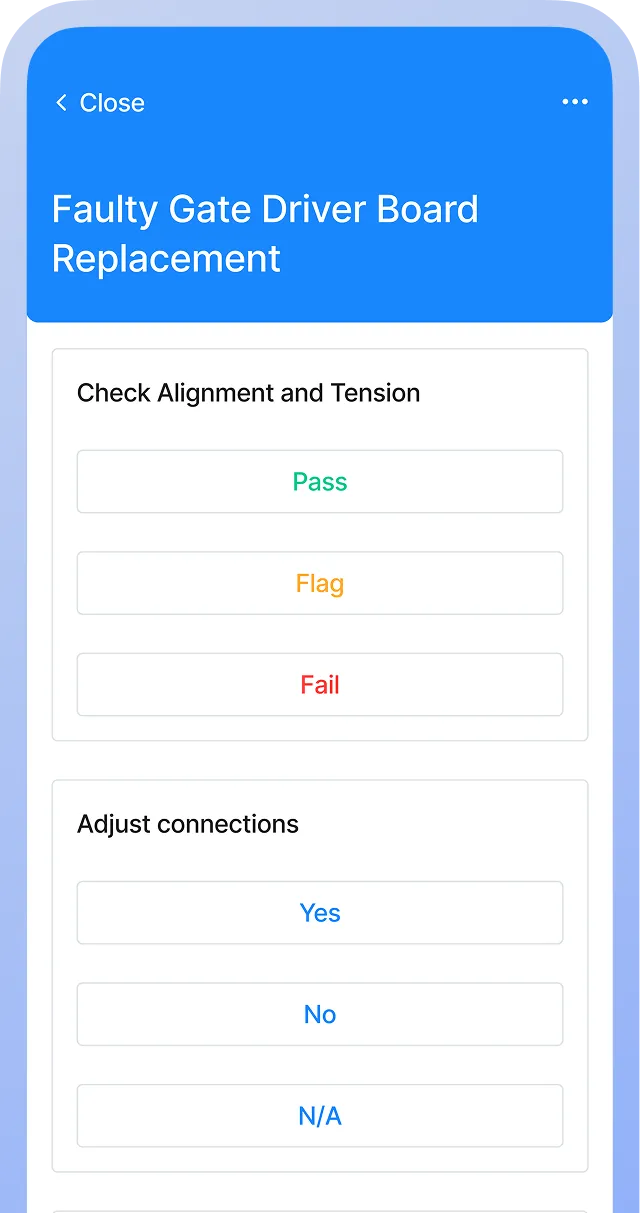
Digital inspection forms eliminate paper logs that get lost or become illegible. Operators can complete checks on a mobile device and automatically trigger work orders for corrective action if needed. A CMMS can also maintain timestamped records that simplify OSHA compliance documentation during audits, and help you track usage-based service intervals without manual data entry.


Forklift inspection checklist
Structural integrity and safety devices
Forks and mast assembly
Power system and fluids
Hydraulic system
Tires, wheels, and steering
Brakes and drivetrain
Operator station and visibility
Documentation and compliance
This checklist is to be used only by those with appropriate training, expertise, and professional judgment. You are solely responsible for reviewing this checklist to ensure that it meets all professional standards and legal requirements, as well as your needs and intent.
How to handle failed inspections
Your forklift maintenance program should have clear escalation criteria that help operators make confident decisions on the spot when an inspection fails.
Serious defects such as brake or steering problems, hydraulic leaks near heat sources, or visible structural damage can significantly impact safe operation. When a forklift shows signs that could compromise safety, it should be removed from service and evaluated promptly. Always refer to the manufacturer’s documentation and applicable OSHA guidelines to determine the appropriate next steps and required corrective actions.
Minor fluid leaks, worn tires with acceptable tread, or slow battery charging typically warrant a work order without removing the forklift from service. Ask yourself: Could the defect cause harm during the next shift?
Documenting the resolution matters as much as flagging the problem. A documented inspection ensures accountability by creating a record of what was found, who was notified, what action was taken, and when the equipment was returned to service. After repairs, verify that all issues have been addressed and the forklift is safe to operate.
Forklift inspection frequency explained
OSHA requires operators to inspect all powered industrial trucks before each shift, but effective preventive maintenance programs layer additional checks at strategic intervals. Using a forklift maintenance checklist ensures that all critical components are checked for safety and compliance.
Daily inspections create a compliance trail and promote a culture of accountability among operators. Operator responsibilities should include checking tires, brakes, fluid levels, safety features, load backrest, and alarms (such as horns and backup alarms). These daily touchpoints generate frontline data that reveals developing problems.
Weekly or monthly checks go deeper. Maintenance technicians examine hydraulic systems, battery health, chain tension, and fork thickness measurements. Periodic assessments track wear patterns that daily visual checks might miss.
Annual inspections typically involve more comprehensive testing and, often, third-party certification. Many facilities align these with manufacturer service intervals.
Inspection schedules should reflect actual operating conditions. A forklift running 16 hours daily in a distribution center accumulates wear faster than one used for four hours in a light assembly operation.
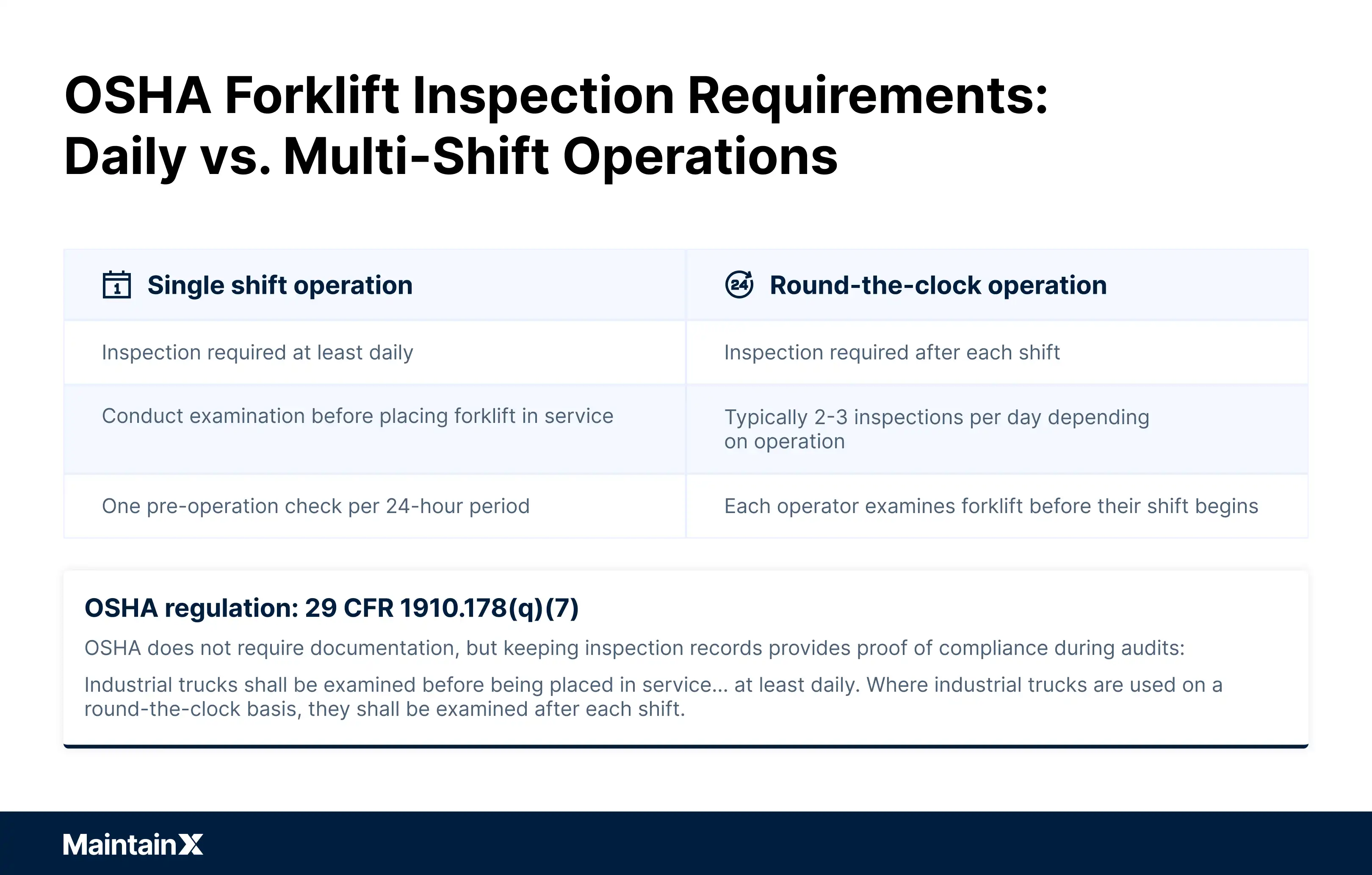
Building audit-ready inspection records: Documentation best practices
Inspection records serve two purposes. They satisfy regulatory requirements during OSHA audits, and they collect data that drives better decisions.
Every record should capture the basics: date, time, operator name, equipment ID, and individual findings for each inspection point. Digital timestamps and signatures strengthen audit defensibility. It's recommended to consult guidelines and manuals to ensure proper tracking of the right things.
Beyond compliance, consistent documentation reveals trends. A forklift showing hydraulic pressure drops over three weeks can signal a developing seal failure. Battery charge times creeping upward may indicate cells approaching end of life.
Most facilities keep inspection logs for at least three years, though some high-risk industries require longer. Records should be organized by site and department for searchability.
Using a CMMS to digitize forklift inspections
Using a CMMS like MaintainX gives you actionable intelligence from your inspection data. Digital checklists standardize what operators record at every inspection point, while photos of developing issues create visual baselines that make progressive wear obvious. Automatic timestamps eliminate the backdating concerns that auditors often flag in paper systems.
The real value comes when inspection findings trigger action automatically. Flagged defects generate work orders with relevant details already attached, and parts forecasting improves as the system tracks which components fail most frequently on specific equipment models.
Turn forklift inspections into fleet intelligence with MaintainX
MaintainX turns checklists and inspections into insights that reduce downtime, extend equipment life, and help your team make smarter parts and scheduling decisions. Book a demo to see it in action:
Forklift Inspection Checklist FAQs
How often does OSHA require forklift inspections?
OSHA requires forklift inspections before each shift. Employers are responsible for ensuring compliance with these regulations.
To promote a culture of accountability, all operators, regardless of employment status—full-time, part-time, seasonal, or temporary—must be included in inspection and training protocols.
What are the five most important items on a forklift inspection checklist?
The most important components on a forklift inspection checklist include brakes, steering, hydraulic systems, fork condition, and mast/chain integrity. Each signals a distinct failure mode: spongy brakes indicate fluid loss, hydraulic leaks predict pump failure, fork cracks warn of catastrophic load drops, and worn chain links signal imminent breakage under load.
How long should a daily forklift inspection take?
A thorough pre-operation inspection typically takes five to 10 minutes. Experienced operators develop efficient routines that catch problems early. The time investment pays off; identifying a worn brake line takes minutes, while an unplanned breakdown costs hours.
What should I do if my forklift fails inspection?
When a forklift fails inspection, tag it out immediately and report the defect to maintenance. Forklifts with defects should not be placed in service until repaired and deemed safe, as required by OSHA regulation. Always review the appropriate manuals, compliance requirements, and documentation to ensure accurate reporting and determine next steps.
Operators should never attempt repairs unless trained and authorized. Instead, document what you found; this will help technicians diagnose the issue faster and build an equipment history that drives smarter maintenance decisions.
What's the difference between pre-operation and operational forklift checks?
A standard forklift inspection checklist must cover two distinct phases: a pre-operational visual check and an operational test. Pre-operation checks happen with the forklift off: visual inspection of forks, tires, fluid levels, and safety devices. Operational checks occur with the engine running: testing the parking brake, steering response, horn, and lift controls. Both catch different defect types.
Pre-shift inspections are a critical forklift safety measure to identify equipment issues before operation and ensure compliance with safety standards. Operators must inspect and verify that all components, such as safety devices, locking pins, and other critical parts, are secure and functioning properly. Inspection checks should be performed in a level, well-lit area at least 10 feet from active operations.
Do I need different checklists for electric vs. propane forklifts?
Yes. Electric forklifts require battery and charger checks, while propane units need fuel system and tank inspections. Core safety items overlap, but power system differences demand tailored inspection points for each equipment type.
Can forklift inspections be done digitally instead of on paper?
Absolutely. Digital inspections through a CMMS like MaintainX offer significant advantages: automatic timestamps, photo documentation, instant defect routing to maintenance, and trend analysis across your fleet. Digital tools provide easy access to documented inspection records, which can be organized by department and company for efficient retrieval.

The MaintainX team is made up of maintenance and manufacturing experts. They’re here to share industry knowledge, explain product features, and help workers get more done with MaintainX!

.webp)