
.webp)
Most maintenance leaders want a proactive program, yet fewer than 35% of facilities allocate the majority of their maintenance time to preventive work. Clearly, there is a gap between strategy and execution.
Organizations that master preventive maintenance (PM) fundamentals reduce unplanned downtime while extending asset lifecycles and controlling maintenance costs.
This guide to preventive maintenance best practices shows you how to get there. You will learn the core principles of high-performing PM programs, the best practices used by world-class teams, and a maturity model that helps you understand where your program stands today. You will also see the red flags that signal your program is stuck and the practical steps that move you to the next stage.
Key takeaways
- Focus PM efforts on equipment where failure would halt production or create safety risks, rather than spreading resources equally across all assets.
- Use data on unplanned maintenance costs to gain leadership support and ensure PM complements production instead of competing with it.
- Progress systematically by monitoring PM completion rates and planned vs. reactive work ratios to move beyond the reactive stage where most facilities are stuck.


What makes a preventive maintenance program effective?
An effective preventive maintenance program defines which assets matter most and what work needs to be done regularly to keep them in working order. It then provides technicians with a repeatable process and realistic schedule for completing the work.
Core principles of successful PM programs
Preventive maintenance is prioritized
A strong PM program must protect production, rather than compete with it. If preventive maintenance gets shunted aside every time production schedules tighten, it’s doomed to failure.
Organizations use maintenance data to justify downtime
Using maintenance data as a planning tool helps keep everybody on the same page. When everybody can see the same trends and failure patterns, and the impact those failures have on production, it’s easier to argue for planned downtime to perform maintenance activities.
Technicians follow SOPs
Once that work is underway, technicians need access to clear industrial maintenance procedures and well-documented workflows so they can complete things quickly and efficiently. That way, production fires right back up with minimal interruptions.
The program is developed iteratively
This should be an iterative process. Start with high-priority assets, and hone the process a little at a time. Small successes will build upon each other and eventually build a culture where your PM program can succeed.
Preventive vs. predictive vs. reactive maintenance
Preventive maintenance is often just one part of a strategy that blends multiple types of maintenance approaches.
- Preventive maintenance relies on scheduled tasks at defined intervals. It reduces the likelihood of failure, stabilizes asset performance, and provides structure for the team.
- Predictive maintenance uses real-time or historical condition data to determine when service is actually needed. This reduces unnecessary work and helps teams intervene earlier on high-value assets. Predictive maintenance works best once maintenance processes and data capture are already reliable.
- Reactive maintenance happens after a failure. The goal should be to reduce this type of work, as reactive maintenance is typically more expensive and disruptive than other types of maintenance.
The most effective programs use preventive maintenance as the base, then add predictive capabilities as their processes and data mature. To get the most out of your preventive maintenance activity, follow these best practices.
Best practice one: Build organizational buy-in before launching
Preventive maintenance only works when the entire organization supports it. If production managers protect only throughput or if technicians see PM as low-value tasks, the program will stall.
That’s why a successful PM launch starts with alignment across leadership, operations, and the maintenance team.
Gain buy-in by using data on how much unplanned maintenance costs the organization. Make the case for better documentation of procedures and maintenance work by demonstrating the organizational risks of failed audits or safety violations. This information makes the impact of a strong PM program more tangible.
Clear expectations then reinforce that buy-in. Define what success for your PM program looks like and how it will be measured. Be sure to celebrate early wins to help shift your culture from firefighting to proactive maintenance.
Best practice two: Prioritize assets based on criticality
You cannot maintain every asset at the same high level. That’s a recipe for burning out your maintenance professionals by spreading them too thin.
Instead, a PM program should focus effort where failures create the greatest impact. Analyzing your most critical assets gives you a structured way to decide which of those assets deserves your attention first, and how frequently they should be serviced.
If an asset’s failure would bring your production line to a halt or create a serious safety risk, it should sit at the top of your priority list. Other assets still matter, but they can tolerate less frequent PM or even be candidates for a run-to-failure strategy.
Best practice three: Create effective maintenance checklists
Effective checklists ensure technicians perform their work the same way every time across shifts and even between facilities.
Make sure each task is specific. “Inspect motor” leaves too much room for interpretation. Try “check motor temperature with IR gun and compare to baseline.”
Where possible, use visual aids like photos and diagrams that help technicians confirm they are performing a task correctly.
Best practice four: Optimize scheduling and planning
If your PM program starts competing with daily operations, it’s on the wrong track.
Being transparent with the operations team is essential. When production leaders know why PM is scheduled and how long it will take, it’s easier for them to plan around it.
Where possible, maintenance teams should plan PM during ebbs in production cycles. Sometimes, though, disruption is unavoidable. In those cases, match PM frequency to asset priority and actual failure patterns. That data will help you avoid unnecessary PM that wastes time and slows production, while ensuring you perform maintenance before failures occur.
Best practice five: Track the right metrics (and avoid the wrong ones)
Effective PM programs rely on data that shows whether planned work is happening on time, whether it is preventing failures, and where resource constraints are slowing progress.
Key performance indicators like PM completion rate, schedule compliance, and planned vs. reactive work ratios show whether your team has enough time and capacity to perform preventive tasks consistently. These metrics reveal the early signs of overload.
Other useful metrics include those that reflect equipment health. Mean time between failures (MTBF), failure rate trends, and work order history help you understand whether PMs are having the intended effect of keeping assets operating.
On the other hand, counting total work orders, total routine maintenance tasks completed, or total technician hours tells you nothing about reliability, cost control, or workload. These numbers can inflate easily while hiding the underlying issues that drive downtime.
Best practice six: Integrate predictive maintenance where appropriate
Predictive maintenance works best when it enhances a disciplined PM program. Teams often rush into sensors and analytics before their preventive maintenance schedules, checklists, and data capture processes are reliable and robust. Without sufficient data and ingrained processes, predictive maintenance is less effective.
Once your PM completion rates and planned vs. reactive work ratios have improved, start identifying assets that justify condition monitoring. These are usually your critical assets like motors, compressors, pumps, and other rotating equipment. Here, predictive maintenance tools can reveal shifts in vibration, temperature, amperage, or other measurable variables that cue technicians to intervene early.
The goal is not to replace your preventive maintenance strategy with predictive tools, but rather to use those tools to complement and strengthen your PM program.
The PM maturity model: Where your program actually stands
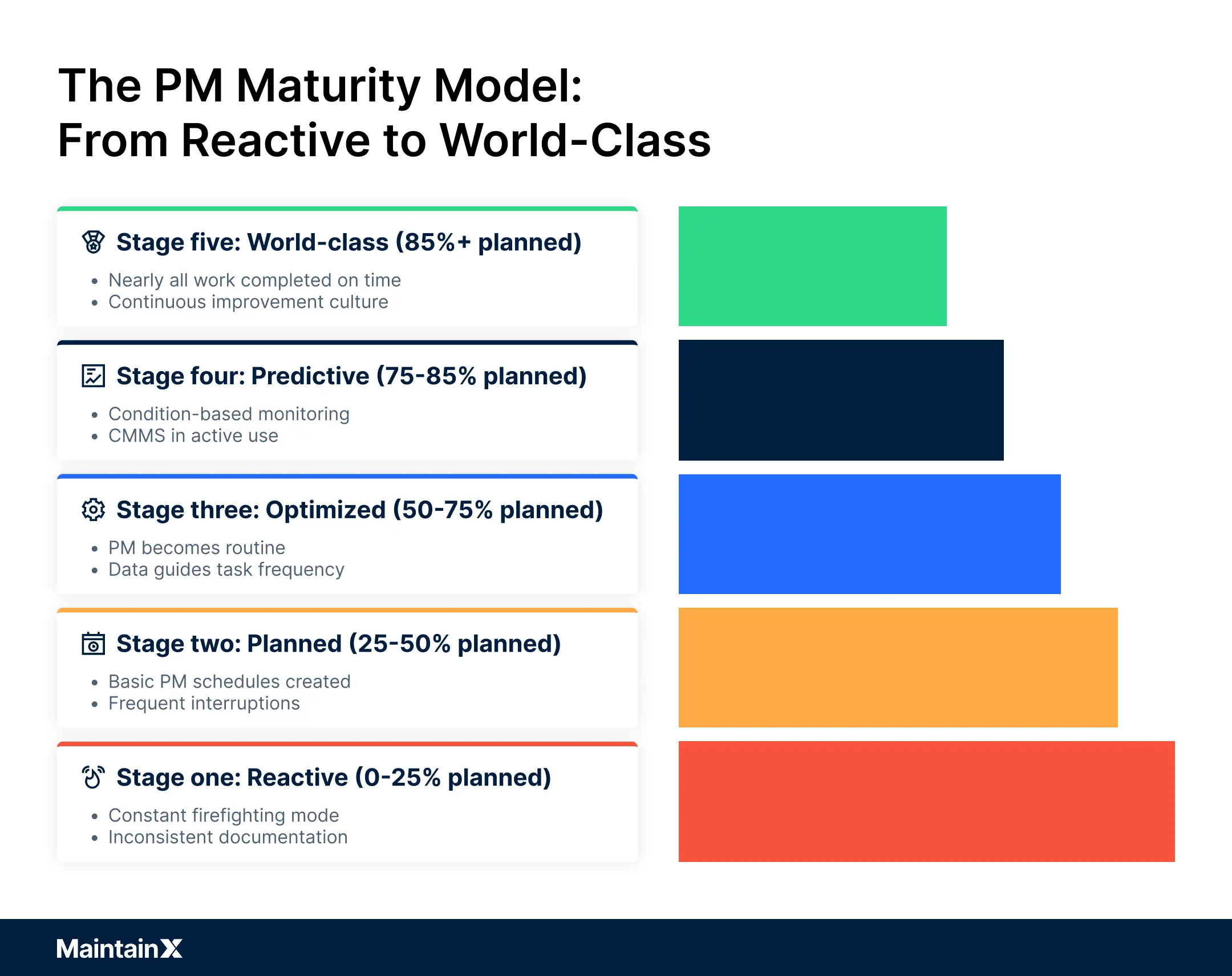
A PM maturity model helps you set expectations with leadership, plan budgets, and help you iteratively improve your maintenance program.
Our model includes five stages that describe your readiness to implement more advanced maintenance practices. Each reflects your balance of planned vs. reactive work, and how you use data within your program.
Stage one: Reactive (0–25% planned maintenance)
Reactive teams spend most of their time responding to failures. Work execution is inconsistent because documentation is often missing. Since production schedules drive every decision, work orders are unpredictable, and parts shortages are common.
Stage two: Planned (25–50% planned maintenance)
Teams in this stage begin to schedule PMs with more intention. At minimum, critical assets have at least basic checklists. Reactive work still interrupts scheduled maintenance too frequently, and PM work quality is inconsistent between shifts and technicians. There may be some maintenance data available, but it’s not yet being used to guide a good preventive maintenance plan.
Stage three: Optimized (50–75% planned maintenance)
At this level, PM is becoming a routine part of operations. Procedures are more standardized now, which helps make work order management more predictable. Leaders are starting to use data to refine task frequency based on equipment performance.
This is where you’ll start to see backlogs shrink. Your operations team should experience fewer repeat failures as downtime becomes easier to control.
Stage four: Predictive (75–85% planned maintenance)
Maintenance personnel begin to integrate condition-based monitoring and predictive insights into their PM program. They use sensor data, inspections, and trend data to identify early signs of failure so technicians can act before breakdowns happen.
Facilities operating at this stage are typically using a computerized maintenance management system (CMMS) to gain visibility into asset performance, which helps leaders adjust maintenance schedules based on real asset behavior rather than assumptions.
Stage five: World-class (85%+ planned maintenance)
World-class programs combine preventive, predictive, and continuous improvement practices. They complete nearly all planned work on time.
By this point, data quality is high, and procedures are robust and refined regularly. At these facilities, operations teams view maintenance as a strategic advantage for the company rather than a cost center.
Red flags that your program is stuck or regressing
Even with a solid plan in place, PM programs are always at risk of losing momentum or slipping back into reactive habits.
Here are some of the patterns that signal a need to redouble your efforts:
- Rising reactive work may indicate that your PM tasks or frequencies no longer match asset conditions.
- Growing PM backlogs show that your schedules are unrealistic or production pressure is deprioritizing preventive maintenance.
- Incomplete documentation is a sign technicians are skipping note-taking because the process feels burdensome or disconnected from the actual work they need to complete.
- Emergency part orders are a symptom of slipping planning discipline.
Common mistakes to avoid
Even strong PM programs lose ground when teams fall into a few avoidable mistakes that limit impact and slow progress.
Attempting to maintain assets equally
Many teams weaken their PM programs by trying to maintain every asset at the same level. When resources are spread evenly across all equipment, technicians spend time on low-impact assets while the equipment that matters most continues to fail. Focus effort where it delivers the highest operational return to keep your program both effective and manageable.
Creating over-detailed work orders
Another common issue is work orders that contain too many details. When instructions become too long, overly technical, or cluttered with unnecessary steps, technicians lose momentum, and compliance drops. Provide simple, direct procedures to reduce the administrative burden.
Ignoring technician feedback
Teams also run into problems when they overlook technician feedback. Technicians see how PM tasks play out on the floor, which steps cause confusion, and which intervals do not match real equipment behavior. Ignoring their insight limits your ability to refine the program and erodes buy-in.
Capturing poor data
Finally, poor data capture creates gaps in your PM program. Make it easy for technicians to submit consistent, accurate information that you can use to plan work, analyze trends, and improve your program over time.
How technology enables PM best practices
It’s easier to execute a preventive maintenance program with the right technology.
Modern CMMS platforms give teams the structure, visibility, and automation they need to move from reactive work to a disciplined, data-driven PM approach.
A CMMS centralizes work orders, checklists, schedules, and asset histories so your team can follow consistent processes across every shift. The platform’s inventory and parts tracking tools help technicians and planners avoid stockouts and prevent emergency purchases that can sink budgets.
As your program matures, a CMMS becomes even more valuable. Condition monitoring, sensor integrations, and AI-assisted scheduling help teams identify early signs of failure and allocate labor and resources more effectively to prevent it.
To explore how a CMMS can strengthen your PM workflows, check out our guide to preventive maintenance.
FAQs
How long does it take to implement a preventive maintenance program?
Most teams start to see structure and consistency within 60 to 90 days of gaining buy-in, prioritizing their assets, creating effective checklists, and building a schedule.
A full transition from reactive to proactive work typically takes six to 12 months, depending on staffing, asset complexity, and how quickly the organization adopts new processes.
What percentage of maintenance work should be preventive vs. reactive?
A healthy program aims for at least 60% planned work, with best-in-class teams reaching 85% or more.
The goal is not to eliminate reactive work entirely but to reduce it to a manageable level that no longer disrupts production or strains technician bandwidth.
How often should preventive maintenance tasks be performed?
Planned maintenance task frequency depends on asset criticality, manufacturer recommendations, environmental conditions, and your own maintenance history.
Start with OEM intervals, then adjust based on real-world data. If technicians keep seeing the same issues between PM cycles, the interval is too long. If PMs never uncover meaningful findings, it may be too short.
Can small facilities benefit from formal PM programs?
Yes. Smaller teams often feel the impact of equipment downtime more acutely because they have limited staffing and fewer redundant assets. A simple, well-structured PM program helps stabilize workload, reduce unexpected failures, and free up time for improvement work.
What's the difference between preventive and predictive maintenance?
Preventive maintenance relies on a time- or usage-based schedule. Predictive maintenance uses real-time or historical condition data to determine when the work should happen.

The MaintainX team is made up of maintenance and manufacturing experts. They’re here to share industry knowledge, explain product features, and help workers get more done with MaintainX!




.webp)