

Risk-based maintenance (RBM) prioritizes maintenance resources based on asset failure risk. The foundation of RBM is straightforward: Risk = Probability of Failure × Consequence of Failure. With this simple equation, you can effectively allocate limited maintenance budgets, minimize unplanned downtime, and extend the useful life of critical equipment.
Key takeaways
- Risk-based maintenance uses probability and consequence analysis to prioritize which assets receive maintenance attention.
- The RBM process involves gathering asset data, conducting criticality analysis, assessing failure probability, calculating risk priority numbers, plotting assets on risk matrices, and developing mitigation plans.
- Common implementation failures stem from poor data quality, oversimplified risk calculations, lack of cross-functional alignment, missing continuous improvement cycles, and inadequate CMMS infrastructure.
- A robust computerized maintenance management system (CMMS) is essential for RBM success. It combines historical data with automated calculations and work orders to maintain accurate risk assessments over time.
Risk-based maintenance explained
Risk-based maintenance helps you figure out which equipment truly deserves your maintenance team’s attention. Instead of servicing everything on the same schedule or just reacting to breakdowns, RBM identifies which asset failures would actually hurt your organization and prioritizes maintenance work based on that reality.
Two factors affect a piece of equipment’s priority score: its probability of failure (how often does it break down?) and the consequence of that failure (when it does break down, how significant is it?). By multiplying these factors together, RBM gives you a score that lets you compare different types of assets on the same scale.
When RBM makes sense for your operation
Risk-based maintenance isn’t for every organization, but it delivers real value in specific situations. You should consider RBM if you’re dealing with:
- Expensive, hard-to-replace equipment: When individual assets cost hundreds of thousands of dollars or take months to procure, you need a smart approach to protecting those investments. RBM ensures your most valuable equipment gets the attention it needs.
- Tight maintenance budgets: If you’re constantly being asked to do more with less, RBM can tell you exactly where to focus your limited dollars for maximum impact. When you can’t maintain everything perfectly, at least you’ll maintain the right things.
- Equipment spread across multiple locations: Managing assets at remote sites or across several facilities means travel costs add up fast. RBM helps you figure out which sites actually need visits and which equipment can safely wait longer between services.
- Mission-critical equipment with no backup: If certain failures would completely shut you down or lead to injury, RBM makes sure those assets get the maintenance frequency they require.
On the flip side, if you’ve got a simple operation or you have plenty of maintenance resources, RBM might be more work than it’s worth.


The six-step risk-based maintenance process
Step one: Gather asset data and maintenance history
You can't assess risk without good information about your equipment. Start by collecting the basics: what each asset is, where it's located, when you bought it, how much it cost, and what condition it's in.
Next, dig into maintenance history. Pull work orders showing how often things break, what typically fails, and what repairs cost. Calculate your mean time between failures (MTBF) and mean time to repair (MTTR). Figure out what downtime actually costs in lost production and emergency repair bills.
If you've got a CMMS, most of this data should be readily available. (If you're still working with paper records or spreadsheets, this step often reveals that you need to get that information better organized before you can implement RBM effectively.)
Step two: Conduct criticality analysis
This is where you figure out what happens if your equipment fails. Look at consequences across several areas:
- Safety: Could someone get hurt?
- Environmental impact: Would it cause a chemical spill?
- Production impact: Does everything grind to a halt?
- Equipment damage: Does one failure cascade into others?
- Financial impact: What’s this going to cost?
- Regulatory consequences: Are you breaking any rules?
A criticality matrix is often used to visualize and compare asset importance based on multiple risk factors, helping prioritize maintenance and risk mitigation strategies.
Set up a simple 1–5 scoring system for each category, where 1 means “barely matters” and 5 means “catastrophic.” For each piece of equipment, think about a realistic worst-case failure and score it across all these categories, paying special attention to severe consequences, especially those related to safety hazards.
Then, combine those scores into one asset criticality rating. You can multiply them together, add them up, or just use the highest score. Pick one method and stick with it for all your equipment so you’re comparing apples to apples.
Step three: Assess the probability of failure
Now that you know what happens if something fails, figure out how likely that failure actually is. Use the same 1–5 scale: 1 means it almost never happens (maybe once every few years), while 5 means it’s failing all the time. As part of this process, identify and document the failure modes and specific failure events for each asset to ensure a thorough risk assessment.
Base your ratings on the best data you have: actual failure records from your CMMS, manufacturer specs, equipment age, what conditions it operates in, or how well it’s been maintained historically. Understanding asset failure modes also helps refine your probability assessments by focusing on the most relevant risks.
Step four: Calculate risk priority numbers (RPN)
Take those two numbers you just calculated and multiply them. That’s your risk priority number: RPN = Asset Criticality Rating × Probability of Failure.
Do this for all your equipment, then sort everything by RPN from highest to lowest. Assets with the highest risk level should be prioritized for maintenance intervention, as they have the greatest potential for failure or operational disruption.
Step five: Plot assets on a risk matrix
Visual representation can help you communicate your goals more effectively and prioritize with more nuance. Create a simple grid with probability (1–5) on one axis and criticality (1–5) on the other, then plot each asset on it.
Color-code things to make it obvious: red for high-risk assets (high probability AND high consequence), orange for medium-high risk (one or the other is elevated), yellow for moderate risk, and green for low risk.
Pay special attention to outliers. Equipment in the upper-left corner (rarely fails but would be catastrophic if it did) still deserves serious preventive attention, even if its RPN number isn't the absolute highest.
Step six: Develop risk mitigation plans
For your red-zone high-risk assets, invest in more frequent preventive maintenance. You may also want to consider predictive technologies like vibration monitoring or thermal imaging.
Medium-risk assets—in the orange and yellow zones—get standard treatment: regular preventive maintenance following manufacturer guidelines and periodic inspections to catch problems early.
For low-risk, green-zone equipment, consider whether prevention is even worth it. Sometimes it's cheaper to just fix things when they break, especially if failure doesn't cost you much and the equipment is easy to repair.
Risk-based maintenance vs. other maintenance strategies
Understanding how RBM compares to other approaches helps you figure out which strategy makes sense for your operation.
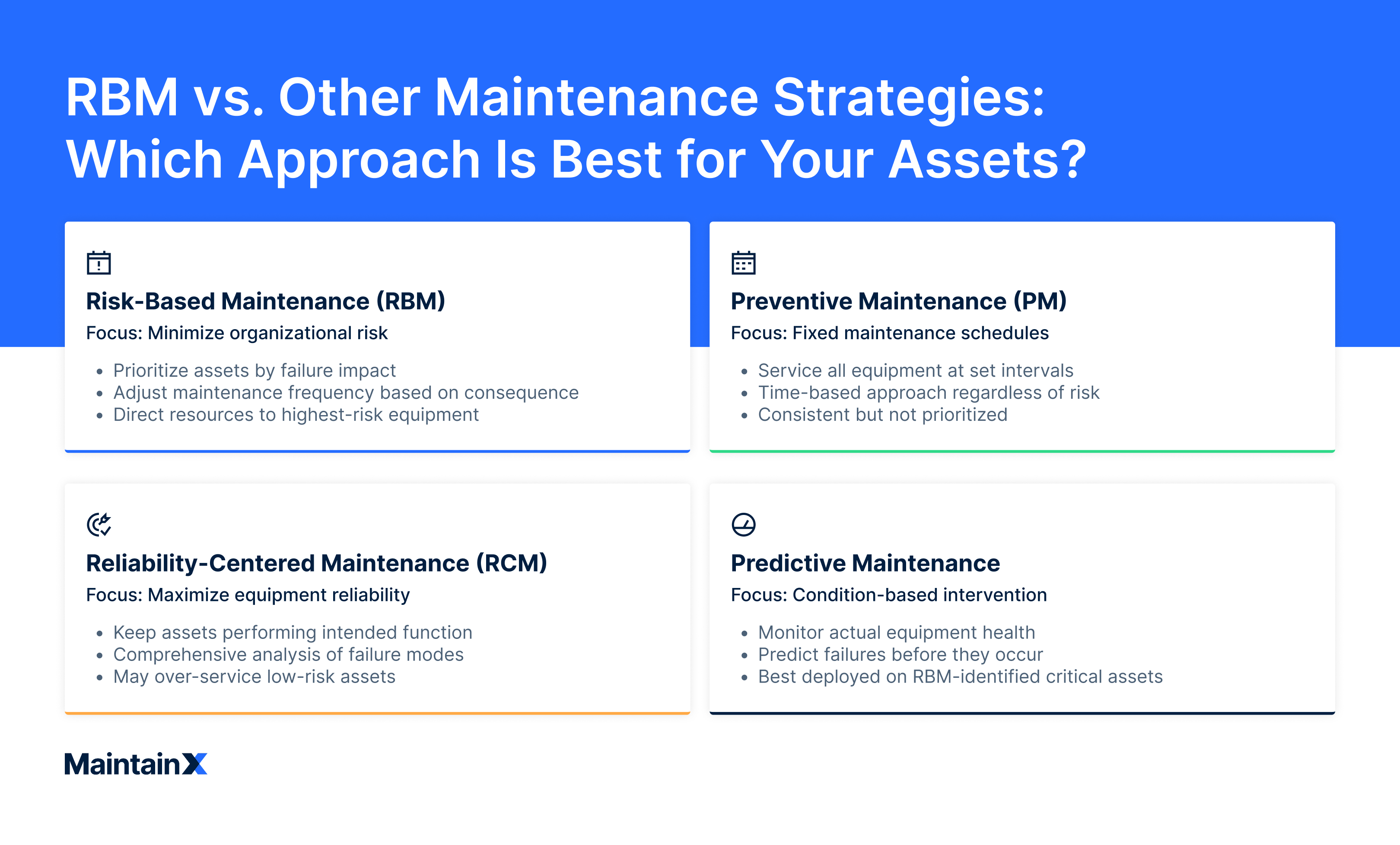
- RBM vs. preventive maintenance (PM): Traditional PM maintains everything on fixed schedules regardless of how important it is. RBM adjusts those schedules based on risk: Your critical assets might get serviced every 300 hours while identical low-risk equipment goes 1,000 hours between services.
- RBM vs. reliability-centered maintenance (RCM): RCM is all about keeping equipment performing its intended function as reliably as possible. RBM focuses on minimizing risk to your organization. Sometimes those goals align perfectly, but not always. Consider a conveyor belt system that requires regular tension adjustments, alignment checks, and bearing lubrication. An RCM model might tell you to prioritize it, since it requires such frequent service; an RBM model might look at the relatively minor consequence of the belt failing and recommend deprioritizing it.
- RBM vs. condition-based/predictive maintenance: Condition-based/predictive maintenance tells you when to maintain specific assets based on their actual condition. RBM tells you which assets deserve that level of attention in the first place. These strategies complement one another: Use RBM to identify your high-risk equipment, then deploy predictive sensors only on those assets that justify the investment.
Most sophisticated maintenance management programs mix and match. You might use RBM to identify critical assets, put predictive technologies on your highest-risk equipment, do condition-based monitoring for medium-risk equipment, and run simple time-based PM on everything else.
Why risk-based maintenance implementations fail
Poor data quality undermines risk assessments
RBM is only as good as your data. If your maintenance records are incomplete or inconsistent, your risk ratings won’t be much better than educated guesses.
Common problems include maintenance histories that exist only in filing cabinets or people’s heads, a lack of real data on what downtime actually costs, different technicians recording the same failure in completely different ways, and unofficial fixes that never get documented at all.
Clean up what exists, accept that your initial risk ratings will be imperfect, start capturing better data immediately, and use manufacturer specs or industry benchmarks as temporary stand-ins until you build up your own history. High-quality maintenance data is essential for making data-driven decisions in risk-based maintenance; once you have that, you can accurately assess asset criticality and optimize your maintenance strategies.
Oversimplified risk calculations
Some organizations water down RBM until it doesn't work anymore. This includes only looking at production impact while ignoring safety or environmental consequences, or dividing everything into "critical" and "non-critical" buckets without any nuance.
Real RBM requires thinking through the specifics of your operation. Get people from operations, engineering, safety, and finance in the room together to make sure you're considering all the ways equipment failure can hurt you, not just the most obvious ones.
Lack of cross-functional buy-in
RBM can involve making tough choices. Operations managers may get upset at the idea that some equipment is more critical than others. Finance may question why you're spending more on some assets than others. Technicians may ignore the system if they weren't part of building it.
The solution is getting everyone involved early. Show stakeholders how risk ratings are calculated and the logic behind them. Start with a pilot on one production line to prove it works before trying to change everything at once. Keep sharing success stories so people see the value.
No plan for continuous improvement
Some teams treat RBM like a one-and-done project: assess risk, set priorities, check the box, move on. That doesn't work because conditions constantly change. Equipment ages and becomes less reliable. Operating conditions shift. New failure patterns emerge.
Reappraise your highest-risk assets quarterly. Set up triggers that force you to revisit risk ratings when big failures happen, when you change how equipment operates, or when your business priorities shift. Make it part of your regular maintenance planning workflow, not something extra you do when you have time.
Inadequate technology infrastructure
You can technically do RBM with spreadsheets, but it's painful at scale. Calculating risk numbers for hundreds of assets, manually prioritizing work orders, and tracking whether high-risk equipment got its prescribed maintenance is a big administrative burden.
If you're serious about RBM, invest in a CMMS that stores risk ratings with your asset data, surfaces them automatically when planners create work orders, and tracks completion so you know your high-risk assets are getting maintained as planned.
Why use a CMMS for risk-based maintenance?
RBM relies on good data, which is exactly what a CMMS helps you collect and store. Instead of manually digging through old work orders to figure out failure rates, your CMMS should instantly show you how often each asset breaks, how long repairs take, and what downtime costs. Those metrics feed directly into your probability assessments.
Modern CMMS platforms integrate risk ratings right into work order management. When planners look at pending work, the system shows criticality scores and risk priority numbers for each task. High-risk asset maintenance automatically floats to the top of the queue instead of requiring someone to manually sort through everything.
A CMMS also standardizes how technicians record failures, makes data entry easier, and keeps an audit trail showing when and why risk ratings changed.
Explore MaintainX's maintenance capabilities to see how modern CMMS platforms integrate risk-based prioritization, mobile work order management, and predictive analytics.
FAQs
How long does it take to implement risk-based maintenance?
Plan on two to four months for your initial assessment: gathering data, analyzing criticality, and calculating risk scores. Then, another two to three months for a pilot program on one production line or facility area where you test the approach. Full rollout across your organization typically takes six to 12 months.
Most places see measurable improvements in reliability for their critical assets within six to nine months, with full return on investment happening around 12 to 18 months.
What's the minimum asset count where RBM makes sense?
There’s no hard rule, but 50–100 critical assets is usually where the effort pays off. Below that, simpler preventive maintenance might work fine.
That said, complexity matters more than count. If you only have 40 assets, but the failure of some of those assets can cost you six or seven figures, RBM justifies itself regardless of how much equipment you have.
Can RBM work alongside predictive maintenance programs?
Absolutely. RBM tells you which assets deserve your attention and investment. Predictive maintenance tells you exactly when to service those specific assets based on their actual condition.
Many organizations use RBM to identify their highest-risk equipment, then put predictive sensors and analytics only on those assets, rather than trying to monitor everything. That way, your predictive maintenance investment goes where it’ll deliver the most value. By focusing maintenance efforts on assets that pose the highest risk, you can improve asset reliability and optimize resource allocation.
How often should we recalculate risk priority numbers?
It depends on the asset. Your highest-risk equipment should be reviewed quarterly since small changes can significantly impact your risk profile. Medium-risk assets need annual reviews. Low-risk equipment can go two to three years between formal reassessments.
Recalculate immediately when something major happens: an unexpected failure despite your preventive efforts, significant changes in how you operate equipment, modifications or upgrades, or shifts in your business priorities that change what's critical and what's not.

The MaintainX team is made up of maintenance and manufacturing experts. They’re here to share industry knowledge, explain product features, and help workers get more done with MaintainX!




.webp)