

Your fleet represents one of your organization’s largest capital investments. Every dollar saved on operations flows directly to your bottom line. At the same time, fleet managers must balance immediate cost savings with long-term vehicle reliability and safety.
Strategic preventive maintenance, smart technology adoption, and data-driven operational improvements are key to managing this balance. This guide contains nine evidence-based strategies for reducing fleet costs that have been proven in real-world operations.
Key takeaways
- Preventive maintenance programs reduce unexpected breakdowns and extend vehicle lifespan.
- Fleet management software and CMMS platforms support data-driven decision-making and improve technician efficiency.
- Driver training improves fuel efficiency, reduces wear and tear, and contributes to an overall reduction in fleet costs.


Fleet cost management: Why it matters
Fleet cost management is more important than ever. Rising fuel prices, combined with increasingly expensive and complex maintenance requirements, have put pressure on managers to be accountable for every dollar.
The first steps in managing fleet costs are to understand the main methods of calculating them, and the factors that influence them.
What is total cost of fleet ownership (TCO)?
Total cost of ownership is the most common top-line metric for tracking fleet costs. It represents every dollar you spend on your fleet, from acquisition to disposal. TCO includes vehicle purchase or lease payments, fuel, maintenance, insurance, licensing, driver wages, and depreciation.
Understanding your true TCO helps you make smarter decisions about vehicle selection, replacement timing, and maintenance strategies.
Breaking down fleet expenses: Fixed, variable, and indirect costs
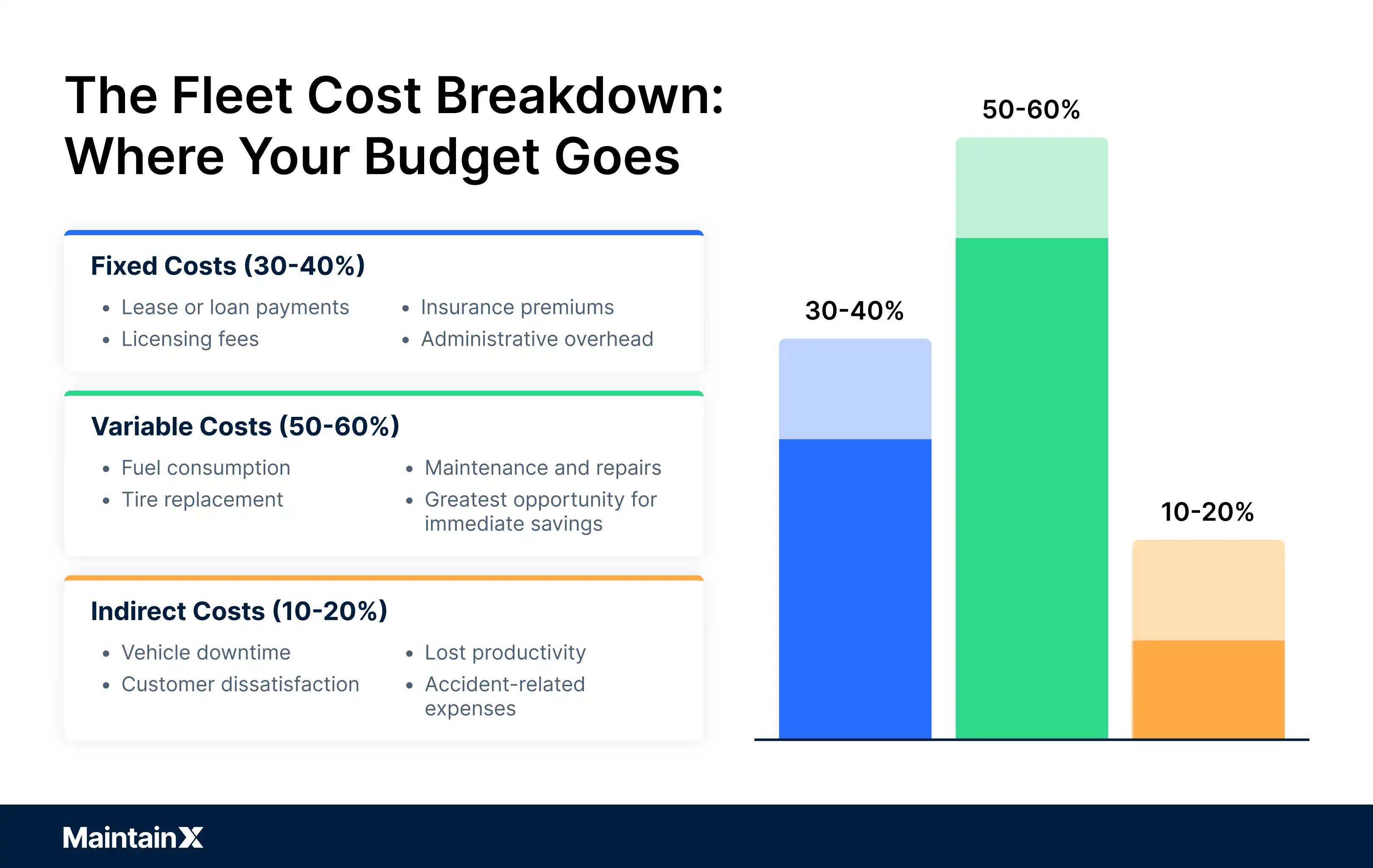
Total cost of ownership comprises fixed, variable, and indirect costs.
Fixed costs stay constant regardless of vehicle usage. These include lease or loan payments, insurance premiums, licensing fees, and administrative overhead. Whether your vehicles sit idle or run constantly, you pay the same amount each month for these expenses.
Variable costs change based on how much you use your vehicles. Fuel, maintenance, repairs, and tire replacement all fall into this category. The more miles you drive, the more fuel you consume and the faster components wear out. Strategic decisions about routing, driver behavior, and preventive maintenance can significantly impact variable costs, offering the greatest opportunity for savings.
The breakdown of fixed vs. variable costs will be different for every fleet and industry. For example, in the trucking industry, fixed financing costs represent an average of 17% of total marginal costs, variable fuel costs are around 21%, and maintenance costs are around 9%.
Indirect costs are harder to quantify but equally important. These hidden expenses include things like lost revenue due to vehicle downtime, administrative costs due to emergency repairs, etc. While they may not show up clearly in budget reports, indirect costs directly affect your bottom line and can mean the difference between a profitable operation and one that struggles financially.
Nine strategies to reduce fleet costs
One: Implement a preventive maintenance program
Preventive maintenance significantly reduces the risk of unexpected breakdowns and the costs that go along with them. When a delivery van breaks down on the road, for example, you pay for emergency towing, expedited parts, overtime labor, lost productivity, and, potentially, disappointed customers.
Regular preventive maintenance could have caught the issue before it led to unexpected downtime. You could have scheduled necessary repairs in advance and avoided both the disruption and the costs that came with it.
To calculate the ROI of preventive maintenance, compare the total costs of your preventive maintenance program against the costs you've avoided from reduced breakdowns, extended asset lifespans, and improved operational efficiency. MaintainX customers report an average 32% reduction in unplanned downtime and 37% increase in MTBF (mean time between failures) after implementing a preventive maintenance program.
Two: Leverage a CMMS
Investing in a CMMS helps you standardize preventive maintenance operations and ensure no service interval is missed. CMMS platforms generate work orders based on mileage, engine hours, or calendar dates. They can automatically assign work to a technician and help schedule around low-demand periods.
Using a CMMS for fleet management gives you access to advanced reporting on metrics like cost per mile, maintenance expenses by vehicle, common failure patterns, and vendor performance. With this data, you can identify which vehicles cost too much to maintain, which drivers need additional training, and other factors that impact your fleet management costs.
Three: Optimize fuel consumption and management
Small improvements in efficiency can create substantial savings. Cutting just five miles per vehicle per day saves a 50-vehicle fleet about $30,000 annually in fuel costs alone.
There are several ways to reduce fuel consumption and lower your fleet costs. Optimizing routes for traffic patterns, delivery windows, vehicle capacity, and driver availability reduces unnecessary mileage. Telematics systems track aggressive acceleration, excessive idling, speeding, harsh braking, and other driver behaviors that affect fuel efficiency. Fuel cards and tracking systems provide visibility into unusual patterns that might indicate theft, unauthorized use, or latent mechanical problems.
Four: Train drivers on cost-efficient practices
Driver training reduces costs in other ways, too. Aggressive driving can lead to increased wear and tear on replaceable components. It’s also a safety risk: An accident caused by aggressive driver behavior can result in vehicle repairs, legal liability, increased insurance premiums, unplanned downtime, and administrative overhead.
To control fleet costs, train operators on defensive driving techniques. Don’t incentivize or encourage risky behavior. Ultimately, you’ll save more in the long run if your fleet drivers know how to anticipate traffic flow, maintain steady speeds, and avoid hard braking.
Five: Right-size your fleet
Too few vehicles create service delays and excessive overtime, which costs you money. Too many vehicles means you’re spending money on insurance, licensing, depreciation, and storage for underutilized assets.
Here’s an easy benchmark for assessing the size of your fleet: Calculate the percentage of time each vehicle spends in active use versus sitting idle. Optimal utilization rates are between 70-85%; vehicles below 50% utilization are candidates for elimination or reassignment.
Seasonality plays a role in asset optimization. In some cases, it may be more cost-effective to rent extra vehicles during peak periods than to have backup trucks sitting idle in the yard for most of the year.
Six: Utilize telematics and IoT technology for predictive maintenance
Telematics systems and IoT sensors provide real-time vehicle health monitoring of parameters like engine temperature, oil pressure, battery voltage, and diagnostic trouble codes. This allows you to forecast when components will fail and take action accordingly.
For example, sensors on a vehicle could use machine learning to predict that a vehicle's alternator will fail within the next 500 miles based on voltage patterns. You can avoid a costly breakdown by scheduling a replacement during downtime.
Though it requires an initial investment in IoT sensors, this approach, known as predictive maintenance, is one of the best ways to reduce fleet costs over time. Read more in our article comparing predictive and preventive maintenance models.
Seven: Optimize parts inventory and procurement
Parts management prevents costly delays while reducing capital tied up in inventory. Again, balance is key here: Your goal is to have the right parts available when you need them without overstocking slow-moving items.
Analyze your maintenance history and stock commonly replaced items like filters, belts, brake pads, and fluids based on your actual usage patterns. Use a CMMS to track parts usage and trigger reorder notifications when quantities fall below preset thresholds. This easy-to-implement automation avoids relying on manual inventory checks and reduces the risk of stockouts.
Inventory carrying costs may not be your biggest fleet management expense, but with smart planning, you can make small tweaks that add up to big savings.
Eight: Standardize maintenance procedures with digital checklists
Investing in tech and tools will ultimately reduce fleet costs by maximizing uptime and keeping equipment healthy for longer.
Digital checklists your team can complete from a mobile-friendly CMMS add accountability and consistency to your preventive or predictive maintenance program. Technicians can access step-by-step instructions, SOPs, photos, torque specifications, and compliance requirements from their smartphones or tablets, reducing errors and improving efficiency.
Download our free fleet maintenance checklist to standardize your inspection procedures.
Nine: Analyze and act on fleet performance metrics
Leveraging data to make informed training, maintenance, and planning decisions is the through-line for all nine of these recommendations. The more you lean on an evidence-based approach to managing your fleet, the easier it will be to spot opportunities to save.
Track performance indicators such as cost per mile, maintenance cost per vehicle, mean time to repair (MTTR), vehicle uptime percentage, and fuel efficiency. If one vehicle consistently shows higher maintenance costs than similar units, investigate whether it has mechanical issues, receives harder use, or simply needs replacement. If certain drivers show significantly higher fuel consumption, target them for additional training.
How does fleet management reduce costs?
The tips we’ve provided on this page can be used on their own or as part of a multi-pronged program to reduce fleet costs. Here’s how that might look in different verticals.
Transportation and logistics
A regional trucking company with 75 semi-trucks implements a comprehensive PM program using fleet management (CMMS) software. They reduce roadside breakdowns by 65% in the first year, cutting emergency repair costs by $127,000. Their average vehicle uptime improves from 87% to 94%, allowing them to handle more deliveries with the same fleet size.
Delivery and distribution services
A last-mile delivery service with 200 vans installs telematics systems and launches a driver training initiative focused on fuel efficiency and safe driving. Within eight months, they reduce fuel consumption by 12%, decrease accident rates by 35%, and lower insurance premiums by $85,000 annually. The program pays for itself in four months.
Municipal and government fleets
A city government managing 400 vehicles across multiple departments consolidates its maintenance operations and manages the program from a centralized CMMS. They standardize parts inventory across similar vehicles, negotiate better vendor contracts using consolidated purchasing power, and reduce their parts inventory carrying costs by 28%. Total fleet operating costs drop 18% over two years.
Start reducing your fleet costs today
Most organizations start reducing fleet costs by implementing a preventive maintenance program. Adding a CMMS into the mix helps you standardize procedures and establish baseline metrics that prove the value of your initiatives to management and guide your priorities.
Start with a free trial of MaintainX’s fleet maintenance management software and see for yourself how data-driven technology can transform your operations.
You can also explore how MaintainX helps fleet managers cut costs while improving uptime.
FAQs
What is the biggest expense in fleet management?
Fleet cost structures vary significantly by industry and operation type. In the trucking sector, fuel represents approximately 21% of total marginal costs, financing accounts for 17%, and maintenance runs around 9%, according to the 2025 ATRI Operational Costs of Trucking report. However, these percentages shift based on vertical, fleet age and operational intensity. For example, newer fleets carry higher financing burdens while older fleets face escalating maintenance expenses.
How much can preventive maintenance reduce fleet costs?
According to MaintainX customer reports, preventive maintenance programs can reduce unplanned downtime by 32% and increase MTBF (mean time between failures) by 37%. The savings come from preventing expensive emergency repairs, reducing vehicle downtime, and catching small problems before they cause major failures. Most fleet managers see positive ROI within six months of implementing a structured PM program.
What is the difference between preventive and predictive maintenance for fleets?
Preventive maintenance services vehicles on fixed schedules determined by time or mileage intervals, regardless of actual condition. Predictive maintenance uses sensor data and analytics to service vehicles based on actual component condition and predicted failure timing.
Predictive maintenance eliminates unnecessary service while preventing unexpected failures. However, it requires an investment in telematics and analytics technology.
How does driver behavior impact fleet operating costs?
Driver behavior affects fuel consumption, vehicle wear rates, accident frequency, and maintenance costs. Aggressive driving increases fuel consumption, accelerates brake and tire wear, and stresses engines and transmissions. Training drivers to practice eco-driving techniques saves money on fuel, maintenance, and insurance.
What fleet management KPIs should I track to reduce costs?
Focus on cost per mile or kilometer, maintenance cost per vehicle, fuel cost per mile, vehicle utilization rate, mean time between failures (MTBF), mean time to repair (MTTR), and overall vehicle uptime percentage. These metrics identify specific problems and measure improvement over time. Track KPIs monthly and compare them against industry benchmarks to identify opportunities.
Can fleet management software help with compliance and safety?
Fleet management software helps you maintain compliance with DOT regulations, OSHA requirements, emission standards, and safety protocols. Systems like MaintainX track inspection due dates, driver qualification expirations, vehicle registration renewals, and required maintenance intervals. Automated alerts ensure you never miss critical service deadlines, while digital documentation provides an audit-ready record of your efforts.

The MaintainX team is made up of maintenance and manufacturing experts. They’re here to share industry knowledge, explain product features, and help workers get more done with MaintainX!




.webp)