

Preventive maintenance (PM) and breakdown maintenance are the cornerstones of any professional maintenance program. They are the most commonly used maintenance strategies on the planet. There's a common misconception that facilities either practice one type of maintenance or the other. However, most maintenance teams rely on a mix of preventive and breakdown maintenance to reach their goals.
Key takeaways
- Preventive maintenance (PM) is a proactive strategy involving scheduled tasks to prevent equipment failure, while breakdown maintenance is a reactive approach where technicians perform work only after an asset fails.
- The most effective maintenance programs use a hybrid strategy, applying PM to critical assets to reduce unplanned downtime and using breakdown maintenance for non-essential, low-cost, or redundant equipment.
- Choosing the right strategy depends on asset criticality, failure impact, and repair costs. A data-driven approach using a computerized maintenance management system (CMMS) helps optimize this balance for maximum efficiency.
Preventive maintenance vs. breakdown maintenance
The difference between preventive maintenance and breakdown maintenance lies in how each of these strategies are executed. Preventive maintenance is proactive work performed on a scheduled basis to prevent failures, while breakdown maintenance is reactive work that technicians perform only after equipment fails.
Preventive maintenance includes regular inspections, reporting equipment issues, and replacing parts before failure. The primary goal is catching small issues before they become costly problems, an approach that helped Titan America decrease unplanned downtime by 30% through systematic reliability-centered maintenance.
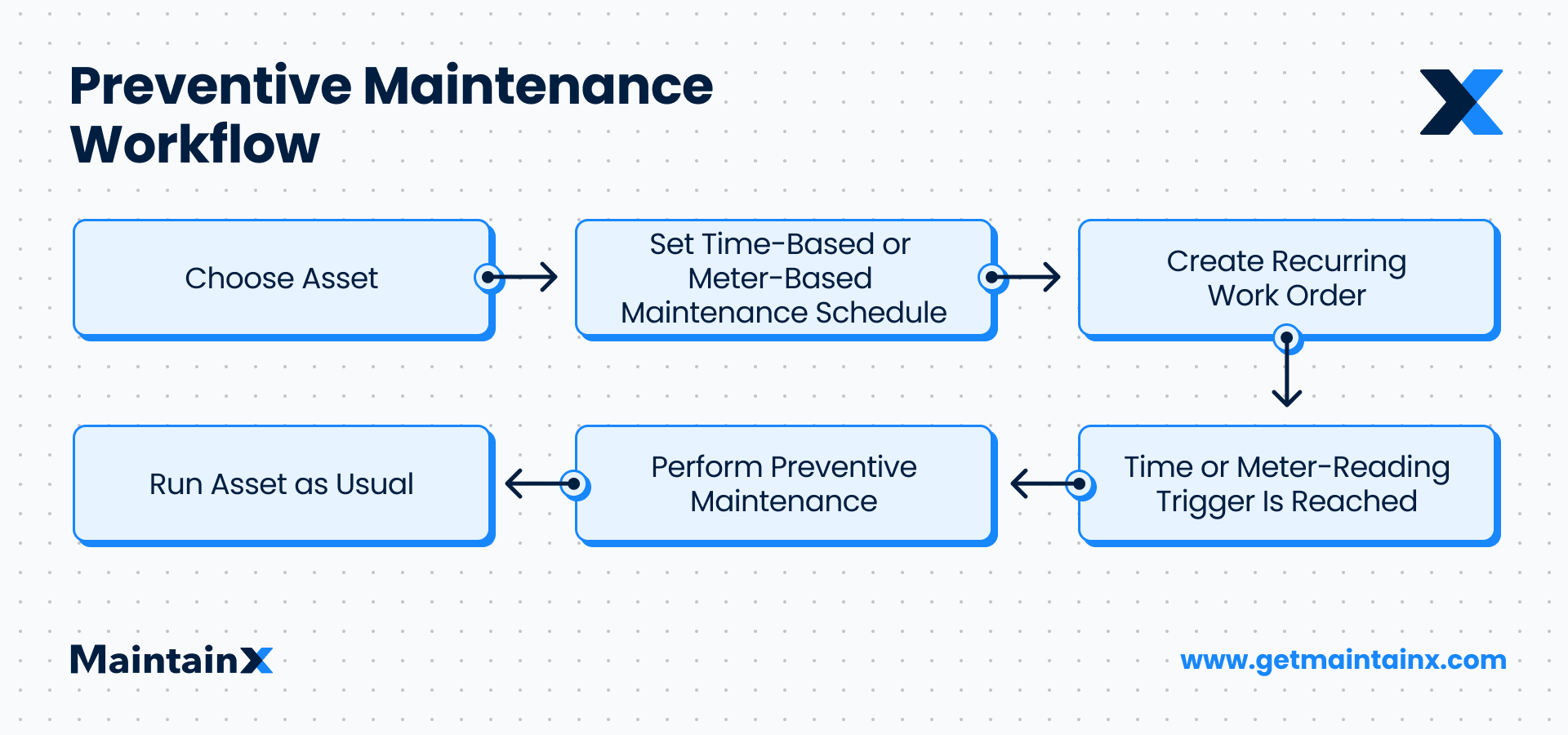
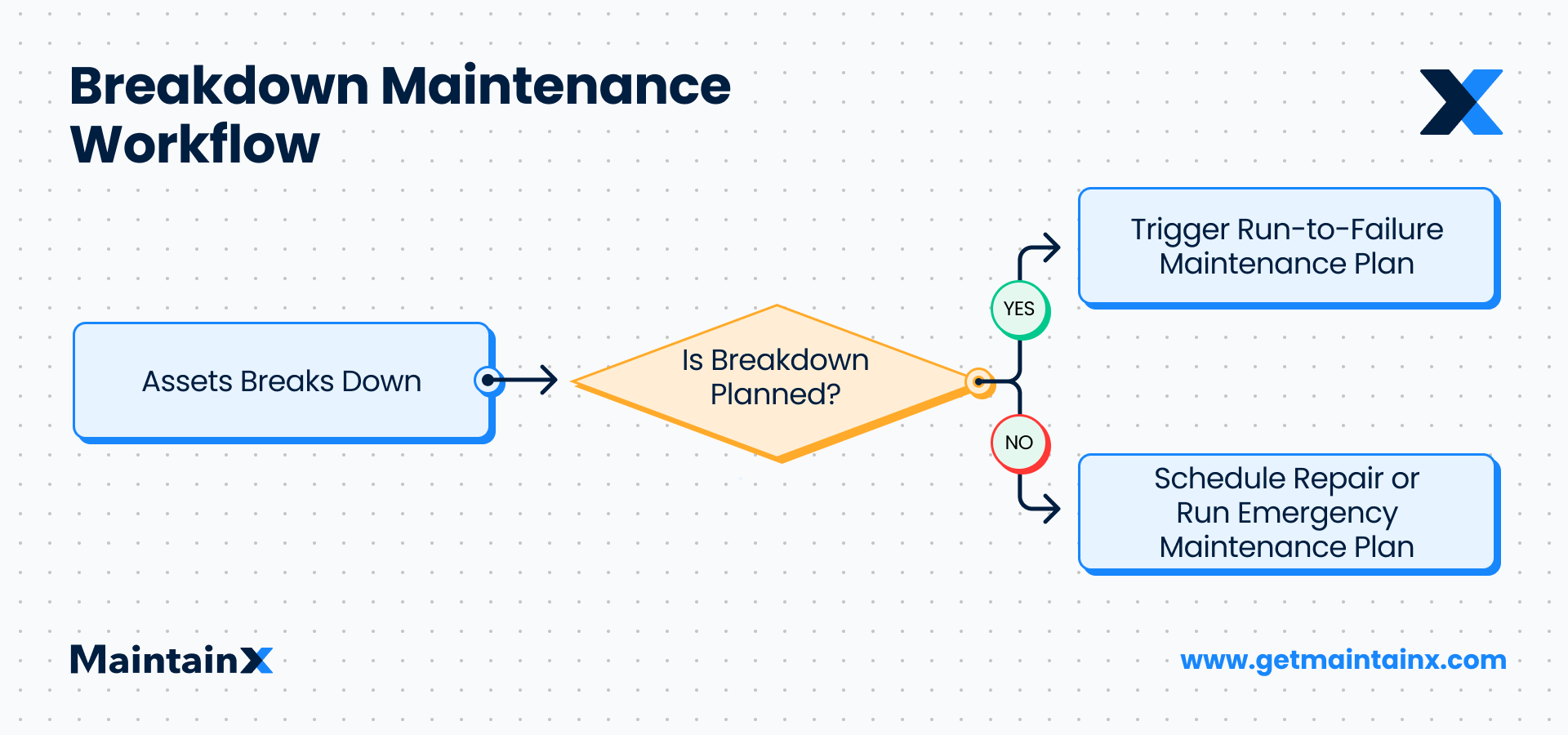
Breakdown maintenance, also referred to as corrective maintenance, is a strategy that performs maintenance tasks only after an asset fails. Technicians only perform maintenance tasks when they become urgent. For example, repairing or replacing a water heater after it has broken down.
Leading manufacturing facilities typically maintain a 70:30 or 80:20 ratio of preventive to breakdown maintenance work. Reactive facilities often operate at 40:60 ratios with significantly higher maintenance costs.
Types of preventive maintenance
Preventive maintenance involves identifying triggers that indicate potential equipment failure. Manufacturing facilities use five different types of preventive maintenance, each suiting different asset categories and operational needs.
Risk-based maintenance (RBM)
Risk-based maintenance (RBM) prioritizes maintenance tasks based on the level of risk an asset poses in the event of failure. The system calculates risk by analyzing both the likelihood of failure and the consequences of those failures. Critical assets like primary production lines receive high priority for maintenance resources.
Failure-finding maintenance
This preventive maintenance type focuses on detecting potential hidden failures of protective equipment. Safety valves, trip transmitters, and emergency shutdown systems only function when another asset fails. Organizations conduct failure-finding maintenance at fixed intervals to verify these protective systems remain operational.
Time-based maintenance (TBM)
Time-based maintenance (TBM), which maintenance teams also call scheduled maintenance, performs tasks at fixed intervals regardless of equipment condition.
Condition-based maintenance (CBM)
Condition-based maintenance (CBM) triggers maintenance work when real-time equipment monitoring shows declining performance or impending failure. The strategy requires early detection systems that provide enough lead time to organize maintenance resources. CBM helps teams perform work exactly when needed, improving labor and parts usage.
Predictive maintenance (PdM)
Predictive maintenance (PdM) represents an advanced form of CBM using sensors and Internet of Things (IoT) data to predict failures before they occur. PdM systems monitor process parameters continuously to identify declining performance patterns. This approach allows technicians to restore equipment to best performance before functional failure occurs.
All preventive maintenance strategies share the same goal: perform maintenance tasks before failure occurs to maximize equipment reliability and minimize production disruptions.


Types of breakdown maintenance
Breakdown maintenance, which some maintenance professionals call run-to-failure maintenance, involves performing maintenance tasks after equipment fails. Manufacturing facilities use two distinct types of breakdown maintenance that they base on planning and risk assessment.
Planned breakdown maintenance
Manufacturing facilities use planned breakdown maintenance when they expect equipment failure but decide the risk is manageable. For example, a plant manager allows a non-critical conveyor motor to run to failure during a planned production shutdown. This approach prevents unnecessary maintenance costs during peak production periods.
Unplanned breakdown maintenance
Every manufacturing facility has unexpected equipment failures. A sudden bearing failure on a production line or an unplanned HVAC system breakdown requires immediate attention. Most facilities budget 15%-25% of their maintenance spend for these unexpected repairs.
Preventive maintenance example
Aviation shows how well preventive maintenance works thanks to strict regulations. Planes can't fly unless they meet specific maintenance standards. The industry's systematic approach prevents catastrophic failures through scheduled inspections and component replacements.
For instance, the Boeing 737 grounding for its defective safety system highlights how preventive maintenance identifies critical issues before accidents occur. The aviation industry's robust preventive maintenance strategy has reduced accident rates by over 90% in the past four decades.
Breakdown maintenance examples
Breakdown maintenance works best for specific asset categories in manufacturing environments:
- Consumable items: Light bulbs, filters, and gaskets in non-critical applications
- Redundant systems: Backup pumps or secondary conveyor lines where failure won't halt production
- Low-cost components: Hand tools, small motors under $500, or disposable sensors
- End-of-life equipment: Assets scheduled for replacement within six months
Consider a packaging facility where replacing a failed label printer takes 10 minutes and costs $200. The downtime impact is minimal, making breakdown maintenance more cost-effective than frequent preventive inspections.
Preventive maintenance vs. breakdown maintenance comparison chart
How to balance preventive maintenance and breakdown maintenance
Preventive and breakdown maintenance each have their place in today's facilities. Critical assets require a systematic approach to extend lifespans and maintain optimal performance.
The most effective maintenance strategies use both approaches:
- Critical equipment: Apply preventive maintenance to reduce unplanned downtime
- Non-critical assets: Use breakdown maintenance when it won't impact production, safety, or costs
- Balanced approach: Teams like Electro Cycle achieved a 70:30 preventive-to-reactive ratio, increasing planned maintenance by 30%
What works best varies by organization, but data-driven decisions help find the ideal balance.
The final word on maintenance strategy selection
The smartest maintenance programs use both preventive and breakdown maintenance in the right situations.. Modern manufacturing facilities can't rely on outdated paper-based systems or reactive-only approaches because they limit frontline worker engagement and production capacity.
You need the right digital tools to handle both approaches well. A modern CMMS gives you the real-time data to decide when preventive maintenance makes sense and when breakdown maintenance works better. The right platform helps maintenance teams use their resources better, cut down on surprise breakdowns, and keep everything running.
Ready to build a more strategic maintenance program? Sign Up for Free and see how MaintainX helps 12,000+ customers optimize their maintenance strategies across physical asset-driven industries.
Preventive vs Breakdown Maintenance FAQs
Why is preventive maintenance preferred over breakdown maintenance for critical manufacturing equipment?
Preventive maintenance reduces the risk of unexpected production shutdowns that cost manufacturers $50,000+ per hour. By scheduling maintenance during planned downtime, facilities protect production schedules and extend equipment lifespan while maintaining safety standards.
What's the difference between preventive maintenance and condition-based maintenance for plant managers?
Preventive maintenance follows fixed schedules regardless of equipment condition, while condition-based maintenance responds to real-time data from sensors or inspections. CBM allows maintenance managers to perform work exactly when needed, optimizing labor and parts usage.
How does a computerized maintenance management system help maintenance managers balance preventive and breakdown maintenance strategies?
A CMMS automates preventive maintenance scheduling, tracks failure patterns, and manages reactive work orders from a single platform. Maintenance managers can analyze data to improve their preventive-to-reactive ratios and allocate resources more effectively across their facilities.
.webp)