

The industrial landscape has undergone a massive shift in just a handful of years. Costs have skyrocketed, the labor market is quickly thinning, and AI has rapidly impacted every role. All of this change can undoubtedly be seen as at least a little unsettling or overwhelming. But it has also provided maintenance teams with an opportunity to be seen as difference-makers in their organizations—the department that can lead businesses through change and come out on the other side ahead of its competition.
Industrial companies seem to agree with this sentiment. An analysis of 100 job posts revealed one clear, overall trend: businesses see the next generation of maintenance leaders as not just masters of their domain, but as someone who can help the organization gain a competitive advantage on par with other senior leaders.
This article dives into that analysis and picks out 20 key findings that will help you take advantage of this new era of maintenance leadership. Get the full report and see even more insights, trends, and templates by downloading The Anatomy of the Modern Maintenance Leader.

Key takeaways
- 85% of job posts prioritize team leadership and development as a core competency.
- 76% of companies now measure maintenance leaders based on equipment reliability and 33% also hold maintenance accountable for production efficiency.
- 71% of roles require mastery of CMMS software to drive daily operations.
- 82% of leaders are expected to manage cross-functional relationships, particularly with production teams.
1. Managing people is just as important as managing equipment
Managing a team is so essential to the role of a maintenance manager that it was mentioned as a primary duty in 85% of openings, second only to safety (86%). Here are some key stats about people management that came from analyzing 100 job posts for maintenance managers, directors, and supervisors:
- 81% of employers expect leaders to engage in team development, like succession planning and coaching.
- 73% of posts specifically mention maximizing team productivity as a key requirement.
- 57% of listings now include the ability to foster psychological safety and inclusive cultures.
- 82% of companies listed managing relationships with other departments as a requirement, including sharing goals, targets, meetings, and schedules.
- 22% of positions expected maintenance leaders to have frequent collaboration and communication with four or more departments, including communication with executives about reporting and KPIs.
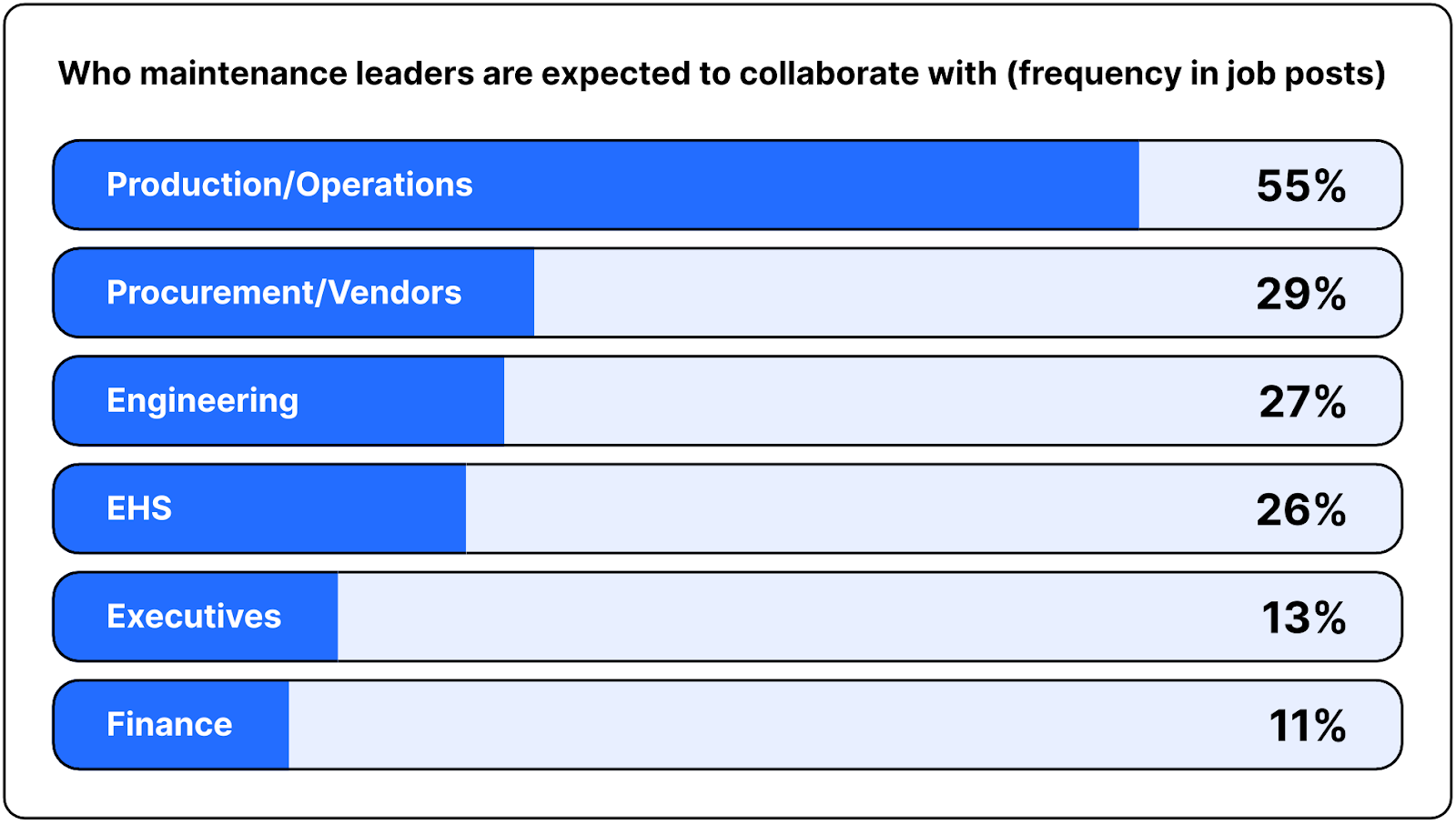
What it means for you: Your value is no longer tied to what you can fix, but how well you can build a team that fixes things. Spend time strengthening your one-on-one management skills by developing growth plans for each member of your team and building a set of metrics measuring team development. Make sure you’re talking with other departments multiple times a week, and sharing responsibilities and targets with those functions. Set aside dedicated time to find and prioritize obstacles affecting your team, then build a plan to remove friction across processes.
2. The strongest leaders think at the business level and act at the maintenance level
Maintenance leaders are expected to think beyond the plant floor and translate the company’s priorities into a maintenance strategy. The stats below uncover how maintenance leaders can bridge these two worlds:
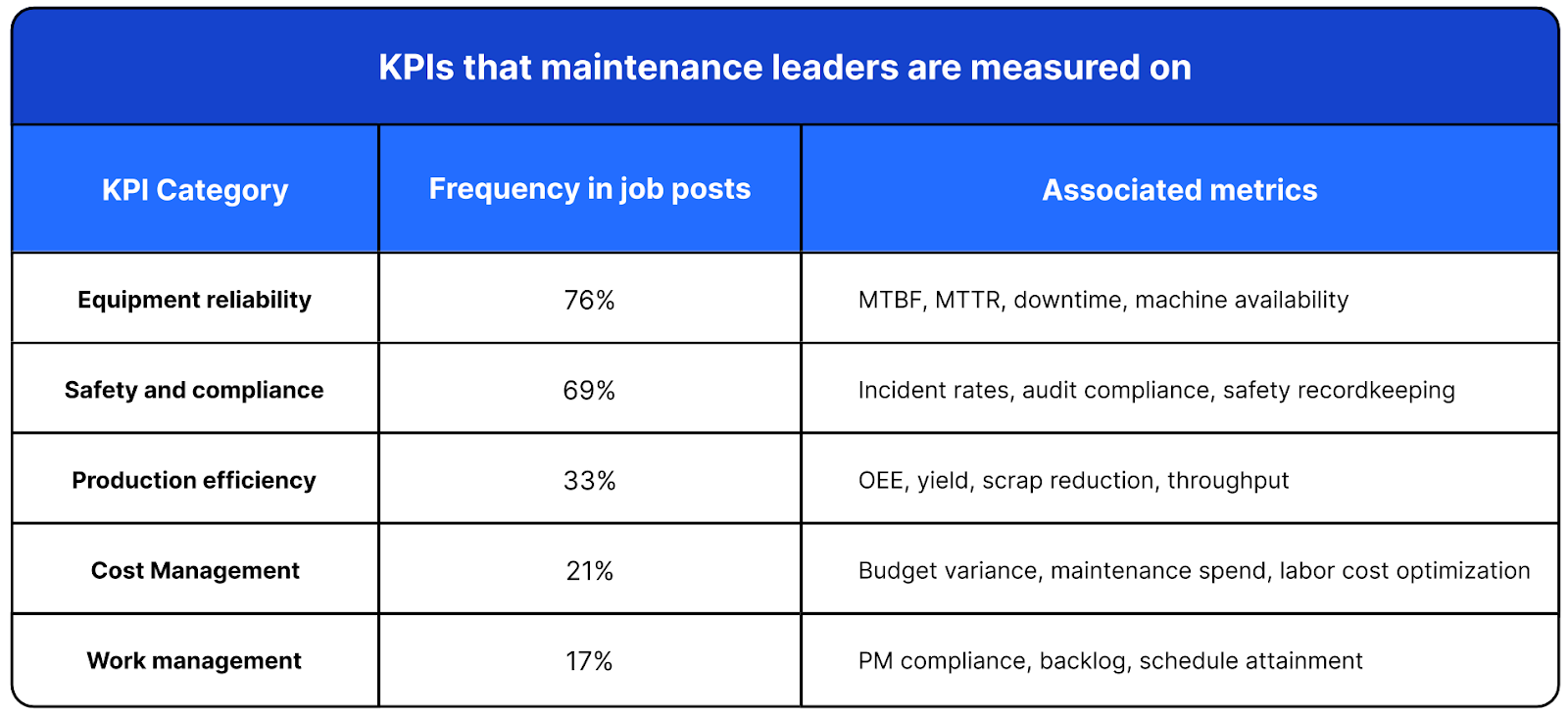
- 76% of leaders are held accountable for equipment reliability metrics, like mean time between failure (MTBF) and mean time to repair (MTTR), while 33% are responsible for production efficiency KPIs, like overall equipment effectiveness (OEE) and yield.
- 21% of roles are directly measured on cost management and budget variance.
- 74% of roles require a firm grasp of continuous improvement methods like Lean or Six Sigma
- 44% of postings require the ability to create a three to five year strategic roadmap..
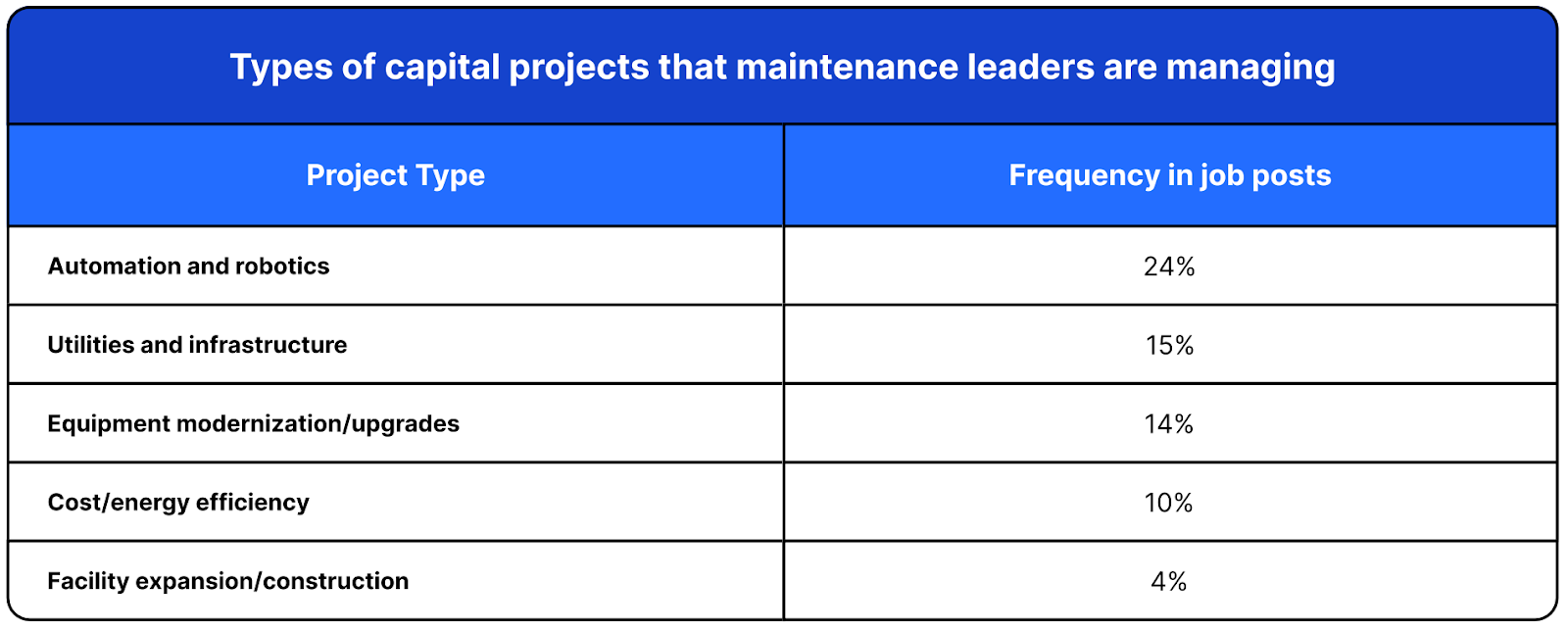
- 49% of organizations want leaders capable of executing company-wide capital projects.
- 46% of companies want maintenance leaders to build up a preventive maintenance program and 30% want the role to develop and oversee a predictive maintenance strategy.
- 63% of maintenance leadership roles include risk management responsibilities.
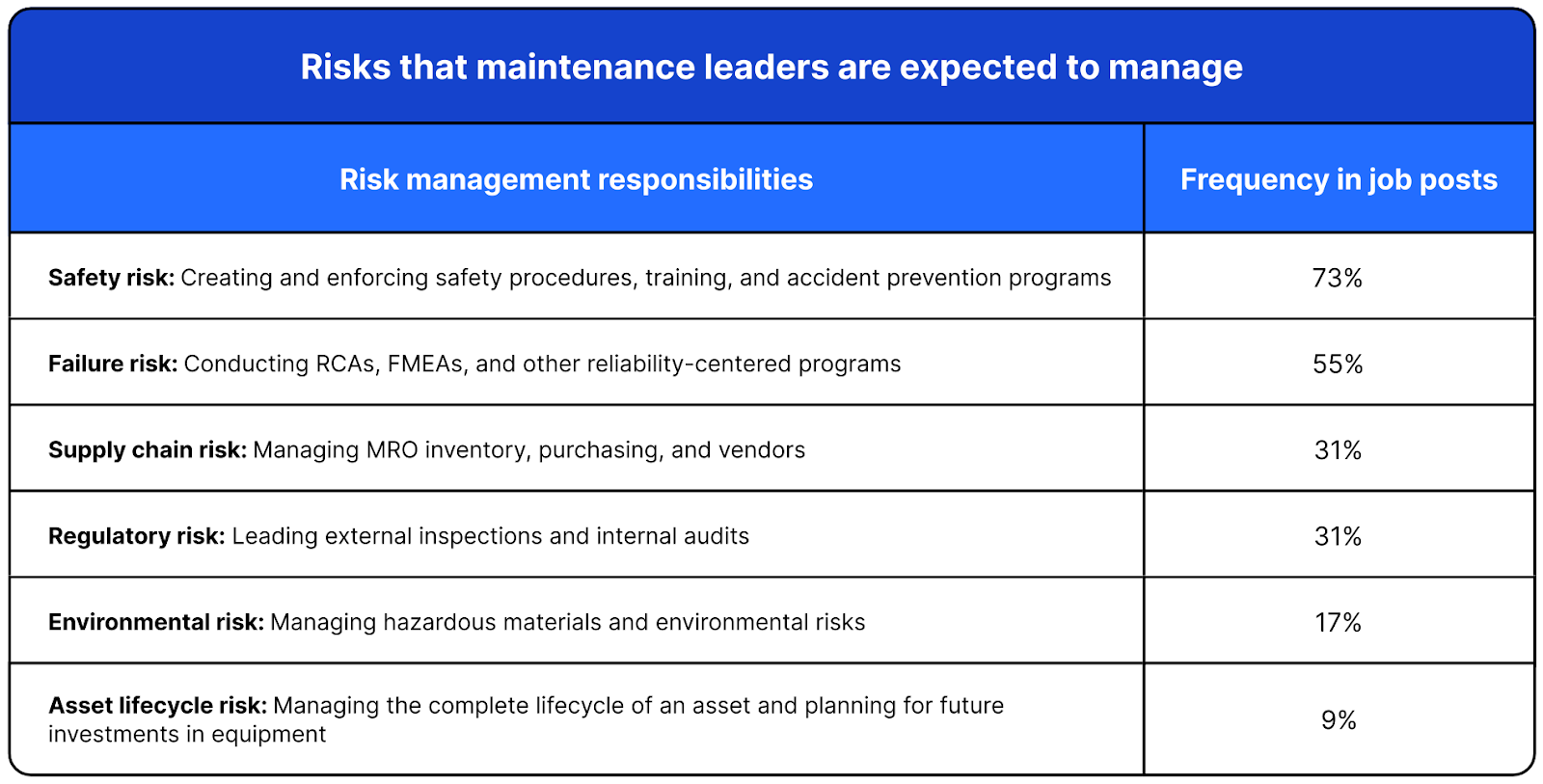
What it means for you: Make sure you’re as comfortable with dashboards and data as you are with PM checklists. Don’t just track metrics—make sure you know who needs them, how to talk to them, and how they’re influenced. Develop a long-term plan for maintenance that maps to the company's vision. Reframe your work, strategy, and KPIs through the lens of risk reduction. This helps extend your influence beyond the plant floor in the here and now.
3. The next generation of maintenance leaders will own a deep maintenance tech
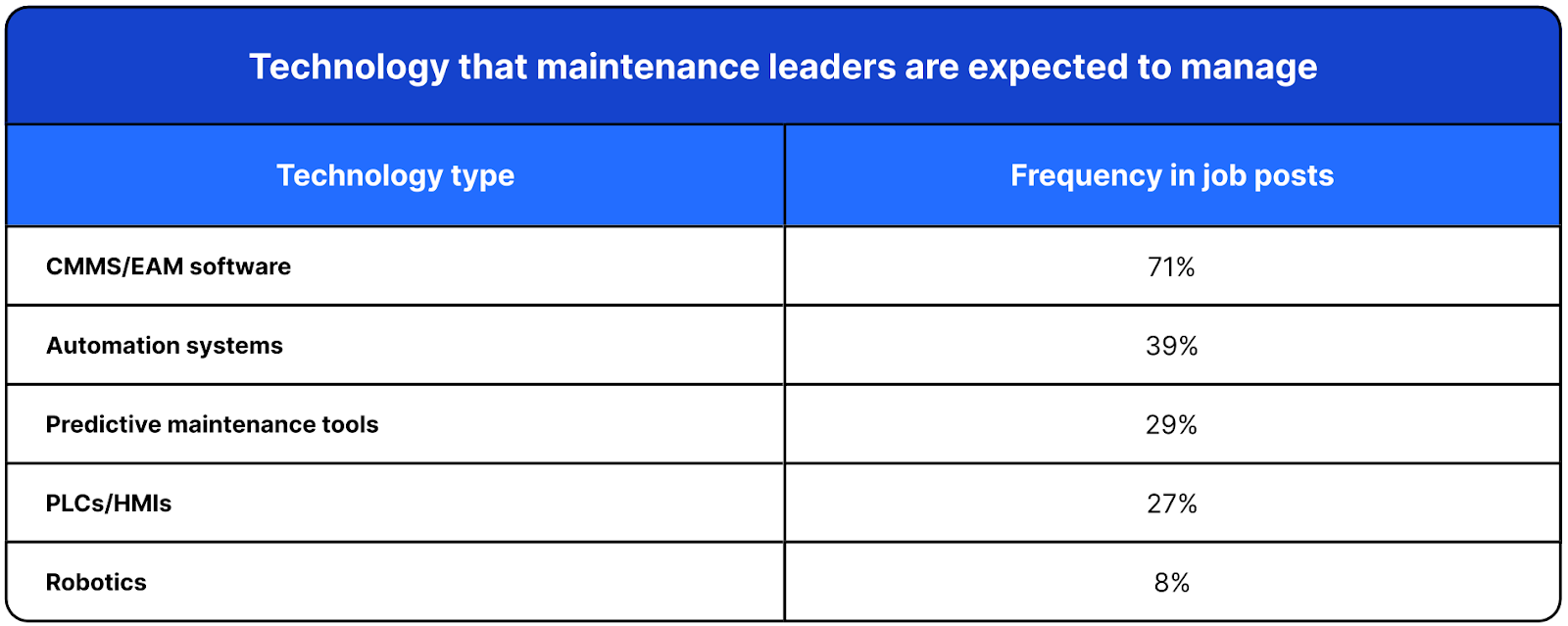
While many maintenance leaders interact with software every day, they’re now expected to own a multi-system tech stack. It’s not just about how many systems you manage, but also how you use them to increase efficiency and make decisions. These insights tell us more about how maintenance leaders can stand out by evolving their team’s digital maturity:
- 71% of leadership roles require maintenance managers to use a CMMS as a core system.
- 90% of organizations want maintenance leaders to use a CMMS for planning and scheduling, while 66% connect a CMMS to reporting, and 30% mention it as a platform to implement predictive and condition-based maintenance.
- 49% of maintenance leaders are expected to manage three or more digital systems and 28% are responsible for four or more systems.
- 39% of employers want their maintenance leaders to have experience with automation systems.
- 29% of postings explicitly mention the use of PdM tools like sensors or vibration analysis.
- 17% of job listings refer to digital transformation as a key responsibility for maintenance leaders.
What it means for you: Mastery of a CMMS is now the baseline. To stand out, learn how to integrate your maintenance data with other systems to show how maintenance impacts the bottom line. Stop looking at your tech stack and data in isolation. Familiarize yourself with the entire industrial tech ecosystem and how you can work with others at your facility to connect maintenance into that network. Master your CMMS beyond the basics of work orders. Treat it as a data hub to prove the value of your team and build a roadmap for continuous improvement.
4. Salary trends
Here are a few insights on salary taken from the analysis of job posts for the role of maintenance leaders:
- $131,400 is the current median salary for maintenance leaders in the U.S.
- 18% is the increase in average salary for first-line maintenance managers since May 2023.
- Maintenance leaders with 10+ years of experience were offered an average salary of $145,000, while those with six to nine years of experience had an average posted salary of $133,500, and those with three to five years of experience were offered an average of $120,500.
Five ways to stand out as a maintenance leader
In a world of aging equipment, skyrocketing labor shortages, and growing pressure to do more with less, top-tier maintenance leaders are the ones that turn day-to-day maintenance into a reliable value center for businesses. The five areas below are the surest ways for you to accomplish this goal and set yourself apart. Get 90-day starter kits for each of them in The Anatomy of the Modern Maintenance Leader.
1. Turn your team’s knowledge into better processes and outcomes
Technicians spend countless hours interacting with equipment. But the knowledge they gain in the process often lives only in their minds, scraps of paper, and outdated spreadsheets. It can be lost in a single day if not preserved.
Maintenance leaders who want to stand out will embed technology into existing workflows to continuously gather data on how assets work and what to do when they don’t. These leaders will feed this information into AI to create and surface work orders, checklists, and SOPs faster.
2. Unlock the true potential of work data and asset data
Manufacturers generate more data than any other sector. Maintenance often sits at the intersection of this information, monitoring equipment while generating data with work orders. However, only 28% of industrial organizations derive insights from this data. That’s because most of it is trapped in control systems, ERPs, and clipboards instead of going to the right person at the right time.
This presents an opportunity for maintenance leaders: they can help the businesses find ways to connect data from multiple sources, translate it into insights, and create systems that trigger action based on those insights.
3. Improve your storytelling skills
Many maintenance leaders aren’t trained to communicate in executive terms. With higher visibility comes higher expectations, and if you can’t clearly explain how you’re meeting them, it’s easy to lose the ground you’ve gained.
That’s why maintenance leaders who thrive are strong storytellers. This isn’t just about reports or metrics. It’s about understanding what matters to the business, speaking to those priorities, and using numbers to translate maintenance work into outcomes leadership cares about.
4. Accelerate maintenance maturity with technology
Maintenance maturity reflects an organization’s culture around reliability. Does each asset have its own reliability strategy? Is there a formal process for digital knowledge capture? Do technicians have the time, tools, and authority to work efficiently?
The strongest maintenance leaders understand this cultural shift. They know that standardized work, disciplined planning, and data quality are pillars of a well-run operation. With this foundation, they can improve maturity in targeted ways and adopt technology that fits the roadmap.
5. Help your company get the most out of its industrial tech stack
Industrial companies spend roughly $355B annually on smart technology and software. That investment is growing—75% of leaders plan to increase spending on smart manufacturing software in 2026. With that level of spend, executives want more ROI from every system.
Maintenance is one of the largest untapped opportunities to maximize both IT and OT investments. The strongest maintenance leaders are connecting workflows to the broader tech stack so information can move across systems and departments. The goal is to deliver the right information, at the right time, to the right people to trigger the right work.
What now: Your next step as a maintenance leader
The data from 100 job posts tells a consistent story: the era of the isolated maintenance manager is over. Today's successful leader is a cross-functional communicator, a data analyst, and a talent developer. By shifting your focus from reactive repairs to proactive business strategy, you can significantly accelerate your career path.
The transition doesn't happen overnight. Start by picking one area—perhaps improving your data storytelling or digitizing your team's tribal knowledge—and build a 90-day plan to master it.

Marc Cousineau is the Senior Content Marketing Manager at MaintainX. Marc has over a decade of experience telling stories for technology brands, including more than five years writing about the maintenance and asset management industry.
.png)



.webp)