

Facility management involves coordinating people, maintaining equipment, optimizing space utilization, and ensuring compliance—all while controlling costs and keeping operations running smoothly.
Limited budgets and understaffed teams are forcing facility managers to do more with less while maintaining the same performance and safety standards. According to our 2026 State of Industrial Maintenance report, 40% of maintenance professionals say a lack of resources is their top challenge.
The infrastructure you're managing isn't getting any younger, either. Our recent survey found that industrial assets are 24 years old on average, the oldest they've been since 1947, making proactive maintenance more critical than ever.
Add workforce challenges to the mix, with 36% of maintenance professionals identifying skilled labor shortages as their primary concern, and it's clear that successful facility management requires a more comprehensive approach than ever before.
In this guide, we'll explore what modern facility management encompasses, the core functions that drive operational success, and the best practices for maximizing your facility's performance.
Key Takeaways
- Facility management coordinates people, processes, and technology to ensure building functionality, safety, and efficiency.
- Modern facility management addresses resource constraints, aging infrastructure, and workforce challenges through strategic planning.
- Hard services include building maintenance and HVAC, while soft services cover cleaning, security, and landscaping.
- Preventive maintenance and CMMS technology shift operations from reactive repairs to strategic asset management.
- Track facility uptime, cost per square foot, and preventive maintenance ratios to measure success and justify investments.
What is facility management?
Facility management is the practice of coordinating your physical workplace with your people and work processes. It encompasses everything from maintaining building systems and managing space utilization to ensuring regulatory compliance and optimizing operational costs across your built environment.
Most organizations distinguish between two main categories of facility management services:
Hard facility management services include:
- Building maintenance and structural repairs
- HVAC systems, electrical, and plumbing operations
- Equipment maintenance and asset tracking
- Safety systems and access controls
Soft facility management services cover:
- Custodial/janitorial services
- Landscaping and grounds maintenance
- Food services and catering
- Reception and administrative support
Your facility management strategy directly influences business outcomes like operational efficiency, employee productivity, and long-term cost savings.
Teams can’t afford to focus only on reactive repairs and keeping systems running. Strategic planning, data-driven decisions, and proactive asset management are non-negotiable parts of the process.
What are the core functions of facility management?
Facility managers oversee five core areas. Each function requires specialized knowledge and coordinates with the others to create an environment conducive to productivity and safety.
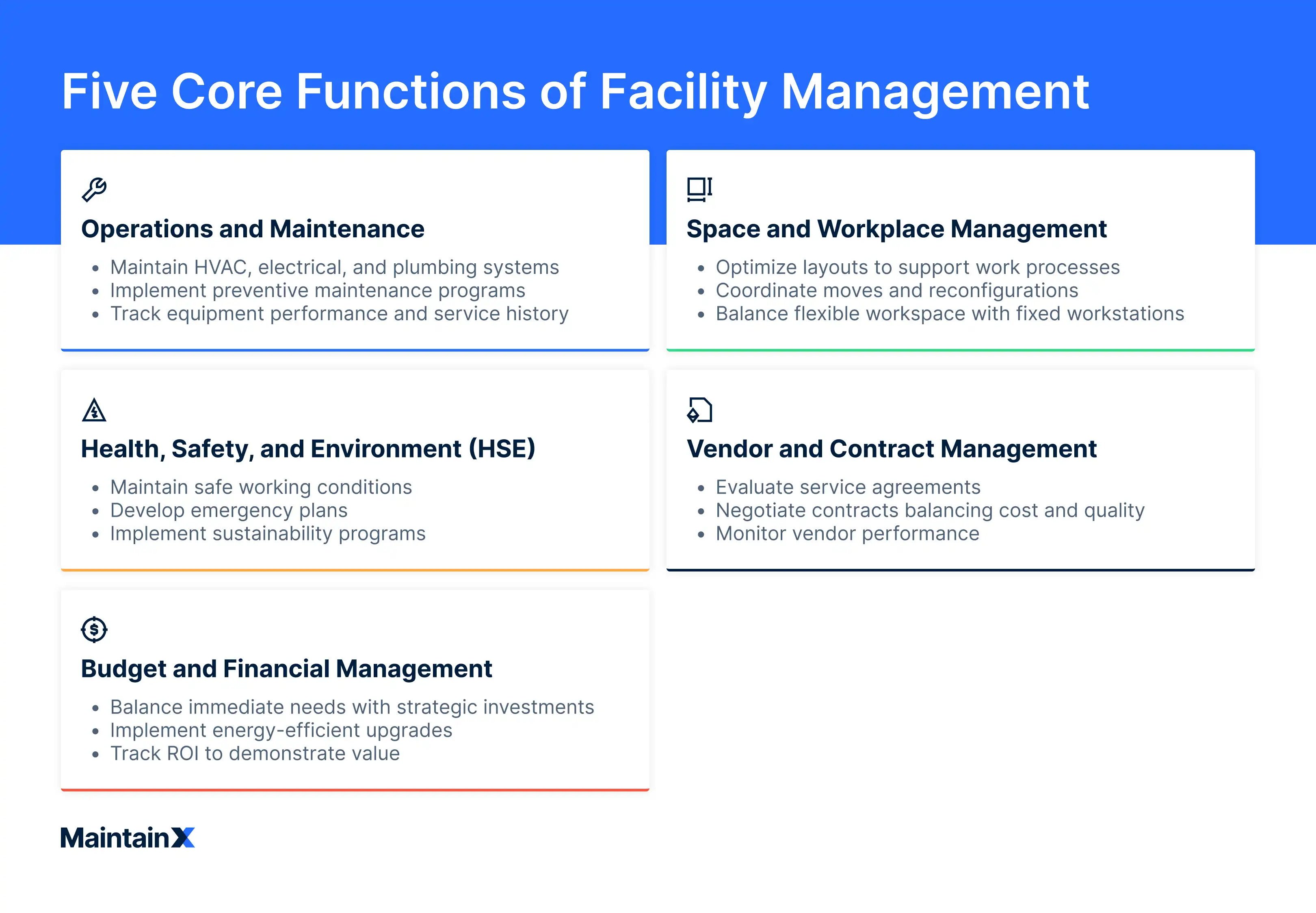
Operations and maintenance management
Equipment and asset maintenance form the backbone of facility operations. Your team must keep critical systems running while minimizing unexpected breakdowns that disrupt day-to-day operations.
Building systems that require constant attention include:
- HVAC systems for occupant comfort and air quality
- Electrical networks powering equipment and lighting
- Plumbing infrastructure for water supply and waste management
- Safety systems, including fire suppression and emergency lighting
The most effective way to provide this constant attention is through preventive maintenance—the practice of performing routine inspections, servicing, and repairs on equipment according to a predetermined schedule, rather than waiting for equipment to fail. This approach helps you avoid reactive repairs that cost more and cause downtime.
Key benefits of preventive maintenance include:
- Reduced emergency repair costs
- Extended equipment life
- Improved safety for building occupants
- Better regulatory compliance
Space and workplace management
Space planning and utilization—optimizing layouts to support work processes and business needs—directly affect operational efficiency and employee engagement. Effective space management also involves:
- Move management: Coordinating relocations and reconfigurations with minimal disruption
- Hot desking and hybrid work: Balancing flexible workspace needs with traditional fixed workstations
Health, safety, and environment (HSE)
Workplace safety compliance protects building occupants and shields your organization from liability. Core HSE responsibilities include:
- Safety compliance: Maintaining safe working conditions and conducting regular audits
- Emergency preparedness: Developing evacuation procedures and business continuity plans
- Environmental sustainability: Implementing energy management and waste reduction programs that support sustainability goals
Vendor and contract management
Service provider coordination ensures quality services at competitive prices. Key activities include:
- Contractor evaluation: Assessing performance and managing service level agreements
- Contract negotiation: Balancing cost savings with service quality requirements
- Quality assurance: Monitoring vendor performance through regular reviews and satisfaction surveys
Budget and financial management
Financial management determines your facility's long-term health and operational efficiency through:
- Capital planning: Balancing immediate needs with strategic investments
- Cost optimization: Implementing energy-efficient upgrades and predictive maintenance
- ROI tracking: Measuring cost savings to demonstrate value to organizational leadership

Why is facility management important?
Effective facility management delivers measurable business value across multiple areas that directly impact your organization's success.
Reduces operational costs through efficient resource management
Proper facility management takes a proactive approach to resource management that catches issues before they become expensive emergencies. This involves implementing preventive maintenance programs, coordinating vendor relationships, standardizing procedures across locations, and tracking asset performance data to eliminate redundant spending and optimize resource allocation.
Energy management programs build on these foundations by identifying consumption patterns and implementing efficiency measures that compound savings over time.
Ensures regulatory compliance and workplace safety
Systematic facility management establishes audit trails and documentation to demonstrate compliance with safety regulations, building codes, and environmental standards. Regular inspection schedules work hand in hand with standardized safety procedures and proper record-keeping to protect your organization from fines and liability while ensuring employee safety.
Digital work order systems complete this framework by tracking completion of required maintenance tasks and safety checks.
Improves employee productivity and satisfaction
Well-maintained facilities eliminate the disruptions that pull employees away from their core work. When HVAC systems maintain comfortable temperatures, equipment operates reliably, and spaces remain clean and functional, employees can focus on productive activities rather than facility-related problems.
Consistent maintenance processes further support productivity by reducing time spent searching for information or waiting for repairs.
Extends asset life and maximizes return on infrastructure investments
Strategic maintenance scheduling based on manufacturer recommendations and usage patterns prevents premature equipment failure. This approach enables facility managers to track maintenance history and asset performance, identifying patterns that help optimize replacement timing and maintenance intervals.
Proper care of building systems and equipment ultimately protects the significant capital investments your organization has made.
Supports sustainability and corporate responsibility goals
Facility management systems provide the data visibility needed to track energy consumption, waste generation, and resource usage. This information enables targeted improvement programs that reduce environmental impact while often delivering cost savings.
Preventive maintenance reinforces these sustainability efforts by reducing waste from premature equipment replacement and emergency repairs.


Facility management best practices
Effective facility management requires strategic planning and systematic execution. These proven practices help you optimize operations while controlling costs.
Develop comprehensive facility management plans aligned with business objectives
Start by identifying your organization's core business outcomes and mapping how facility operations support them. Create annual facility management plans that include asset maintenance schedules, capital improvement projects, and regulatory compliance requirements.
Review these plans quarterly with leadership to ensure investments align with business priorities and operational efficiency goals.
Implement preventive maintenance programs to reduce reactive work
Begin with your most critical physical assets and establish maintenance schedules based on manufacturer recommendations and usage patterns.
Create standardized procedures for routine inspections and maintenance tasks. Track the ratio of preventive to reactive maintenance work monthly, with the aim of shifting more resources toward planned activities.
Leverage facility management technology for data-driven decisions
Modern facility management relies on integrated technology systems that collect, analyze, and report on facility performance data. Start by implementing centralized software platforms to coordinate work orders, maintenance schedules, and asset tracking across your organization.
These systems connect with building technologies such as IoT sensors that monitor critical equipment performance in real time and building management systems that track energy consumption and identify efficiency improvement opportunities.
Together, these integrated platforms generate comprehensive reports you can review weekly to spot trends, identify maintenance needs before they become problems, and make proactive adjustments to optimize facility performance and costs.
Standardize processes and procedures across multiple facilities
Document your most effective maintenance procedures and safety protocols, then replicate them across all facilities. Create template work orders for everyday tasks and establish consistent vendor management practices.
Train facilities managers at each location on standardized procedures and perform regular audits to ensure compliance across many organizations and building locations.
Prioritize employee experience and workplace satisfaction
Survey building occupants regularly about facility-related maintenance issues and response times. Establish clear communication channels for reporting maintenance needs and provide updates on work progress.
Focus on quickly resolving issues that directly impact employee productivity and create productive environments, such as HVAC system problems, lighting failures, and workspace functionality issues.
Track and optimize key performance indicators continuously
Monitor facility uptime, maintenance response times, and operational costs monthly. Track energy consumption trends and benchmark against industry standards for energy management.
Review vendor performance quarterly and adjust contracts based on service quality and cost savings opportunities. Use this data to reduce costs, identify operational efficiencies, and justify facility management investments.
Key facility management metrics and KPIs
Tracking the right metrics helps you measure facility performance, identify improvement opportunities, and demonstrate value to organizational leadership. Focus on these key areas to optimize your facility management program.
Operational metrics
Operational metrics measure how effectively your facility systems and maintenance processes support day-to-day business operations:
- Facility uptime and availability: Measures the percentage of time your building systems operate without disruption, calculated by dividing operational hours by total scheduled hours.
- Work order completion rates and response times: Tracks the percentage of maintenance requests completed within target timeframes and calculates the average time from request submission to technician response.
- Preventive vs. reactive maintenance ratio: Compares the percentage of planned maintenance work against emergency repairs, with higher preventive ratios indicating better facility management.
Financial metrics
Financial metrics help you control costs, justify investments, and demonstrate the economic value of facility management:
- Total cost of ownership (TCO): Calculates complete lifecycle costs for facility assets, including acquisition, maintenance, energy consumption, and disposal expenses.
- Cost per square foot: Divides annual facility operating expenses by total building square footage to create standardized cost comparisons across facilities.
- Budget variance and forecasting accuracy: Measures the difference between planned and actual facility expenses and compares predicted costs against actual spending to improve future planning.
Sustainability metrics
Sustainability metrics track your facility's environmental impact and progress toward corporate responsibility goals:
- Energy consumption and efficiency: Tracks total energy usage measured in kWh or BTUs per square foot and compares useful output to energy input for building systems.
- Water usage and waste reduction: Measures gallons consumed per square foot and calculates the percentage of waste recycled or composted versus sent to landfills.
- Carbon footprint and environmental impact: Quantifies total greenhouse gas emissions from facility operations and measures progress toward environmental commitments.

Common facility management challenges
Facility managers face interconnected challenges that require strategic thinking and adaptable solutions, including:
Managing aging infrastructure with limited budgets
Many organizations struggle to maintain equipment that has reached or exceeded its expected lifespan while operating under tight financial constraints. The key is prioritizing repairs and replacements based on criticality to operations, balancing immediate safety needs with long-term asset planning.
Strategic maintenance scheduling and careful vendor selection can help maximize the value of every maintenance dollar.
Balancing day-to-day operations with long-term strategic planning
Urgent maintenance issues often consume time and resources that should be dedicated to strategic improvements. Successful facility managers establish systems that handle routine operations efficiently while protecting time for planning capital improvements, technology upgrades, and process enhancements.
This requires clear priorities and delegation of operational tasks to focus on strategic initiatives.
Coordinating multiple vendors and service providers
Managing relationships with contractors, cleaning services, security companies, landscaping teams, and other vendors requires careful coordination to avoid scheduling conflicts and service gaps.
Standardized contracts, clear communication protocols, and performance-monitoring systems help ensure that all service providers meet your facility's needs while staying within budget.
Adapting to evolving workplace models
Hybrid and remote work arrangements have changed how employees use facility space, requiring adjustments to cleaning schedules, HVAC operations, and space configurations. The challenge is optimizing building operations for variable occupancy while maintaining employee satisfaction and operational efficiency.
This includes reconfiguring spaces for flexible use and adjusting maintenance schedules based on actual usage patterns.
Maintaining compliance across changing regulations
Safety standards, environmental regulations, and building codes evolve continuously, requiring ongoing attention to ensure your facility meets current requirements. Effective compliance management involves systems to track regulatory changes, schedule required inspections, and document compliance activities.
Staying current with regulations protects your organization from fines and liability while ensuring employee safety.
Justifying facility management investments to leadership
Demonstrating the value of preventive maintenance, technology upgrades, and facility improvements requires clear metrics and well-developed business cases.
The most successful facility managers translate operational benefits into financial terms that organizational leadership understands, showing how facility investments support broader business objectives and deliver measurable returns.


Technology and tools for facility management
Modern facility management relies on technology to streamline operations, improve decision-making, and maximize operational efficiency. The right tools help you manage complex facilities more effectively while reducing costs.
One of the most essential tools for facility managers is a computerized maintenance management system (CMMS). This facility management software centralizes all maintenance and asset management activities on a single digital platform, helping you:
- Centralize data management: Store all facility management information in one platform for better coordination and data-driven decisions.
- Automate preventive maintenance: Schedule routine maintenance tasks automatically based on time intervals or usage patterns.
- Track work orders: Monitor completion rates and response times across all maintenance requests.
- See real-time cost visibility: Monitor maintenance expenses, parts inventory costs, and budget performance instantly.
- Monitor asset performance: Track equipment status and maintenance history to optimize replacement timing.
- Optimize resources: Allocate maintenance staff and materials more effectively based on actual needs.
- Provide mobile accessibility: Enable technicians to update work orders and access procedures from anywhere in your facility.
- Manage parts inventory: Track spare parts availability and automate reordering to prevent stockouts.
- Upkeep compliance documentation: Maintain digital records to meet regulatory requirements and ensure audit readiness.
Get started with smart facility management
Effective facility management integrates people, processes, and technology to create productive environments while controlling operational costs.
Whether you're managing a single building or multiple facilities, the principles remain the same: prioritize preventive maintenance, leverage data for decision-making, and align facility operations with your organization's business objectives.
Ready to transform your facility management approach? Explore MaintainX's facility management solutions to discover how our CMMS platform can help your team streamline operations, reduce costs, and improve building performance.
Facility management FAQs
What is the difference between facility management and facilities maintenance?
Facility management encompasses the strategic coordination of people, processes, and technology across your entire built environment, while facilities maintenance focuses specifically on keeping building systems and equipment operational.
Facility management includes space planning, vendor coordination, compliance management, and budget oversight. Maintenance primarily involves repairs, preventive maintenance programs, and equipment servicing.
Most organizations need both comprehensive facility management and dedicated maintenance teams to optimize building operations and asset performance.
What is facility management software?
Facility management software, often called a CMMS or facilities management technology, centralizes all aspects of building operations into a single digital platform. This management software helps you schedule preventive maintenance, track work orders, manage vendor relationships, and monitor operational costs across multiple facilities.
Modern facility management software includes features for asset tracking, energy management, compliance reporting, and mobile access for maintenance teams, enabling data-driven decisions that improve operational efficiency and reduce costs.
What industries need facility management?
Most organizations with physical facilities benefit from professional facility management, including manufacturing plants, retail locations, healthcare facilities, office buildings, educational institutions, and hospitality venues.
Manufacturing and industrial facilities require specialized facility management for equipment maintenance, safety compliance, and operational efficiency. Commercial real estate, government buildings, and multi-site organizations particularly benefit from standardized facility management processes that ensure consistent building operations and cost control across all locations.
What is the difference between hard and soft facility management?
Hard facility management services focus on building systems and physical infrastructure, including HVAC systems, electrical networks, plumbing, structural maintenance, and safety systems.
Soft facility management covers support services that enhance the workplace experience, such as custodial services, landscaping, security, food services, and reception support. Most organizations require both hard and soft facility management services to create productive environments, though the specific mix depends on building type, occupancy, and organizational needs.
How does facility management contribute to business success?
Facility management directly impacts business success by reducing operational costs, improving employee productivity, and ensuring regulatory compliance. Well-managed facilities minimize disruptions that affect core business operations, while strategic facility management extends asset life and maximizes return on infrastructure investments.
Effective facility management also supports sustainability goals, enhances employee satisfaction, and creates professional environments that support organizational objectives. By optimizing building operations and controlling costs, facility management becomes a strategic advantage rather than just a cost center.
What is the role of sustainability in facility management?
Sustainability in facility management focuses on reducing environmental impact while achieving cost savings through energy efficiency and resource optimization. Sustainable facility management includes energy management programs, waste reduction initiatives, water conservation, and carbon footprint tracking to support corporate responsibility goals.
Many organizations find that sustainable practices also deliver operational efficiencies, such as reduced energy consumption costs and improved building performance. Modern facility management integrates sustainability metrics with operational and financial KPIs to demonstrate the business value of environmental stewardship.

The MaintainX team is made up of maintenance and manufacturing experts. They’re here to share industry knowledge, explain product features, and help workers get more done with MaintainX!




.webp)