

Precision maintenance is a maintenance strategy that uses standardized procedures and exact specifications to ensure consistent, high-quality results regardless of which technician performs the work. This approach focuses on eliminating variability in maintenance execution through detailed standard operating procedures (SOPs), proper training, and strict adherence to manufacturer specifications.
Key takeaways
- Precision maintenance relies on standardized procedures (SOPs) to ensure every task is completed with accuracy and consistency, regardless of which technician performs the work.
- By eliminating variations in maintenance execution, you can significantly reduce unplanned downtime, lower operational costs, and extend the lifespan of critical assets.
- A successful precision maintenance program depends on detailed documentation, continuous team training, and a culture committed to operational excellence and process improvement.
- Using a computerized maintenance management system (CMMS) helps you digitize SOPs into mobile-friendly checklists, track performance against standards, and ensure your team executes every task with precision.
What is precision maintenance?
Precision maintenance is a maintenance approach that relies on standardized procedures and precise specifications to deliver consistent, high-quality results, no matter which technician completes the work.The goal is to reduce as much variation in the work as possible through consistent SOPs, continuous training, and a focus on manufacturer guidelines.
It's important to recognize that what one organization considers precise will differ entirely for another. Depending on the industry, and the type of equipment involved, ideal maintenance protocols will vary.
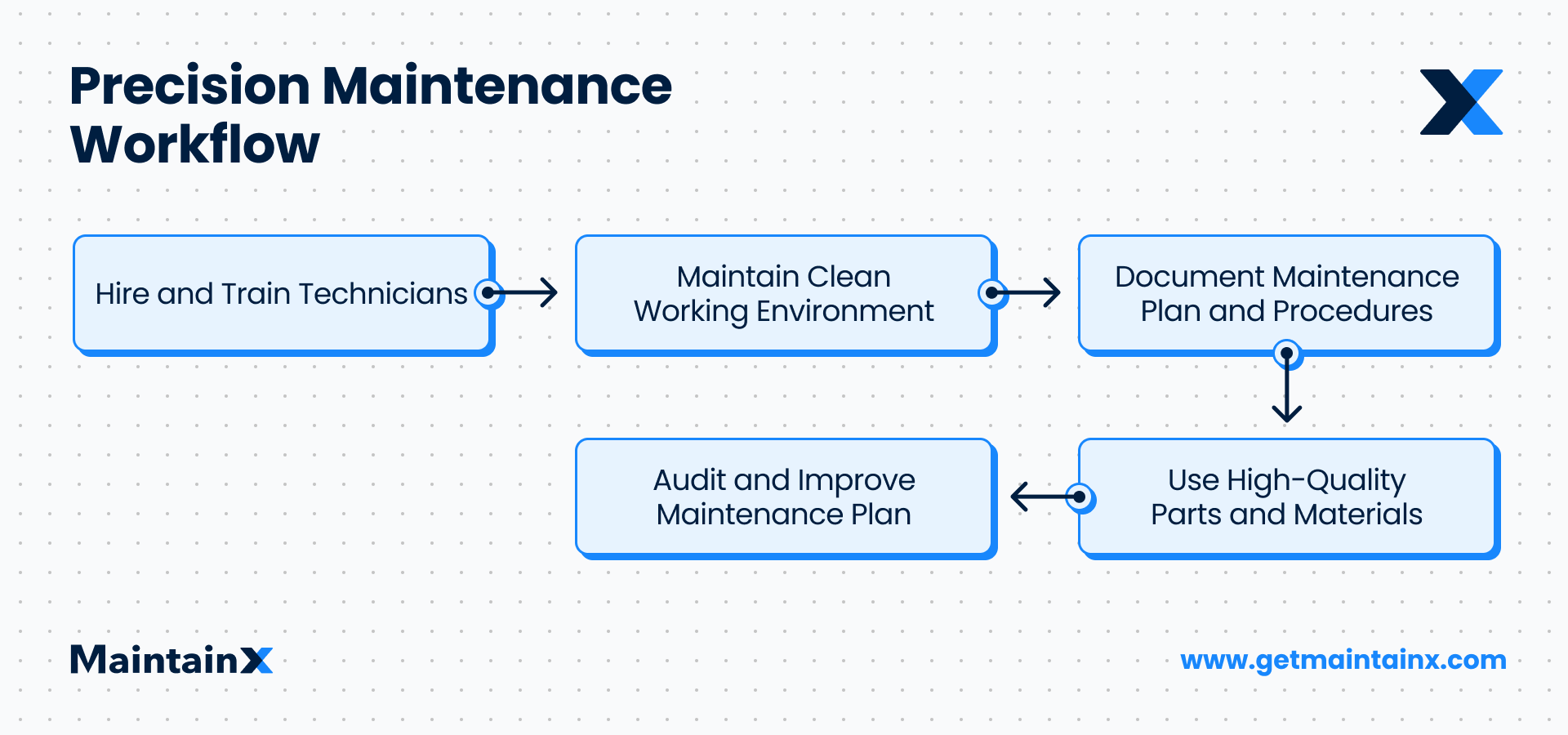
The cornerstone of a successful precision maintenance program is documented standard operating procedures that leave no room for error. Clearly articulated SOPs, and proper team training, guarantee consistent task outcomes regardless of who is completing a work order. Precision maintenance SOPs must be detailed, accessible, and up to date.
Why does precision maintenance matter?
Without clear SOPs, technicians can handle the same work orders completely differently. Varying work experiences, education levels, and skill levels can lead to tasks that are done inconsistently, which often produces undesirable results.
For example, a maintenance manager at a food processing facility notices that one production line experiences more breakdowns during the night shift compared to the day shift. After investigating, they discover that night shift technicians are using different torque specifications for belt adjustments. Precision maintenance eliminates such inconsistencies by establishing exact standards that all technicians must follow, regardless of their shift or experience level.
The benefits of precision maintenance
Organizations typically see a 20–40% reduction in unplanned downtime after implementing precision maintenance programs, significantly higher than the 10–15% improvement from preventive maintenance alone. In manufacturing environments, where each hour of downtime costs $50,000 or more, this improvement translates to substantial cost savings.
In addition to reducing downtime (with some organizations achieving 30% reductions in unplanned maintenance), precision maintenance plans deliver:
- A positive maintenance culture focused on continuous improvement
- Extended equipment lifespan through consistent, high-quality maintenance
- Increased production capacity via improved machine reliability
- A team of skilled and highly-trained maintenance professionals
- Continuously improving process efficiency through standardized procedures
- Increased asset reliability and availability
- Reduced risk of equipment failures and resulting production losses
- Predictable maintenance costs through proactive planning
How does precision maintenance reduce downtime?
Equipment needs proper maintenance to run at peak performance. The best approach combines a solid predictive or preventive maintenance program with consistent precision maintenance practices.
Four ways precision maintenance improves reliability
- Extends asset life and uptime: Maintenance teams extend the lifespan of assets by always using high-quality parts, tools, and lubricants. This dramatically reduces the risk of unexpected breakdowns and production interruptions.
- Reduces the need for reactive maintenance: Although precision maintenance cannot completely eliminate reactive maintenance, it greatly reduces instances when you require reactive maintenance (as demonstrated by Electro Cycle's shift from a 40:60 to a 70:30 preventive-to-reactive ratio). This helps limit maintenance costs and operate within tight budgets.
- Improves performance: Properly maintained equipment performs at its best. Precision maintenance improves machine reliability and helps keep production at the best possible levels, with minimal downtime necessary.
- Eliminates the likelihood of maintenance overtime: Precision maintenance allows managers to predict project timelines with greater accuracy. When teams properly document maintenance procedures and technicians follow SOP checklists, routine task duration becomes predictable, preventing extended scheduled downtime.


Precision maintenance program requirements
Precision maintenance programs look different across facilities, but the successful ones share key requirements that most often lead to consistent, measurable results.
Core program requirements
- Skills and training: Maintenance technicians must have the necessary skills and training to follow maintenance procedures with a high level of precision.
- Proactive maintenance: A robust preventive or predictive maintenance program forms the foundation of precision maintenance. Teams must stay ahead of scheduled maintenance work.
- Detailed procedures and workflows: Detailed workflows and SOPs are necessary for each maintenance task, with precise standards for execution. Employees need easy access to maintenance documentation and must follow each step exactly. The correct fits, tolerances, torques, and tensions all need clear documentation with no room for misinterpretation.
- Up-to-date procedures: Teams must systematically review all procedures to ensure accuracy. Equipment upgrades, improved maintenance procedures, or updated manufacturer information require immediate documentation updates.
Technical requirements
- Maintenance tools calibration: All maintenance tools and equipment need regular calibration.
- High-quality materials: All maintenance materials, including lubricants, spare parts, and tools must meet quality standards. Stick to manufacturer-specified spare parts and avoid cheap replacements.
- Precise shaft alignment and correct balance: Technicians must ensure precise shaft alignment and maintain proper balance between rotating elements.
- Correct operating temperatures: Teams must maintain correct operating temperatures for all machines through frequent temperature checks. Automatic alert systems for abnormal temperature readings offer excellent protection.
Process requirements
- Root cause analysis: Conduct root cause analysis (RCA) for each failure to address underlying causes and prevent repeat issues.
- Document past maintenance work: Technicians must document maintenance as performed, providing clear visibility into completed work and results for continuous improvement.
Key precision maintenance techniques
Precision maintenance programs typically focus on several core techniques:
- Vibration reduction: Excessive machine vibration indicates equipment malfunction and potential failure
- Precise alignment: Ensuring rotating components are properly aligned
- Temperature control: Maintaining equipment within optimal operating ranges
- Quality materials: Using only manufacturer-specified parts and lubricants
Best practices for precision maintenance
Establishing a precision maintenance program requires more than just writing down procedures. To ensure success and drive continuous improvement, your team should adopt several best practices that reinforce a culture of accuracy and reliability.
Implementation best practices
- Standardize with digital checklists: Converting SOPs into digital checklists in a CMMS makes procedures easy to access on mobile devices, ensures technicians never miss a step, and creates a verifiable record of every task performed.
- Focus on root cause analysis: Instead of just fixing failures, teams conduct RCAs to understand why they happened. These insights lead to updated maintenance procedures so you can prevent similar issues from recurring.
- Calibrate tools regularly: Precision work requires precise tools. Make sure you establish regular calibration schedules for all measurement instruments, like torque wrenches and alignment tools, to guarantee accuracy in every task.
Cultural best practices
- Maintain a clean and organized environment: Contamination is a leading cause of premature component failure. Emphasize clean work habits and proper storage for parts and lubricants to protect asset integrity and ensure reliable performance.
- Invest in continuous precision maintenance training: As equipment and technology evolve, team skills must keep pace. Provide ongoing, hands-on training to reinforce precision standards and ensure everyone understands the value of doing the job right every time.

How to start a precision maintenance program
Launching a precision maintenance program at your facility may feel like a daunting task, especially if your team has relied heavily on reactive maintenance in the past. However, the effort pays off through reduced downtime and lower maintenance costs. Follow these seven steps to transition to precision maintenance.
1. Conduct a team skills assessment
Assess and analyze any skills gaps that the organization needs to overcome. Assessment identifies additional skills technicians should acquire to perform all maintenance tasks with high precision. Results typically range from minimal necessary training needed to a complete retraining of the workforce.
2. Create a culture of continuous improvement
Create a culture of excellence by clearly communicating why precision maintenance matters. Getting everyone on board through skills investment ensures each employee understands their role in reaching company goals.
3. Invest in training for maintenance personnel
Maintenance managers and experienced technicians should perform hands-on training sessions, teaching precision maintenance procedures step-by-step while replicating real-world situations.
4. Identify high-maintenance equipment
Some machines require more routine maintenance than others due to intense usage or manufacturer specifications. Teams prioritize tracking equipment based on specific criteria, which can include:
- Expensive assets with high replacement costs
- Equipment crucial to production throughput
- Machines prone to high levels of vibration
Use a CMMS to track all maintenance work and identify your highest-maintenance equipment over time. These assets benefit most from precision maintenance and deliver the highest return on investment (ROI).
5. Create detailed workflows and procedures
Create clear, step-by-step procedures and workflows with highly detailed instructions that leave no room for interpretation. Documentation includes all requirements (torque specifications, pressure settings, and alignment numbers) so maintenance technicians never have to guess.
Standard operating procedures must be up-to-date, well-organized, and understandable for everyone (similar to how Southeast Power developed comprehensive SOPs that helped them launch their preventive maintenance program successfully). Document all completed maintenance work to analyze results, streamline processes, and improve procedures.
6. Invest in a user-friendly CMMS
A user-friendly CMMS provides full visibility of maintenance work, asset history, and cost-saving opportunities. Critical features for precision maintenance include:
- User experience: The system must be easy to navigate to ensure adoption across all team members.
- Instant messaging and chat: Workers need the ability to communicate within work orders for real-time collaboration.
- Recurring work order scheduling: Automated scheduling ensures preventive maintenance happens on time, every time.
- KPI tracking: Performance metrics allow teams to measure results and identify improvement opportunities.
- User-friendly digital checklists: The most effective platforms provide drag-and-drop templates that teams can customize for specific needs.
7. Conduct progress reviews
Precision maintenance requires continuous involvement through regular measurement and assessment of KPIs, including:
- Equipment failure rates
- Asset life extension
- Operational cost trends
- Downtime reduction
- Equipment performance metrics
This data enables teams to analyze which procedures work effectively and what needs improvement. It’s important to continuously improve SOPs, keep digital checklists current, and conduct one-on-one progress reviews to invest in technician development.
Precision maintenance examples
Precision maintenance can be paired with many different types of maintenance programs and schedules. Real-world applications show how precision principles improve maintenance outcomes.
Common precision maintenance applications
- Teams use only high-quality tools, spare parts, and lubricants while ensuring proper storage conditions
- Facilities maintain clean, contamination-free environments to prevent premature wear
- Technicians frequently check operating temperatures to ensure equipment stays within required ranges
- Teams maintain low machine vibration levels through regular monitoring and adjustment
- Maintenance professionals ensure precise alignment of all rotating parts during installation and service
- Technicians systematically apply correct torque levels for each fastener according to specifications
What are the other types of maintenance?
Understanding how precision maintenance fits within the broader maintenance landscape helps teams develop comprehensive strategies. Here are five common programs often used in combination with precision maintenance:
Reactive and scheduled maintenance types
- Corrective maintenance: Corrective maintenance is executed once a breakdown occurs. The goal is returning equipment to working order quickly via repairs or replacements. While necessary for unexpected failures, excessive corrective maintenance indicates program gaps.
- Preventive maintenance: Preventive maintenance involves scheduled inspection and maintenance of assets. Its main objective is maintaining optimal equipment performance, fixing issues before they become problems, and reducing corrective maintenance needs.
Advanced maintenance strategies
- Predictive maintenance: Predictive maintenance measures equipment condition to predict lifespan and prevent failure through sensor monitoring and data analysis. This approach complements precision maintenance by improving maintenance timing while precision maintenance ensures quality execution.
- Condition-based maintenance: Condition-based maintenance monitors equipment performance in real-time to spot impending failures. Despite high implementation costs, it significantly decreases failure risk when teams combine it with precision maintenance standards.
The final word on precision maintenance
Precision maintenance turns reactive guesswork into a competitive advantage. By standardizing procedures and ensuring consistent execution, maintenance teams dramatically improve equipment reliability while reducing costs.
Precision maintenance FAQs
What are the four main types of maintenance strategies used in manufacturing facilities?
Manufacturing facilities typically use four maintenance strategies: preventive maintenance (scheduled based on time or usage), corrective maintenance (technicians perform after equipment failure), condition-based maintenance (monitoring tools trigger), and predictive maintenance (using data analysis to predict failures). Most facilities combine these approaches for optimal equipment reliability.
How does precision maintenance differ from predictive maintenance in industrial operations?
Precision maintenance focuses on the quality and consistency of maintenance work execution, while predictive maintenance focuses on timing maintenance based on data analysis. Precision maintenance ensures every technician follows exact procedures, while predictive maintenance determines when maintenance should occur.
Which asset-intensive industries benefit most from precision maintenance programs?
Manufacturing, food processing, oil and gas, and logistics see the highest ROI from precision maintenance due to high downtime costs. These industries often achieve 20–40% reductions in unplanned downtime when implementing comprehensive precision maintenance programs.
.webp)