

In a typical week, your maintenance operations (O&M) team walks the floor, listening for unusual noises in compressors and checking temperatures on mixing equipment that has been running hot. They check off small preventive maintenance tasks that help catch small issues before they grow into production-stopping problems.
When line operators submit work requests, the maintenance manager reviews them and assigns the tasks to a technician. The technician updates parts usage so inventory stays accurate and documents the repair to stay on track for compliance.
Sometimes, a critical asset fails without warning, bringing production to a halt. The maintenance team will pull data from earlier inspections, check recent repairs, and locate the right replacement parts to get the equipment running again.
O&M encompasses these activities and more. Effective maintenance operations balance proactive upkeep with resource constraints to minimize downtime, extend asset life, and control costs.
This guide explains what maintenance operations include, how to build an effective O&M program, and where hidden costs often undermine performance. You’ll learn how to measure progress, identify cost drivers, and use modern tools to improve the way your team works.
Key takeaways
- Effective O&M gives teams control over their workload by reducing unplanned work.
- When technicians follow clear schedules and procedures, equipment performance becomes easier to manage, and failures become easier to prevent.
- Strong documentation and accurate data help maintenance leaders plan budgets and justify resources.
- Poor O&M practices lead to financial pressure from issues like increased downtime.
- Modern tools like a CMMS help teams streamline work and make operational decisions with greater confidence.


Maintenance operations defined
Maintenance operations, or O&M, include the day-to-day activities your team performs to keep your facility reliable, safe, and ready for production.
These activities range from routine inspections to complex repairs, as well as all the administrative tasks to support that work.
Strong O&M programs give organizations the structure and data they need to reduce downtime, manage costs, and make better decisions about their assets.
Core components of maintenance operations
Effective maintenance operations require:
- Planning and scheduling: Determine what work needs to be done and how often to perform preventive maintenance. This involves coordinating with the production team, building weekly schedules, and reviewing backlogs regularly.
- Work execution: Conduct inspections, maintenance tasks, and repairs using clear procedures. Document findings so the team has comprehensive data for evaluating equipment health and team performance.
- Inventory and parts management: Maintain accurate records of spare parts and consumables to prevent stockouts and reduce emergency orders. This also ensures repairs happen without delay.
- Asset documentation: Support audits and warranty claims with centralized work histories and inspection notes.
- Performance monitoring: By tracking KPIs like MTTR, PM compliance, reactive work ratios, and asset availability, you can show where your O&M program is improving and what steps you need to take to improve.
Maintenance vs. operations: Understanding the distinction
Maintenance and operations work toward the same goals, but they focus on different parts of the process:
- Maintenance keeps assets healthy. Maintenance teams perform inspections, execute preventive maintenance, fix equipment failures, and manage documentation. Their work protects uptime and keeps workers safe.
- Operations runs the equipment to meet production goals. This team assists maintenance by noting when assets don’t seem to be running properly. For example, they might note a decrease in throughput or bring attention to a strange vibration within the machinery.
Common MRO activities
Maintenance, repair, and operations work includes a wide range of day-to-day tasks that support equipment reliability:
- Inspections: Check lubrication points, temperatures, pressures, and vibrations for indicators of asset health
- Maintenance: Clean, lubricate, adjust, and schedule component replacements to help prevent failures and extend asset life
- Repairs: Diagnose the issue, source parts, and fix the asset
- Inventory: Track part usage and reorder as necessary to ensure critical spares are available
- Compliance: Update records, verify completion of PM tasks, and prepare documentation for regulatory audits
Key maintenance strategies in operations
Most teams use a mix of maintenance strategies to keep equipment reliable.
Understanding the strengths and limits of each approach helps you decide where to invest your team’s resources.
Preventive maintenance
Preventive maintenance relies on time-based or usage-based schedules. Your team completes tasks at regular intervals to reduce the likelihood of failure.
When preventive maintenance is completed to plan, teams reduce the need for emergency repairs. This maintenance strategy also gives technicians consistent workloads, which makes staffing more predictable.
Predictive maintenance
Predictive maintenance uses real-time, or near real-time, data to identify when equipment conditions begin to deteriorate. Sensors, meters, and performance trends provide signals that a component is wearing out, so you can schedule repairs before a failure occurs.
Predictive maintenance requires accurate data and consistent monitoring, but the extra work saves teams from completing unnecessary PM tasks.
Corrective/reactive maintenance
Corrective or reactive maintenance happens when equipment fails. Some assets will always be best managed on a run-to-failure strategy because they are inexpensive, aren’t critical to production, and don’t pose a safety risk.
For critical equipment, though, relying too heavily on reactive work leads to higher costs, more downtime, and more stress on your O&M team.
Condition-based maintenance
A condition-based maintenance strategy sits between the preventive and predictive approaches. Instead of completing tasks on a fixed schedule, as in preventive maintenance, your team performs work when specific conditions are met.
This might be something like a temperature spike, fluctuations in pressure, or visible wear. This approach allows the team to focus attention where it is most needed, especially on your most critical assets.
Building an effective O&M program
A strong O&M program supports reliable equipment performance and predictable operations.
Here’s how to create a program that is practical and easy to follow so your organization can gain more control over uptime and costs.
Establishing goals and objectives
Every O&M program needs clear, measurable goals that help your team prioritize its work and allocate resources effectively.
Some common objectives include increasing asset uptime, reducing reactive work, and meeting audit requirements.
Each of your goals should connect directly back to production performance so everyone understands why each target matters.
Creating standard operating procedures
Standard operating procedures, or SOPs, ensure work happens the same way every time. Good SOPs are specific, easy to follow, and lay out all the steps, tools, and documentation expectations a technician needs to complete the task.
Teams that rely on SOPs complete work more efficiently and capture better data.
Developing O&M manuals and documentation
O&M manuals outline how equipment should be maintained and what failure signs to watch out for. Accurate documentation gives your team a single source of truth for maintenance history and compliance records.
This eliminates knowledge gaps between technicians, and supports you during audits.
Setting up preventive maintenance schedules
A preventive maintenance schedule organizes recurring work so you can stay ahead of failures.
A schedule must account for production windows. Maintenance intervals should be based on historical maintenance records. The schedule also needs to be realistic, given the O&M team’s current staffing and budget for work.
Measuring maintenance operations performance
Reliable metrics help you understand the efficacy of your program as well as where your team spends its time, and where operational or financial risks are building.
Productive O&M teams use performance data to guide decisions about staffing, budgeting, scheduling, and long-term asset planning.
Essential KPIs for O&M programs
Tracking a few KPIs consistently will give you the clearest picture of maintenance performance:
- PM schedule compliance: Is planned work being completed on time? High PM compliance usually correlates with fewer failures and less reactive work.
- Reactive work ratio: How often is your team responding to failures instead of following the planned schedule? A rising ratio of reactive repairs to preventive maintenance is a sign that equipment health or staffing capacity may be slipping.
- Mean time to repair (MTTR): How long does it take to restore equipment after a failure? Lower MTTR signals strong troubleshooting processes, available parts, and skilled technicians.
- Mean time between failures (MTBF): How frequently does equipment break down? Improving MTBF helps demonstrate the impact of your preventive and predictive maintenance strategies.
- Asset availability: Is equipment ready when production needs it? Availability is one of the clearest links between maintenance performance and operational output.
- Maintenance cost per unit produced: What is the combined cost of labor, parts, and downtime? Tracking maintenance cost per unit produced helps leaders understand whether assets are becoming more expensive to maintain and whether investments in preventive work are paying off.
Benchmarking against industry standards
Benchmarking helps you compare your performance against peers and identify areas for improvement.
Good benchmarks also help maintenance leaders make a stronger business case when resources are needed. When equipment availability falls behind industry norms or reactive work climbs far above typical levels, it becomes easier to justify additional investments in staffing, training, or technology.
The hidden cost of poor maintenance operations
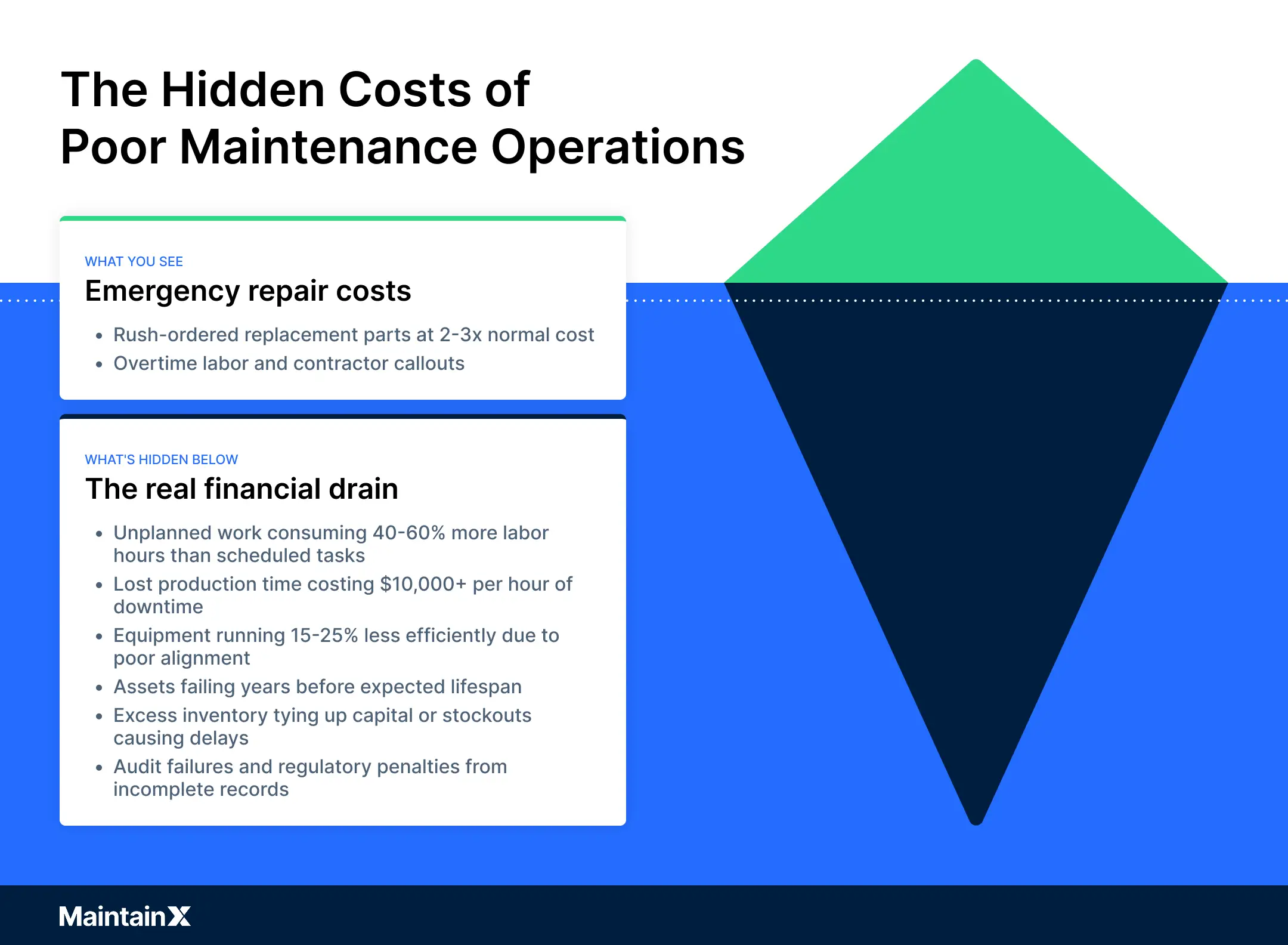
Poor O&M performance drains money long before a failure shuts down production.
Many organizations underestimate the costs of labor, parts, energy use, compliance risk, and lost throughput because they show up in small increments across different budgets. But when you add them together, the financial impact becomes hard to ignore.
Breaking down true O&M costs
Here are some of the ways poor maintenance operations cost your organization:
- Labor: Unplanned work often absorbs far more hours than a scheduled task. Emergency repairs often require multiple technicians and even contractor support.
- Parts and materials: Breakdowns are more likely to require rush orders or emergency shipments than planned maintenance.
- Downtime: Lost production time is the most expensive direct result of poor maintenance.
- Energy waste: Machines that run out of alignment or under undue stress will consume more energy.
- Shorter asset life: When assets are poorly maintained, they fail faster. That means unexpected capital purchases and higher depreciation expenses.
Cost categories most organizations underestimate
Some cost drivers stay hidden because they appear indirectly in operations or financial reports:
- Inventory management: Stockouts are the more obvious financial hit for a facility because if you don’t have the parts to fix an asset, you extend its downtime. However, if you overstock to protect yourself against those instances, you tie up excessive capital and increase your carrying costs.
- Rework: Scrap and rework costs often get attributed to the production team, but poor quality output may also be due to unmaintained equipment.
- Audit failures and regulatory penalties: Incomplete records or missed preventive maintenance create compliance risks.
Financial red flags in maintenance operations
Here are some signs that may indicate underlying problems in how you manage maintenance operations:
- Declining gross margins: Increasing MRO costs without a corresponding improvement in asset health will eventually eat into your revenue.
- Surging repair costs: A rise in repair costs may be due to an increase in reactive repairs and emergency parts orders.
- Unusual capex spikes: If you have to make unexpected large investments in new equipment to replace failing assets, it’s a sign your maintenance program needs to be bolstered to extend asset lifetime.
- Drops in production: If you’re falling short of production targets, it may be a sign that asset downtime is climbing.
Calculating ROI on O&M improvements
A clear ROI model helps you make informed decisions about where to invest in your O&M program. It also helps justify those decisions to senior stakeholders.
The goal is to build a model tailored to your facility so you can understand the financial impact of improvements like better planning, upgraded tools, or more advanced monitoring.
Start with a working definition of ROI
Most teams measure ROI either in dollars or in payback time. A simple ROI formula looks like this:
- ROI = (Increased revenue + decreased costs) / Investment in O&M improvements
Gather the data you need to build the model
A facility-specific ROI calculation will include your complete asset list, cost-of-downtime estimates, labor costs, inventory value and turnover rates, and historical work orders and repair data.
This information helps you determine how much time, money, and productivity the current program consumes.
Account for ROI changes over time
ROI is not static. As equipment health improves and failures decrease, annual savings may decline because the facility is no longer recovering from past inefficiencies. This is a positive trend, even if it may not look like it at first glance.
Technology's role in maintenance operations
Modern O&M programs rely on maintenance management software to improve planning and execution. A computerized maintenance management system (CMMS) stores the documentation and reporting teams need to complete work consistently and make better decisions about equipment health.
With a CMMS, you can organize work requests and PM schedules, log work as it is completed, analyze performance trends, and forecast labor needs.
CMMS tools also support other strategic initiatives like predictive maintenance, staff training, and standardization across multiple sites.
Explore how a platform like MaintainX can unify your data, strengthen planning, and improve reliability across each of your facilities.
Maintenance Operations FAQs
What's the difference between maintenance operations and facility management?
Maintenance operations focus on keeping equipment reliable through inspections, preventive maintenance activities, repairs, and operations and maintenance manuals.
Facility management, also known as facility maintenance, covers the broader environment around that equipment. It includes things like building infrastructure, safety systems, and utilities.
How much should organizations budget for maintenance operations?
Most organizations budget maintenance as a percentage of asset replacement value, production output, or total operating costs.
Actual numbers vary by industry. Facilities with aging equipment, high regulatory requirements, or a large backlog may require higher investment to stabilize performance.
What percentage of maintenance work should be planned vs. reactive?
A healthy O&M program completes the majority of work as planned tasks.
Many teams aim for at least 60 to 80 percent planned work and no more than 20 to 40 percent reactive work. When reactive work rises above this range, it often signals gaps in preventive maintenance schedules, staffing, training, or parts availability.
How do you transition from reactive to proactive maintenance operations?
Teams transition by improving planning, strengthening documentation practices, and increasing PM completion rates.
The most effective steps for a transition include organizing asset lists, standardizing SOPs, building realistic schedules, and tracking KPIs such as PM compliance and reactive work percentage.
What are the most common reasons maintenance operations programs fail?
Programs often fail due to inconsistent execution, poor documentation, limited staffing, unclear maintenance procedures, or unreliable data.
Successful programs address these challenges by building clear workflows and giving technicians tools that make work easier, not harder.

The MaintainX team is made up of maintenance and manufacturing experts. They’re here to share industry knowledge, explain product features, and help workers get more done with MaintainX!


.webp)