

When equipment fails, it’s tempting to only focus on the fix: replace the part, reset the system, get production back online, then move on. But without understanding the true cause of the breakdown, the likelihood that it happens again increases.
That’s why root cause analysis (RCA) is critical. Done well, RCA turns breakdowns into opportunities to learn and improve. Although most maintenance teams conduct RCAs after big breakdowns, there’s also not a lot of room in the calendar for a deep dive into what went wrong, which can lead maintenance managers in the wrong direction.
Traditional RCA is manual and time-consuming. Teams sift through work orders, sensor data, and technician notes. The process requires experience, focus, and time, all resources that are in short supply for the average maintenance team.
This is where AI helps. AI accelerates RCA by analyzing historical data, technician observations, and operational context. It can build structured analyses like the 5 Whys or fishbone diagrams in seconds, highlighting likely causes and recommended next steps


How to build an AI assistant for root cause analysis
AI can make RCA faster, more consistent, and more scalable. Here is a four-step process for building an AI assistant for your RCAs.
Step 1: Gather the data
The success of any AI workflow depends on the data you provide it, including how deep and clean it is. Here’s an overview of the types of data that are useful for a root cause analysis:
- Failure details: Asset ID, date/time, severity, failure codes, and description
- Maintenance history: Corrective and preventive work orders, time since last failure
- Technician notes: Observed irregularities, suspected causes, and deviations from SOPs
- Operational context: Meter readings, throughput, and environmental conditions
- Procedures and SOPs: PM checklists, inspection steps, and deviations logged
- Historical RCA logs: Past analysis and actions taken
- Sensor/IIoT data: Real-time or event-based readings
Step 2: Clean and organize the data
Before you feed any data to AI, make sure you review it for these components:
- Use standardized naming formats
- Separate data into structured sections (failures, causes, corrective actions)
- Replace blanks with placeholders (e.g., “N/A”) instead of leaving empty cells
Step 3: Build your prompts and run your analysis
Here are some key elements to include when you’re building prompts for this purpose:
- State the asset and failure event.
- Example: The main conveyor motor failed during a full-load cycle on July 3.
- Include historical and operational context, like meter readings and recent repairs.
- Example: Several previous PMs found loose wiring.
- Ask for structured outputs like a 5 Whys analysis.
- Example: Per form a 5 Whys analysis using technician notes and meter readings.
- Specify which data to pull from or compare.
- Example: Compare technician notes and RCA reports from similar failures.
- Define the output, like specific next steps or risk rankings.
- Example: Provide a list of process changes and who needs to be informed.
Here are five examples of prompts you can use with AI during a root cause analysis:
- "Using data for [ASSET], per form a 5 Whys analysis of [FAILURE]. Incorporate any sensor anomalies or contextual factors as part of the chain of reasoning."
- "Compare the procedures listed for [ASSET] with the last five PMs. Identify steps that were skipped, altered, or flagged by technicians. Assess whether these deviations contributed to the failure, and recommend tasks that should be updated based on field behavior."
- "Build a fishbone diagram of possible root causes for [ASSET] failure. Group contributing factors in these categories: people, process, machine, environment, materials, and measurement. Link conclusions to evidence from the available data sources."
- “Using your analysis of failure for [ASSET], please provide recommendations to address the root cause. Prioritize recommendations by impact, effort, and feasibility. Provide a timeline to implement each recommendation, and the steps, resources, and process changes needed to achieve them. Build a communication plan to notify relevant stakeholders of these changes”
- “Review the last three failures for [ASSET]. What patterns do you see in technician notes, sensor readings, or environmental conditions? Propose a hypothesis for the underlying cause and tests we can run to validate it.”
Step 4: Action the outputs of your root cause analysis
An RCA is only as good as the action you take after it. Here are some ways you can use the outputs from AI to improve your maintenance program:
- Find the root cause of failure, then develop a prioritized list of follow-up actions based on effort,impact, and feasibility. Build these into monthly maintenance plans and track progress.
- Find gaps in procedures and SOPs, and revise your documentation and workflows.
- Build a roadmap for informing relevant personnel about RCA findings and follow-up actions.
- Build an RCA dashboard to track root cause outcomes and progress toward resolutions.
An example of an RCA with AI
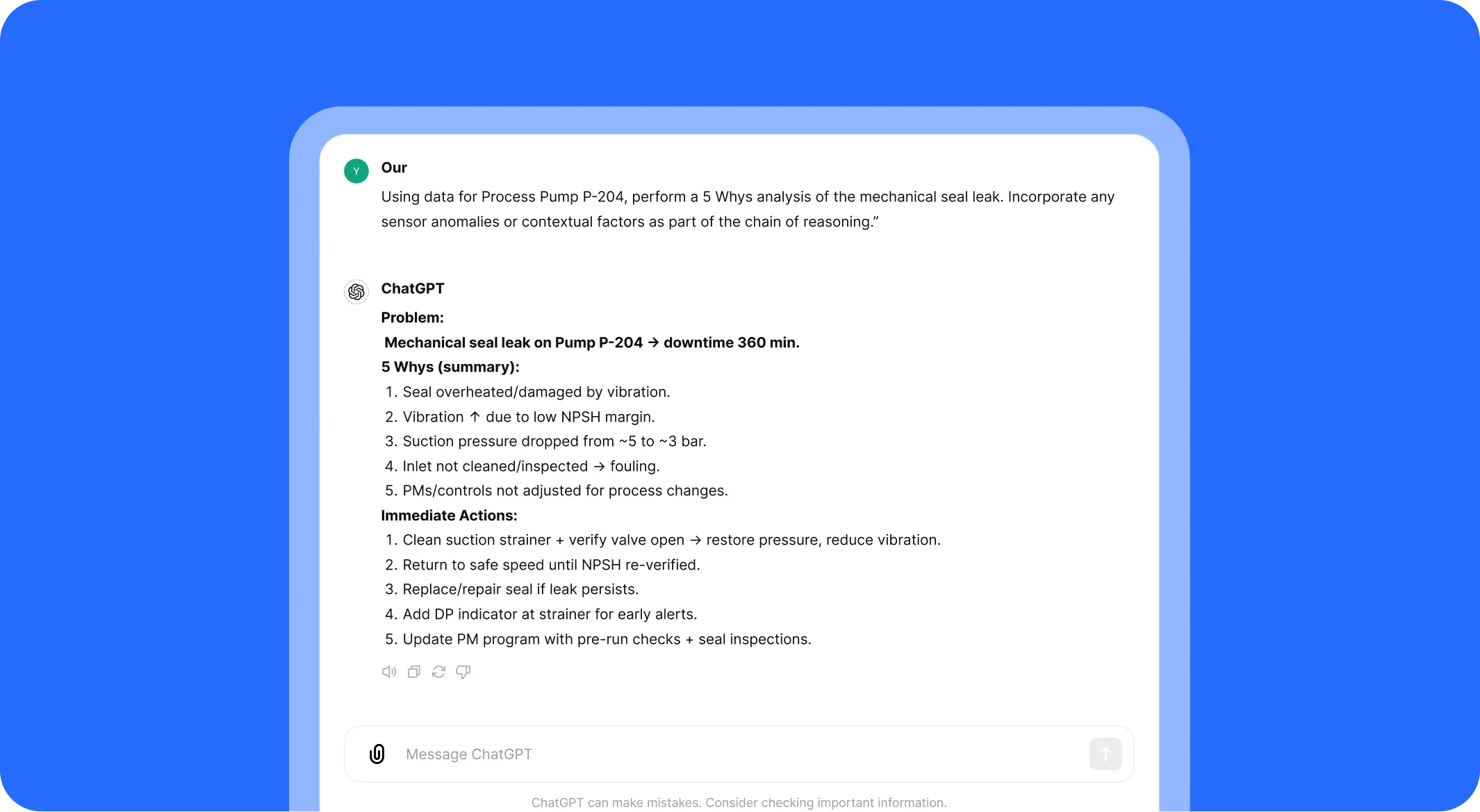
Here’s an example of what it could look like to do a root cause analysis with the AI assistant you’ve built:
A pump experienced a mechanical seal leak, causing 360 minutes of downtime.
- AI performed a 5 Whys analysis and suggested this chain of events:
- Seal overheated due to vibration.
- Vibration increased due to low NPSH margin.
- Suction pressure dropped.
- Inlet not cleaned, causing fouling.
- PMs not adjusted for process changes.
The AI recommends these immediate actions: Clean suction strainer, restore pressure, run pump at safe speed, replace seal, update PM program.
Measuring the Impact
Evaluate AI RCA with metrics such as:
- Repeat failure rate. Fewer recurring issues after RCA adoption.
- RCA cycle time. Faster turnaround from failure to root cause identification.
- Downtime hours. Reduction linked to improved corrective actions.
- Procedures updated. Number of SOPs revised based on RCA findings.
- Stakeholder engagement. Number of teams/sites applying RCA outputs.
Six more ways to use AI in maintenance
There are hundreds of maintenance teams using AI in their day-to-day tasks to help them work faster, reduce downtime, and eliminate obstacles. This includes:
- Building AI assistants for real-time repair support
- Analyzing maintenance data and KPIs
- Generating maintenance procedures
- Forecasting parts usage
- Detecting anomalies and predicting asset failure
- Collecting and actioning team knowledge
For a complete playbook on how to adopt these AI use cases, download the Maintenance Manager’s Quick Start Guide to AI, which includes templates and step-by-step instructions for building your own AI program.
Where to Go from Here
Failures will happen. The difference lies in whether your team learns from them—or repeats them.
AI-powered root cause analysis helps you:
- Find the “why” behind failures faster.
- Build consistent RCA practices across teams.
- Translate findings into practical, prioritized fixes.
MaintainX Assist makes RCA seamless by:
- Analyzing work history, technician notes, and sensor data.
- Running structured frameworks like 5 Whys automatically.
- Recommending corrective actions ranked by impact and feasibility.
- Tracking outcomes in dashboards
With AI RCA, every failure becomes an opportunity to strengthen your operation—reducing downtime, improving processes, and building resilience.

The MaintainX team is made up of maintenance and manufacturing experts. They’re here to share industry knowledge, explain product features, and help workers get more done with MaintainX!

.webp)


.webp)