
.webp)
Safety and compliance are always front-of-mind for maintenance managers. Even if your facility is as safe as can be, you still need to prove it with regular audits, set the right cadence for inspections, and report on everything to prove you’re meeting requirements.
As large as the demands feel, the consequences of not meeting them are even bigger. No manager wants to fail an audit or pay a penalty. But that pales in comparison to shouldering the responsibility of a workplace accident, which can cost an organization more than $100,000, not to mention the mental toll of knowing that it could have been prevented.
In worst-case scenarios, facilities without a good system in place face chaos, failed audits, near-misses, and the inability to turn it all around.
The good news is that safety and compliance don’t need to feel like a burden. And they don’t have to fall entirely on your shoulders. Building a safety and compliance dashboard increases visibility and accountability throughout the organization. In this article, you’ll learn how to build a dashboard that keeps your shop floor safe and compliant so you can sleep better at night.
Key takeaways
- It’s probably time for a safety and compliance program overhaul if your team is missing inspections, unprepared for audits, and doing inspections and PMs differently every time.
- There are a number of safety and compliance KPIs you can track. The important thing is that you choose the best, most motivating KPIs to include on your dashboard.
- Safety and compliance overhauls don’t end with building a dashboard. Implementing a technician-friendly, mobile-first CMMS can greatly improve your KPIs.
Signs you need to build a better safety and compliance dashboard
If you’re still unsure whether you need a safety and compliance overhaul, see if any of the scenarios below are familiar. If so, you need a better solution.
- Safety inspections are missed. They’re scheduled only when someone remembers, and they’re not being recorded or stored centrally. Plus, there’s no way to see when inspections are skipped until it’s too late.
- Audits are a mess. If you’re lying awake at night worrying about your next audit, you’re not alone. OSHA, FDA, GMP, ISO, and other audits shouldn’t make you feel anxious, but if you’re not prepared for them, they’ll always feel like a threat.
- The only way to spot equipment issues is through your frontline staff. Your workers know the equipment they work with better than anyone else, but they can’t be everywhere at the same time. Without a way to proactively spot anomalies and flag faults with potential safety consequences, that burden will always fall on them.
- Driving standardization is next to impossible. How do you create procedures for PMs and inspections? Once they’re created, how do you communicate them across the organization? If they’re shared, how do you make sure they’re followed? If you don’t have answers to these questions, you need a different plan.
- PMs are completed differently every time. Without centralized and easily accessible standard operating procedures (SOPs), your frontline could be following entirely different protocols for PMs. This makes it difficult to ensure everyone’s following the safest path.
The only way to prioritize safety and compliance is to make them everyone’s priority. And the only way to do that is to increase visibility and accountability with a dashboard.
Eight safety and compliance KPIs maintenance teams should be tracking
Keeping your workforce safe starts with understanding and tracking your facility’s safety and compliance KPIs. There are a number of KPIs you could track. Let’s take a look at each one.
Safety KPIs
1. Recordable incident rate
What it measures: The number of recordable incidents, normalized per 100 employees. A “recordable incident,” according to OSHA, is any incident that causes medical treatment beyond first aid, restricted work, days of work missed, loss of consciousness, or significant injury or illness.
How to measure: Rate of Recordable Incidents = (Total Recordable Incidents × 200,000) / Total Hours Worked
2. Near misses
What it measures: An incident that could have resulted in injury or illness, but did not. Near misses indicates a potential hazard is present and could cause a safety incident in the future if not addressed.
How to measure: Near Miss Rate per 100 Employees = (Near Misses ÷ Employees) × 100
3. Safety-related downtime hours
What it measures: The business impact of safety-related injuries, inspections, delays, or stop-work orders.
How to measure: Looking at your total equipment downtime, highlight any downtime that was specifically caused by safety incidents, hazards, or investigations related to safety concerns.
Compliance KPIs
4. Safety training completion rate
What it measures: The percentage of safety training hours completed by employees. It helps you spot compliance gaps and assess the effectiveness of your safety training. If completion rates and incident rates are both high, it may mean you need to update your safety training.
How to measure: Safety Training Completion Rate = (Number of completed required training hours ÷ Total assigned training hours) × 100
5. Safety SOP and checklist attachment rate
What it measures: The number of relevant work orders that include safety SOPs and checklist tasks. This KPI can help you evaluate and improve compliance, standardize safety protocols, and prove compliance during audits.
How to measure: Safety SOP and checklist attachment rate = (Number of work orders with safety documentation ÷ Total applicable work orders) × 100
6. Inspection compliance rate
What it measures: How well your organization is at preparing for compliance audits.
How to measure: There are two ways to calculate this KPI.
The first way measures the percentage of safety and compliance inspections or tasks your team completed, compared to the number they planned to complete:
Inspection Compliance Rate = (Number of Inspections Completed ÷ Number of Inspections Planned) x 100
The second way measure the success of a third-party audit by measuring the percentage of inspection elements that received a pass:
Inspection Compliance Rate = (Number of Elements Passed ÷ Number of Elements) x 100
7. Corrective action closure rate
What it measures: How well you address issues that are identified during internal inspections and third-party audits.
How to measure: Corrective Action Closure Rate = (Corrective actions closed within set period ÷ Corrective actions issued during set period) × 100
8. Time spent on compliance audits
What it measures: The total amount of time your team spends on compliance-related audits. Its purpose is to help you find efficiencies.
How to measure: Add up time spent preparing for, conducting, and responding to audits or inspection tasks.
How to create a safety and compliance dashboard for maintenance
We’ve just thrown a lot of KPIs at you, and while they’re all useful, you need a way to track, analyze, and act on them for the data to be useful. A safety and compliance dashboard is as much a tool as anything your frontline workers hold in their hands. To make your dashboard work for your team, you need to know how to build it, use it, and maintain it.
Choose the KPIs and goals you want to track
Every team and facility is unique. It’s recommended to calculate each of the KPIs listed above to get a baseline for your team, including what it’s doing well and where it may be lacking.
When it comes to building your dashboard, it’s best to choose a few key KPIs that represent your overall safety and compliance goals. You can ask yourself a few questions to determine which KPIs are most important:
- Where is the biggest gap in where you are now and where you want to be?
- Which KPIs could be improved quickly with some concerted effort from everyone?
- Which audits are coming up?
- Is one facility falling behind on safety and compliance KPIs compared to others?
Answering these questions will help you prioritize which KPIs you want to focus on and which ones you may want to start building some support to improve.
Set goals for your KPIs
Before you start working to improve KPIs, you should set a target for your highest priority metrics. It’s easier to make improvements when you know how much things need to change.
Example: Improving safety-related downtime hours
Let’s say that, during your initial calculations, you realize your safety-related downtime hours are higher than you hoped. It’s time to set a goal you’d be happier with. Once you’ve established that number, you can create a strategy to reach that target. Maybe it’s increasing inspection frequency on critical assets, or setting stricter permissions in your CMMS for risky work orders.
Compare and segment KPIs
The point of building a safety and compliance dashboard is to increase visibility and accountability in your facility.
A great dashboard will show KPI comparisons, whether it’s comparing the same data point across facilities, over time, or compared to your targets. Colour-coding KPIs allows your team to clearly see at a glance where the numbers are and need to be, keeping them always top of mind.
Right-size your dashboard
Just like any new maintenance initiative, a safety and compliance dashboard can grow and mature over time.
In the beginning, your dashboard may be a simple spreadsheet you manually update and share with key stakeholders. As your safety and compliance program grows, you might update your tools to make it easier to track metrics. For example, you can use a computerized maintenance management system (CMMS) to create a custom dashboard that’s displayed on the shop floor.

Once you make a leap like that, it’s much easier to automate aspects of the dashboard. For example, you can create work orders for safety training, tagging them as such in a CMMS. You can automatically track this segment of work orders on your dashboard and set up regular weekly or monthly reports.
How your maintenance team can report on safety and compliance
A strong safety and compliance program isn’t just about building a dashboard. It’s important to think about all the initiatives, processes, and systems that contribute to the numbers on your dashboard. The following actions can improve your KPIs, and your safety and compliance culture at large.
Equip your frontline technicians with a mobile-first CMMS
Information is essential for safety and compliance. Your frontline should be able to easily collect and provide the information they need to perform their jobs safely. The best way to enable this is with a mobile CMMS.
Your frontline team needs to be able to reference work orders, read through procedures, and access manuals while they’re on the shop floor. Technicians can use the CMMS to report anomalies, tag other workers, and log completed inspections in real-time so there’s a record of everything.

Standardize and centralize SOPs
The more you introduce step-by-step systems that take safety and risk reduction into account, the better you can protect your workforce. That’s why establishing SOPs for critical tasks and equipment is a big part of a safety and compliance program. But if SOPs live in an Excel file, they are often no good to a technician on the shop floor who needs to access a lockout/tagout procedure at the moment.
Your goal with SOPs, besides creating them in the first place, should be to globalize and centralize them. In other words, the same SOPs should be available at all facilities (globalized) and accessible to all employees (centralized) through a mobile CMMS.
SOPs exist to be followed, so giving your team the tools they need to do that easily ensures a safer environment. When technicians can, for example, scan a QR code on an asset to access a checklist, and then check each item off as they complete it, you’ve built a procedure that actually keeps your workforce safe.
Of course, creating and digitizing SOPs is time-consuming. But a mobile CMMS with an AI assistant can help you instantly create SOPs from thousands of pages of manuals and work orders.
Stay ready for audits
If you put the right measures in place, you’ll always be ready for an audit, whether it’s an OSHA, FDA, GMP, or ISO check. Let’s break this down by the components of any audit.
Set regular inspection intervals (and make your inspections searchable)
As mentioned earlier, if your team is missing inspections, it’s a sign that your safety and compliance program needs work. If you use a CMMS, you can set regular inspection intervals for your most critical assets. You can also assign inspections to specific employees and, once they’re complete, access audit reports at any time to prove they were completed correctly.

Log important compliance-related work orders
Inspections aren’t the only audit-related activity your workforce needs to complete. Depending on your industry, you’ll also have a number of work orders related to things like sanitation, preventive work, and quality assurance. Of course, when it comes to audits, you need to be able to quickly pull up these work orders to prove they were completed on time and by the right people. Using a CMMS can keep a digital record of everything so that pulling it up is a breeze.
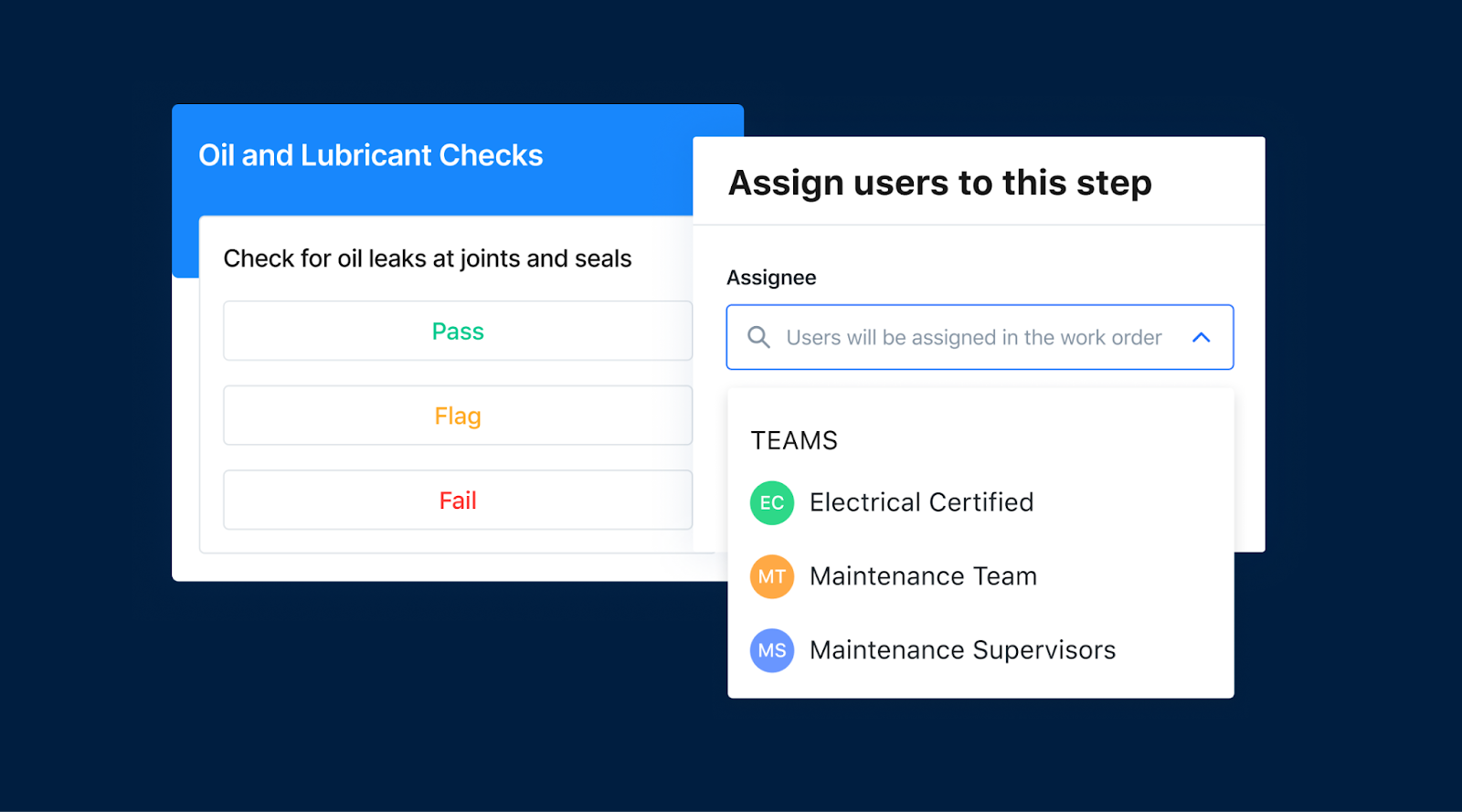
Set permissions for high-risk or specialized tasks
One of the biggest risks to a safety and compliance program is not following through on permissions. High-risk activities, such as LOTO, electrical work, and work in a hazardous zone, should only ever be completed by workers who have the right training and certification to do so.
It’s tough to set permissions for work like this without a CMMS. Adopting one that features work order approvals ensures that only the appropriate team members can ever complete complex, risky, or critical tasks. Having a digital record of this work also allows management to easily track who’s doing what.
Use AI to detect anomalies and risks
No matter how buttoned-up your safety and compliance program gets, without AI, your frontline is still responsible for catching and reporting on anomalies and possible risks. When combined with IoT sensors, AI tools like CoPilot can flag issues before they arise. This takes an enormous burden off of your technicians, and allows them to do the daily work that keeps operations going.

The bottom line: Safety and compliance dashboards create a better environment for everyone
Safety and compliance is so much more than hitting targets and checking off boxes. The KPIs on your dashboard represent factors that genuinely affect your workforce’s quality of life.
The more you build safety and compliance into your facility’s culture, the more it positively impacts everyone’s daily workflows, with many people across the team taking responsibility. If you ask us, that alone is worth the effort.

The MaintainX team is made up of maintenance and manufacturing experts. They’re here to share industry knowledge, explain product features, and help workers get more done with MaintainX!


.webp)